Military History
The Siege of Yorktown: The Battle That Won American Independence
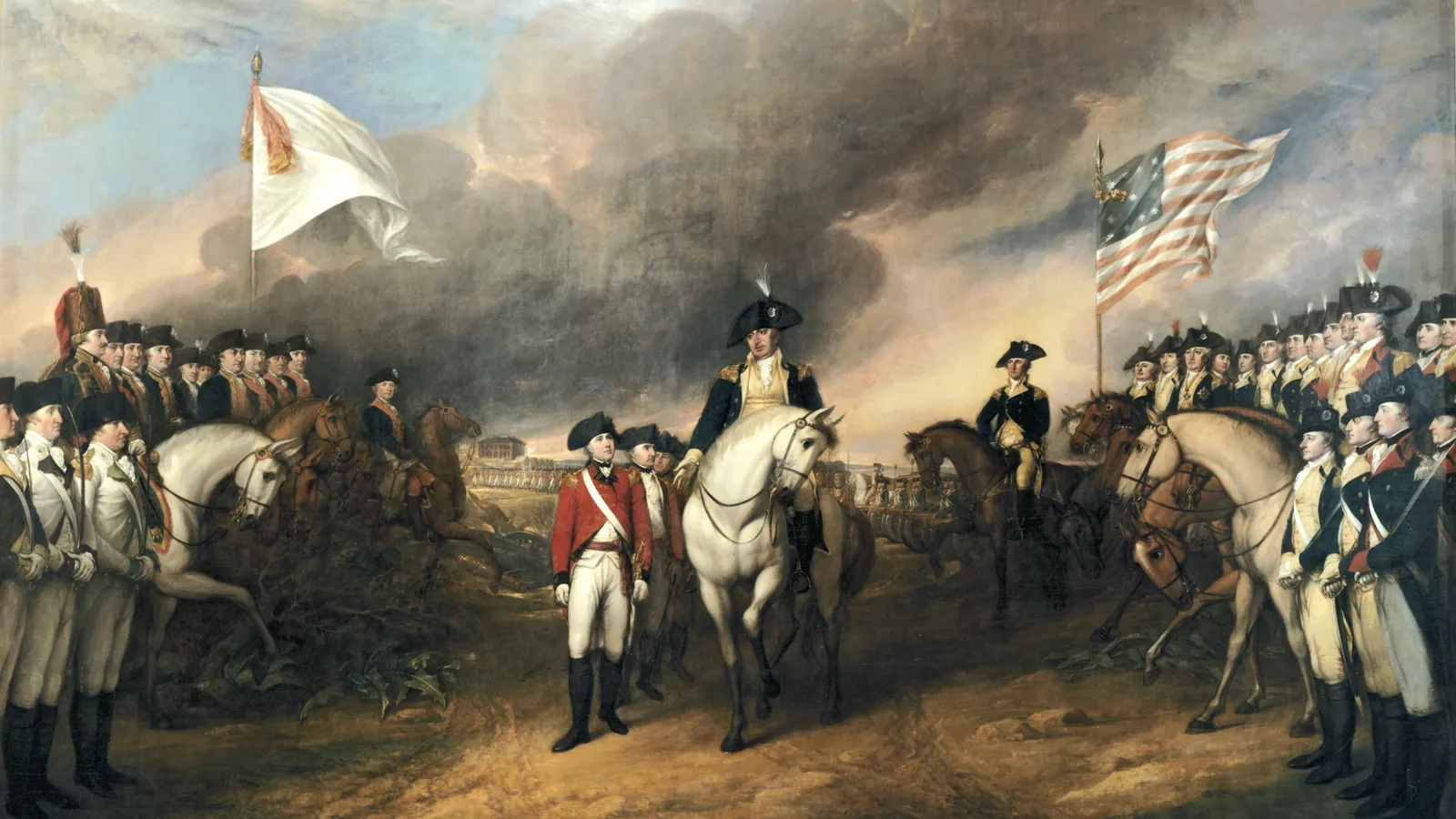
In October 1781, a combined American and French force trapped a British army under General Charles Cornwallis at the small Virginia port town of Yorktown, forcing its surrender after a three-week siege. The victory effectively ended major fighting in the American Revolutionary War and secured the independence the thirteen colonies had declared more than five years earlier. It was also, in a sense, an improbable ending: a campaign decided not primarily by American arms but by a French fleet that arrived at exactly the right place at exactly the right time, closing a trap that Cornwallis had, in effect, helped build for himself.
A War of Attrition
By 1781, the Revolutionary War had dragged on for six years without a decisive outcome. The northern theater had settled into a stalemate around British-held New York City, where General George Washington’s Continental Army had watched and probed without the strength to force a decisive battle since the winter at Valley Forge years earlier. Frustrated by the deadlock in the north, British strategy shifted southward beginning in late 1778, aiming to exploit what London believed was greater Loyalist sentiment in Georgia and the Carolinas. British forces captured Savannah and then Charleston, inflicting one of the worst American defeats of the war when General Benjamin Lincoln’s garrison surrendered there in May 1780.
The southern campaign that followed was marked by dramatic swings of fortune on both sides. A British victory at the Battle of Camden in August 1780 nearly destroyed the American army in the region, but a string of American successes followed, including the destruction of a Loyalist force at Kings Mountain in October 1780 and a sharp tactical victory over British forces at the Battle of Cowpens in January 1781, fought by troops under General Daniel Morgan. These reverses convinced Cornwallis that only a decisive campaign, rather than a slow reconquest of the Carolinas, could restore British control of the South, and command of the southern British army eventually fell to him for exactly that purpose. He won a hard-fought but costly victory over American forces under General Nathanael Greene at the Battle of Guilford Courthouse in North Carolina in March 1781. The battle left Cornwallis’s army badly mauled despite technically holding the field, and he made the fateful decision to abandon the Carolinas campaign and march north into Virginia, where he hoped to link up with other British forces, cut off American supply lines from the south, and establish a base that the Royal Navy could support and resupply from the sea.
Lafayette’s Chase Through Virginia
In Virginia, Cornwallis found himself opposed by a much smaller American force under the young French volunteer general Gilbert du Motier, the Marquis de Lafayette, who had been sent south by Washington earlier in 1781 along with troops to counter British raids led by the turncoat American general Benedict Arnold. Cornwallis, with a considerably larger army after absorbing reinforcements, pursued Lafayette across Virginia through the summer of 1781, reportedly boasting in a letter home that “the boy cannot escape me.” Lafayette, badly outnumbered, refused to be drawn into a battle he could not win, skirmishing, shadowing, and withdrawing while waiting for Cornwallis to make a mistake. That mistake came when Cornwallis, acting on orders from his superior, General Sir Henry Clinton, in New York, marched his army to the small tobacco port of Yorktown on the York River to establish a fortified naval base and await further orders, resupply, or evacuation.
That decision proved fatal. Washington and the Comte de Rochambeau, commanding the French expeditionary army allied with the Americans, recognized an opportunity: if a French fleet could gain control of the Chesapeake Bay and cut off Cornwallis’s escape by sea, his army could be trapped between the bay and Lafayette’s shadowing force, then besieged and destroyed or forced to surrender.
Opposing Commanders and Forces
France’s entry into the war was itself a consequence of an earlier American battlefield success: the defeat and capture of an entire British army under General John Burgoyne at Saratoga in 1777 had convinced the French court that the Americans stood a genuine chance of winning, leading to a formal Franco-American alliance in 1778 and, eventually, the French army and navy that would prove decisive at Yorktown three years later. Rochambeau’s expeditionary force had landed at Newport, Rhode Island, in July 1780, but had spent nearly a year there, largely inactive, while Washington and Rochambeau waited for the right combination of circumstances—above all, sufficient French naval strength in American waters—to attempt a major offensive operation.
The allied effort brought together an unusual coalition of commanders. Washington, in overall command of the combined American and French armies, had spent years building the Continental Army into a professional force capable of standing against British regulars; Rochambeau, a veteran of European wars decades older than Washington, commanded the French expeditionary force that had landed at Newport, Rhode Island, the previous year and brought disciplined, well-equipped regulars along with a siege-artillery train the Americans lacked. Lafayette commanded the smaller combined force already in Virginia that would pin Cornwallis in place until Washington and Rochambeau arrived. At sea, Admiral François-Joseph-Paul, Comte de Grasse, commanding a French fleet from the Caribbean, and Admiral Jacques-Melchior Saint-Laurent, Comte de Barras, bringing a smaller squadron and the vital siege artillery down from Newport, would decide the campaign’s outcome before Washington’s infantry ever fired a shot.
On the British side, Cornwallis commanded a mixed force of British regulars, German auxiliary troops (commonly called Hessians, though drawn from several German states), and Loyalist units, expecting relief or evacuation from the Royal Navy under General Clinton’s overall direction from New York—support that, crucially, never arrived in time.
The March South
In May 1781, Washington and Rochambeau met at Wethersfield, Connecticut, to plan the campaign’s next phase, initially favoring an attack on Clinton’s stronghold in New York City. The final decision on where to strike depended heavily on where de Grasse’s fleet, still in the Caribbean, would sail—and in August, word arrived that de Grasse intended to bring his fleet to the Chesapeake, not New York. Washington and Rochambeau seized the opening, shifting their combined armies south toward Virginia while working hard to conceal the change of plan from Clinton for as long as possible.
The deception was elaborate and effective. Washington ordered large encampments built in New Jersey, complete with the brick bread ovens an army expecting a long stay would need, all positioned where British observers in New York could see them, and allowed forged documents describing a planned attack on New York to fall into British hands. Clinton, aware of Washington’s reputation for misdirection, remained convinced for weeks that the movement south was itself the ruse, and it was not until early September, after the allied armies had already crossed the Delaware River, that he accepted his enemy was actually marching for Virginia. By then it was too late to reinforce Cornwallis in any meaningful way. Washington and Rochambeau marched their combined armies—a force that would grow to roughly 17,000 American and French troops by the time the siege began, including Washington’s Continentals, Rochambeau’s regulars, and Lafayette’s forces already in Virginia—the better part of 450 miles from the New York area to the Chesapeake, an extraordinary logistical achievement for an eighteenth-century army.
The French Fleet at the Chesapeake
While the armies marched, the campaign’s decisive action was fought at sea. On September 5, 1781, de Grasse’s fleet of 24 ships of the line, having landed troops and supplies to reinforce Lafayette, engaged a British fleet of 19 ships of the line under Admiral Thomas Graves, which had sailed from New York to relieve Cornwallis, in the Battle of the Chesapeake (sometimes called the Battle of the Virginia Capes). The battle itself was tactically indecisive and poorly coordinated on the British side, but its strategic result was total: after several days of maneuvering without a clear resolution, Graves withdrew to New York for repairs, leaving de Grasse in undisputed control of the Chesapeake Bay. Days later, de Barras’s squadron arrived from Newport with the French siege guns, and the trap around Cornwallis was complete. Without naval superiority, the Royal Navy could neither resupply nor evacuate Cornwallis’s army, a fact that would decide the siege before it properly began.
Cornwallis Digs In
Cornwallis had spent the weeks before the allied armies arrived fortifying Yorktown, a small but strategically situated town of only a few hundred residents on a bluff above the York River, along with a smaller outpost across the river at Gloucester Point to help guard the river crossing and provide access to forage for his cavalry. The York River itself was deep enough at Yorktown to shelter oceangoing warships, which was precisely why Cornwallis and Clinton had settled on the town as a naval base in the first place—a virtue that became a liability the moment an enemy fleet, rather than a friendly one, controlled the water beyond the river’s mouth. His engineers built an outer ring of earthworks and redoubts and an inner line of fortifications closer to the town itself, expecting to hold out behind these defenses until the Royal Navy could break the blockade or evacuate his men. It was a reasonable plan against an enemy without command of the sea and without heavy siege artillery of its own—precisely the advantages the arrival of de Grasse’s and de Barras’s fleets had just stripped away.
By late September 1781, Washington and Rochambeau’s combined force, numbering roughly 17,000 men, had arrived outside Yorktown and begun to encircle Cornwallis’s smaller garrison of some 9,000 British, German, and Loyalist troops, supported now by heavy siege artillery the French navy had ferried down from Newport.
The Siege Lines Open
The siege that followed was a methodical, textbook eighteenth-century siege operation, of the kind Rochambeau’s professional engineers had trained for their whole careers. On the night of October 6, 1781, American and French troops began digging the first parallel, a trench line roughly 800 yards from the British defenses, working through the night to avoid British artillery fire. By October 9, the first siege batteries were ready, and the allied bombardment began in earnest that afternoon. According to multiple contemporary accounts, Washington personally fired one of the first American guns—by tradition, the very first—touching off the barrage himself before handing the match to his gunners. The following days saw a second parallel trench dug even closer to the British lines, progressively narrowing the range and intensifying the bombardment, which by mid-October involved well over a hundred allied guns pounding Yorktown’s defenses and the town itself around the clock.
The bombardment itself was, by the standards of the war fought until then, unusually intense and sustained. Shells and hot shot set fire to buildings throughout Yorktown, and the British garrison, already cramped inside a small perimeter, had nowhere to shelter from the constant fire; disease, particularly smallpox, spread through both the garrison and the enslaved and free Black Virginians who had fled to the British lines seeking freedom, adding a further human toll to the siege that contemporary accounts describe as considerable. Cornwallis reported in his own dispatches that his works were crumbling and his men exhausted well before the second parallel was even complete, a sign of how quickly the allied artillery, superior in both weight and volume of fire to anything the British had available to answer it, was grinding down his defenses.
Two British-held outworks, designated Redoubts 9 and 10, blocked the completion of the second parallel on the allied left, and their capture became the campaign’s final major tactical action.
Storming Redoubts 9 and 10
On the night of October 14, 1781, allied troops assaulted both redoubts simultaneously in a coordinated night attack. French troops under the Baron de Viomenil, roughly 400 strong, stormed Redoubt 9; a similarly sized American force, led personally by Alexander Hamilton—who had lobbied hard for the assignment—struck Redoubt 10, with Lieutenant Colonel John Laurens leading a detachment around the rear of the position to cut off any British retreat. To preserve surprise, the American troops advanced with unloaded muskets, relying entirely on the bayonet. Both redoubts fell within roughly half an hour in brutal hand-to-hand fighting, at a cost of several dozen American and French casualties. Their capture allowed the allies to complete the second parallel and bring their heaviest guns within close range of the last British defenses, making Cornwallis’s position inside Yorktown untenable.
Cornwallis’s Failed Escape
With his defenses collapsing under the weight of allied artillery and his men exhausted and increasingly sick, Cornwallis made one last attempt to save his army on the night of October 16, 1781: a plan to ferry his troops across the York River to the smaller garrison at Gloucester Point under cover of darkness, break out past the allied forces there, and march north to safety. The first wave of boats crossed successfully, but before the operation could continue, a sudden violent storm scattered the remaining boats on the river, making further crossings impossible and forcing Cornwallis to abandon the escape and recall the troops who had already reached the far shore. It was, by most accounts, his last realistic hope of avoiding surrender.
Cornwallis Surrenders
With no relief in sight, his defenses breached, and further resistance offering only more casualties without any prospect of holding out, Cornwallis requested a cessation of hostilities and opened negotiations for surrender terms on October 17, 1781—coincidentally the fourth anniversary of the earlier British surrender at Saratoga, a parallel not lost on contemporaries. After two days of negotiation over the terms of capitulation, the Articles of Capitulation were signed on October 19, 1781, and the British army marched out to formally surrender that afternoon. Cornwallis, citing illness, did not attend the ceremony in person, sending his second-in-command, Brigadier General Charles O’Hara, in his place. O’Hara first attempted to present Cornwallis’s sword to Rochambeau, who deferred to Washington as the ranking allied commander; Washington, in turn, declined to accept the sword of a subordinate commander directly and directed O’Hara to his own second-in-command, General Benjamin Lincoln—the same American officer who had been forced to surrender Charleston to the British the year before, a symmetry Washington may well have intended.
More than 7,000 British and German officers and men marched out and laid down their arms that day, along with naval personnel and sailors from the ships trapped in the harbor. A persistent tradition holds that the British band played a tune called “The World Turned Upside Down” as the army surrendered, a detail repeated in countless popular histories. Modern historians who have traced the story’s origins have found no contemporary account from anyone actually present at the surrender mentioning this tune; the earliest known references to it appeared only decades later, in secondhand and thirdhand recollections. Whatever music was actually played, the surrender terms themselves were pointed: in a deliberate echo of the humiliating terms the British had imposed on the Americans at Charleston the year before, Cornwallis’s men were denied the customary honors of war and required to march out with their colors furled and cased.
News Reaches London
The news of the disaster took weeks to cross the Atlantic. When it finally reached London on November 25, 1781, Prime Minister Lord North is reported to have received it “as he would have taken a ball in the breast,” pacing his room and repeating, according to the memoirs of the contemporary writer Nathaniel Wraxall, “Oh God! It is all over!” The political shock proved as decisive as the military defeat itself. Parliament, already weary of a war that had grown enormously expensive and had drawn in France, Spain, and the Dutch Republic against Britain, moved within months toward ending the conflict; North’s government fell the following March, and negotiations that would produce the Treaty of Paris began soon after.
Quick Facts
- Dates: September 28 – October 19, 1781
- Location: Yorktown, Virginia
- Commanders: George Washington and the Comte de Rochambeau (America/France) vs. Charles Cornwallis (Britain)
- Naval support: French fleet under Admiral François de Grasse, decisive at the Battle of the Chesapeake
- Forces: Roughly 17,000 American and French troops vs. approximately 9,000 British, German, and Loyalist troops; more than 7,000 surrendered on October 19
- Outcome: Decisive American-French victory; Cornwallis’s army surrendered
Why Yorktown Still Matters
The surrender at Yorktown did not immediately end the Revolutionary War on paper—fighting continued in isolated theaters, and the formal Treaty of Paris was not signed until 1783—but it broke British political will to continue the war. News of the defeat, combined with the mounting cost of a war being fought an ocean away against a widening coalition of European enemies, led Parliament to authorize peace negotiations within months and brought down Lord North’s government.
Yorktown also stands as a landmark example of successful coalition warfare and combined land-sea operations. The victory depended entirely on French naval power denying the Royal Navy access to the Chesapeake at the critical moment—without de Grasse’s fleet controlling the bay, Cornwallis could very likely have been evacuated by sea before Washington and Rochambeau’s armies ever arrived, and the entire campaign might have ended in an anticlimactic withdrawal rather than a war-ending surrender. It remains a case study, still taught at military academies, in how control of the sea can decide a land campaign, and in how alliance politics—the diplomacy that brought France into the war on the American side in 1778, and the coordination between Washington, Rochambeau, and de Grasse that followed—can matter as much as tactics on the battlefield.
More broadly, Yorktown marked the practical end of major fighting in a war that had begun with skirmishes at Lexington and Concord more than six years earlier, and it validated a strategy—avoiding decisive defeat, wearing down British political will, and waiting for the right combination of circumstances to strike a decisive blow—that Washington and the Continental Congress had pursued, not always by choice, through years of setbacks, retreats, and a winter at Valley Forge that nearly broke the army entirely. The independence declared in 1776 became, through the surrender in that Virginia tobacco port five years later, a fact European powers could no longer ignore.
The peace that followed took shape slowly. American negotiators—Benjamin Franklin, John Adams, and John Jay chief among them—spent nearly two years in Paris working out terms with Britain, terms complicated by the competing interests of France and Spain, both of which had their own war aims against Britain only loosely connected to American independence. The resulting Treaty of Paris, signed on September 3, 1783, recognized the United States as a fully independent nation and set its boundaries at the Mississippi River to the west, the Great Lakes to the north, and Florida to the south—a settlement considerably more generous to the new United States than the military situation on the ground in 1781 alone might have suggested, and one that owed a great deal to the diplomatic leverage Yorktown had created.
For France, the victory came at a staggering financial cost. The expense of funding a war fought almost entirely on another continent’s soil, on top of the naval and land forces committed to the campaign, deepened a French royal debt crisis that historians have long linked to the political and financial pressures culminating in the French Revolution less than a decade later—a reminder that the consequences of the battle rippled outward well beyond the thirteen colonies whose independence it secured.
Timeline of Key Events
- 1778 – France formally allies with the United States after the American victory at Saratoga.
- May 1780 – British forces capture Charleston, South Carolina, in one of the worst American defeats of the war.
- March 1781 – Cornwallis wins a costly victory at Guilford Courthouse and decides to march north into Virginia.
- May 1781 – Washington and Rochambeau meet at Wethersfield, Connecticut, to plan the campaign.
- August 1781 – Word arrives that de Grasse’s fleet will sail for the Chesapeake; Washington and Rochambeau march their armies south from New York.
- September 5, 1781 – The Battle of the Chesapeake secures French naval control of the bay.
- September 28, 1781 – Allied forces arrive outside Yorktown and begin the siege.
- October 9, 1781 – Allied artillery bombardment of Yorktown begins.
- October 14, 1781 – Allied troops storm and capture Redoubts 9 and 10.
- October 16, 1781 – Cornwallis’s attempted escape across the York River is thwarted by a storm.
- October 17, 1781 – Cornwallis requests surrender terms.
- October 19, 1781 – The British army formally surrenders at Yorktown.
- November 25, 1781 – News of the surrender reaches London; Lord North’s government begins to collapse.
- September 3, 1783 – The Treaty of Paris formally ends the Revolutionary War.
Frequently Asked Questions
Why did Cornwallis choose to fortify Yorktown instead of continuing to campaign?
Cornwallis moved to Yorktown on orders from his superior, General Clinton, to establish a defensible port that the Royal Navy could use to resupply or evacuate his army. It made sense only so long as Britain controlled the surrounding waters; once de Grasse’s fleet took control of the Chesapeake, the same position that was supposed to protect Cornwallis’s army instead trapped it.
How much of the victory was actually decided by the French?
A very large share of it. French naval power under de Grasse denied the Royal Navy access to the Chesapeake, which was the precondition for the entire siege; French troops under Rochambeau made up roughly half of the allied army; and French siege artillery, brought south by de Barras’s squadron, gave the allies the heavy guns needed to reduce Yorktown’s defenses. Historians generally treat Yorktown as a genuinely joint Franco-American victory rather than an American one with French help.
Did a British band really play “The World Turned Upside Down” at the surrender?
This is one of the most repeated stories about the siege, but it rests on very thin evidence. No account from anyone actually present at the surrender describes this specific tune being played, and the story does not appear in print until decades after the event, based on secondhand recollections. Historians generally treat it as an appealing legend rather than an established fact, though some march of that name likely did exist in period repertoire.
Why didn’t Cornwallis attend his own surrender ceremony?
Cornwallis cited illness and sent his deputy, General Charles O’Hara, to represent him at the formal surrender on October 19, 1781. Whether his illness was genuine, diplomatic, or some combination is debated by historians, though the siege’s final weeks had been physically grueling for the whole garrison, and disease was rampant in the British lines by that point.
Did the Siege of Yorktown end the Revolutionary War?
Not immediately. It ended major fighting between the main armies and destroyed British political will to continue the war, leading to the fall of Lord North’s government within months, but fighting continued in scattered theaters, and the war was not formally concluded until the Treaty of Paris was signed on September 3, 1783, nearly two years later.
What happened to the British soldiers who surrendered?
Under the terms of the Articles of Capitulation, British and German troops became prisoners of war and were marched to camps in Virginia and Maryland; officers were generally permitted parole. Some prisoners later escaped or were exchanged, but many remained in American custody until the war’s formal end.
Recommended Reading
Richard M. Ketchum’s Victory at Yorktown offers a detailed narrative of the campaign, while Robert Middlekauff’s The Glorious Cause places the siege within the broader sweep of the American Revolution. Jerome A. Greene’s The Guns of Independence: The Siege of Yorktown, 1781 provides one of the most thorough modern military accounts of the siege operations themselves, drawing on the diaries and correspondence of participants on both sides.
Read Next
August 8, 2026
The Battle of Midway: The Turning Point of the Pacific War
How American codebreakers and a handful of dive bombers sank four Japanese carriers at Midway and turned the Pacific War.
August 8, 2026
The Battle of Gaugamela: Alexander the Great's Masterpiece
How Alexander the Great defeated a vastly larger Persian army at Gaugamela in 331 BC and effectively ended the Persian Empire.
August 8, 2026
The Battle of Trafalgar: Nelson's Decisive Victory at Sea
How Nelson's outnumbered fleet destroyed the combined French and Spanish navy at Trafalgar in 1805, securing British naval dominance.