Military History
The Battle of Gaugamela: Alexander the Great's Masterpiece
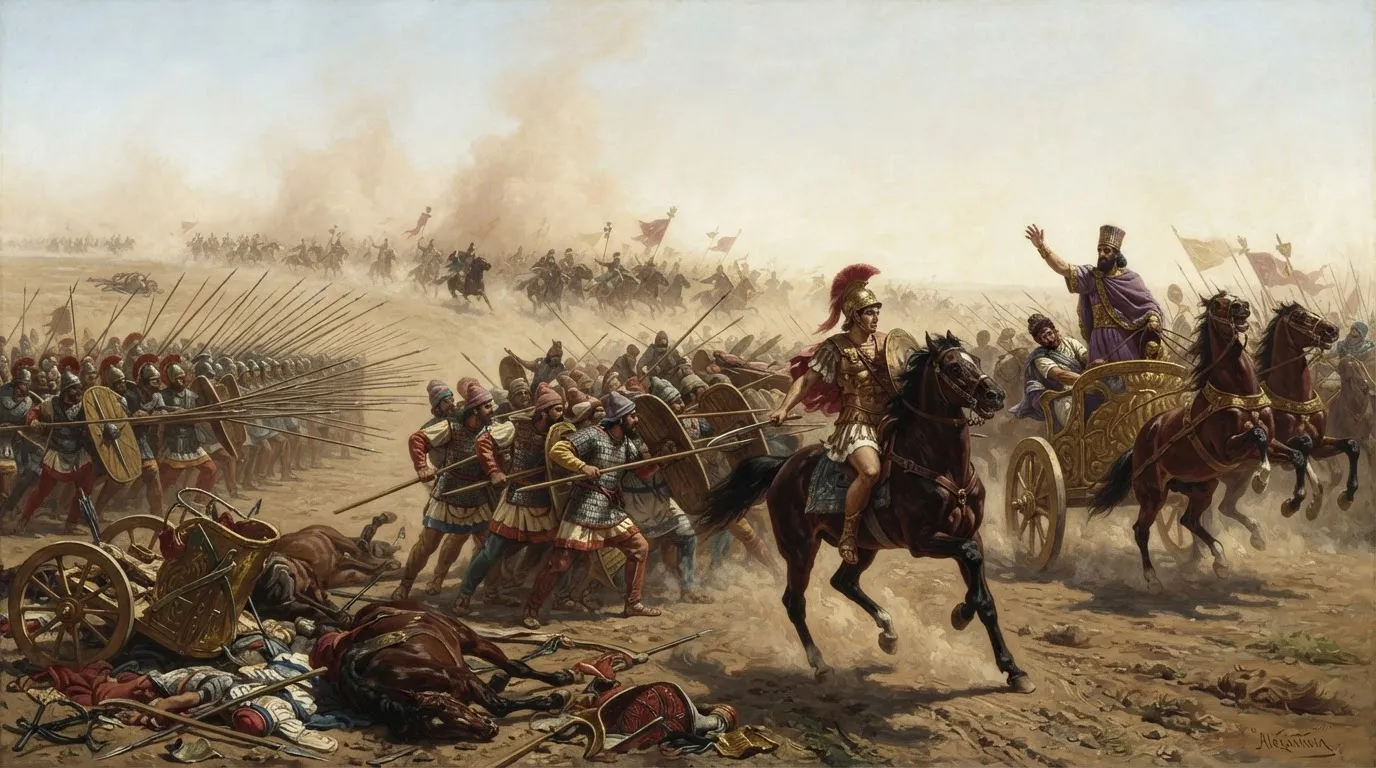
In October 331 BC, on a plain in what is now northern Iraq, Alexander the Great faced the Persian King Darius III in a battle that would decide the fate of the Persian Empire. Despite being outnumbered by a wide margin, Alexander’s tactical brilliance at Gaugamela shattered Persian resistance and opened the way for him to claim the title “King of Asia,” effectively ending nearly two centuries of Achaemenid Persian dominance. Ancient writers who lived centuries after the fact already treated it as the decisive engagement of the age; modern military historians still study its geometry as one of the finest single displays of battlefield generalship in the ancient world.
The Rise of Macedon and the Road to War
Gaugamela did not happen in isolation. It was the culmination of a war that began years earlier and, in a sense, decades before that. Alexander’s father, Philip II of Macedon, had spent a reign transforming a peripheral kingdom on the northern edge of the Greek world into the dominant military power of the Aegean, reorganizing the Macedonian army around the long pike, the sarissa, and a combined-arms doctrine that paired heavy infantry with shock cavalry. Philip was assassinated in 336 BC, just as he was preparing an invasion of the Persian Empire under the banner of a pan-Hellenic war of revenge for Persia’s invasions of Greece a century and a half earlier. Alexander, twenty years old, inherited both the throne and the invasion plan.
Philip’s reforms had given Macedon something no other Greek-speaking power possessed: a genuinely professional standing army built around the sarissa-armed phalanx, a battle line of infantrymen carrying pikes some fifteen to eighteen feet long, presenting an enemy with a wall of spear points before they could close to sword range. Around this infantry core Philip built an elite shock cavalry arm, the Companions, drawn from Macedonian nobility and trained to fight as heavy cavalry rather than the skirmishing horsemen typical of most Greek city-states. Alexander had commanded the Companion cavalry himself as an eighteen-year-old at the Battle of Chaeronea in 338 BC, where Philip crushed a coalition of Athens and Thebes and secured Macedonian dominance over the Greek mainland. By the time he inherited the throne, Alexander had already proven himself a capable battlefield commander in his own right, not merely an heir riding on his father’s reputation.
He crossed into Asia Minor in 334 BC and won his first major victory against Persian forces at the Granicus River. The following year, at Issus, in modern southern Turkey, Alexander personally led his Companion cavalry against Darius III’s own position on the battlefield, routing the Persian king’s army and forcing Darius to flee, abandoning his mother, wife, and children to Macedonian custody. Rather than chase Darius immediately, Alexander spent nearly two years securing the eastern Mediterranean coastline—besieging the island fortress of Tyre for seven months, taking Gaza, and marching into Egypt, where he was welcomed as a liberator from Persian rule and, according to later tradition, visited the oracle of Zeus-Ammon at the Siwah Oasis. Only after Egypt was secure did he turn east again, in the spring of 331 BC, to finish what he had started at Issus.
Darius III and the Achaemenid War Machine
Darius III had come to the Persian throne in 336 BC, the same year Alexander succeeded Philip, after a period of court intrigue that had seen several predecessors murdered. He was not, contrary to the image sometimes painted by Macedonian-friendly sources, an incompetent ruler—he had suppressed rebellions and shown personal courage in earlier fighting—but he now faced an existential threat to an empire that had stood for two centuries, since Cyrus the Great had founded it in the 6th century BC. After the defeat at Issus, Darius understood that another loss on unfavorable ground could be fatal, and he set about assembling the largest army the Achaemenid state could raise, drawing levies and cavalry contingents from across its vast territory: Persians, Medes, Bactrians, Sogdians, Scythian horse-archers from beyond the Oxus, Indian troops with a contingent of war elephants (the first Alexander’s army would ever encounter), and Greek mercenary hoplites who still fought for Persian pay.
Darius also opened negotiations, reportedly offering Alexander a huge ransom for his captured family, the hand of his daughter in marriage, and all Persian territory west of the Euphrates in exchange for peace. Alexander refused. He intended to make himself master of the entire empire, not a junior partner in it.
The Achaemenid Empire Darius commanded was, on paper, an almost incomprehensibly large state, stretching from the Aegean coast of Asia Minor to the Indus Valley and from the Caucasus to the deserts of Egypt, organized into provinces called satrapies that each owed troops, tribute, and loyalty to the Great King. That size was both a strength and a vulnerability: it gave Darius access to a far larger pool of manpower and treasure than Alexander could ever draw on, but it also meant his army was a patchwork of contingents speaking different languages, following different commanders, and possessing wildly varying levels of training and equipment, from elite Persian nobility to levied provincial infantry with minimal battlefield experience. Alexander’s smaller force, by contrast, fought as a single, cohesive unit that had trained and campaigned together for years.
The March to Mesopotamia
In the summer of 331 BC, Alexander led his army out of Egypt, back through Phoenicia and Syria, and struck east across the upper Euphrates and then the Tigris, both crossed largely unopposed—a sign that Darius intended to fight a set-piece battle rather than contest the rivers. Shortly after crossing the Tigris, on the night of September 20, 331 BC, Alexander’s men witnessed a total lunar eclipse, an event Arrian records and which modern astronomical reconstruction confirms actually occurred, allowing historians to fix the chronology of the campaign with unusual precision. Macedonian seers interpreted the omen as favorable, and the army pressed on. Ten days or so later, Macedonian scouts made contact with Darius’s outriders, and Alexander learned that the Persian king had chosen his ground: a broad, open plain near a village called Gaugamela, not far from the later city of Arbela (modern Erbil), from which the battle sometimes takes its alternate name.
The Armies Assemble: Numbers in Dispute
Ancient authors give wildly different figures for Darius’s army, and modern historians have long recognized these numbers as largely unreliable propaganda designed to magnify Alexander’s achievement. Arrian, generally considered the most careful of the surviving sources, puts the Persian army at roughly 1,000,000 infantry and 40,000 cavalry, along with 200 scythed chariots and a handful of elephants. Diodorus Siculus gives 800,000 infantry and 200,000 cavalry. Quintus Curtius Rufus offers a comparatively modest 200,000 infantry and 45,000 cavalry. All of these figures almost certainly exceed what the logistics of the ancient world could feed, water, and move as a single force. Modern scholars have proposed much lower numbers—estimates from serious historians of the campaign range from as few as 50,000 to as many as 250,000, with several placing the realistic figure closer to 100,000 or somewhat below. What can be said with more confidence is that Darius’s army was significantly larger than Alexander’s and considerably more numerous in cavalry, which was the arm he counted on to decide the battle on the flat ground he had chosen.
Alexander’s own force is better attested and less disputed: Arrian’s figures, generally accepted by modern historians, put it at roughly 40,000 infantry and 7,000 cavalry, a total in the neighborhood of 47,000 men. It was, however, an army of veterans, most of whom had fought together at the Granicus and at Issus, welded into a single instrument by years of campaigning and total trust in their commander. At its core stood the phalanx battalions of heavy infantry, supported by the hypaspists—an elite corps of infantry that fought alongside the Companion cavalry and served as the tactical hinge between the slower phalanx and the fast-moving horsemen—along with archers, javelin-throwing skirmishers, and allied Greek and Thracian troops of varying quality. Every element of this force had a defined role in Alexander’s battle plans, and unlike Darius’s army, virtually every unit commander had worked directly under Alexander before and understood both his tactical instincts and the flexibility he expected of subordinates in the middle of a fight.
Darius’s Prepared Battlefield
Unlike Issus, where the terrain had cramped his numerical advantage against him, Darius chose Gaugamela with care. It was a wide, flat expanse of ground, ideal for deploying his mass of cavalry on both flanks and for charging his scythed chariots—four-horse vehicles fitted with blades projecting from the wheel hubs, intended to plow bloody lanes through infantry formations. According to ancient accounts, Darius even had sections of the plain leveled and cleared of scrub and obstructions in the days before the battle, specifically so that his chariots could charge unimpeded and his cavalry could maneuver freely. He arrayed his own line far wider than Alexander’s, hoping to envelop the smaller Macedonian army on both wings simultaneously—a reasonable plan against most opponents, but one that assumed Alexander would fight a conventional linear battle.
Darius positioned himself, as Persian kings traditionally did, at the center of his own line, surrounded by his best infantry, kinsmen, and royal guard, a position of both honor and considerable danger: Persian battlefield custom held that the army’s fate was bound up with the king’s presence on the field, meaning that if the king fell or fled, the battle was effectively considered lost regardless of how the fighting was actually going elsewhere. Alexander, who had studied the outcome of Issus closely, understood this cultural reality as well as anyone in his army and built his entire plan for Gaugamela around exploiting it.
The Eve of Battle: Parmenion’s Counsel
On the night before the battle, several of Alexander’s senior officers, most prominently the veteran general Parmenion, who had served Philip II before him, urged a night attack on the Persian camp. The reasoning was sound on its face: a surprise assault in darkness would neutralize Darius’s advantage in numbers and cavalry, since neither could be used effectively in confusion and low visibility. According to Plutarch’s Life of Alexander, Alexander rejected the proposal, reportedly answering that he would not “steal” his victory:
“I will not steal my victory.”
Plutarch records that some in the army viewed this as arrogance given the risk involved, while others saw it as calculated confidence—Alexander wanted an unambiguous, daylight triumph that no one, least of all Darius, could later attribute to trickery or the cover of night rather than Macedonian superiority in open battle. Whatever the precise motive, Alexander reportedly slept soundly that night while Parmenion and others fretted over the odds, a detail later writers used to illustrate his legendary self-possession on the eve of the empire’s fate being decided.
The Oblique Advance
When battle was joined on the morning of October 1, 331 BC, Alexander did not simply advance his line to meet Darius’s head-on, which would have exposed his flanks to being enveloped by the much wider Persian formation. Instead, he deployed his infantry phalanx in the center as the fixed anchor of his line, while arranging additional infantry and cavalry units at an angle behind and beside his main body, forming a flexible, refused formation capable of guarding against envelopment from either side. He then advanced the entire army obliquely to the right, at an angle away from the center of the Persian line, deliberately drawing Darius’s forces out of their prepared positions.
This maneuver put Alexander’s opponents in a bind. If the Persian cavalry on their left did not respond, Alexander’s line would simply march past the edge of the ground Darius had leveled for his chariots, neutralizing that advantage entirely. If they did respond and moved to counter the shift, as they did, it stretched and thinned the Persian formation and, crucially, began to open gaps between units in the center of Darius’s line, as cavalry contingents peeled off to chase the moving Macedonian flank.
Chariots, Cavalry, and the Widening Gap
Darius launched his scythed chariots as Alexander’s infantry advanced, but they proved far less effective than intended. Macedonian light infantry and skirmishers had been briefed on how to counter them: javelins brought down chariot horses and drivers before they reached the main line, and where chariots did break through, veteran infantrymen simply opened files to let them pass harmlessly into the rear, where grooms and light troops finished off the crews. Simultaneously, ferocious cavalry engagements broke out on both wings—Persian cavalry under the satrap Mazaeus pressed hard against Parmenion’s outnumbered left wing, at one point nearly overwhelming it and even breaking briefly into the Macedonian camp, while on the opposite flank Alexander’s cavalry and light troops held their own against repeated Persian charges.
The critical moment came as the Persian line, stretched thin by its efforts to envelop Alexander’s shifting formation, opened a gap near Darius’s own position at the center of his army, guarded by his best infantry but now dangerously isolated from the cavalry that had moved off to the flanks. Alexander had been watching for precisely this opportunity.
Alexander Strikes the Center
Wheeling his Companion cavalry and supporting infantry into a wedge, Alexander drove directly at the gap and toward Darius’s own position, in effect ignoring the wider battle to aim for the one target that could end it instantly: the Persian king himself. Ancient sources differ on exactly what happened next. Arrian’s account, generally the most flattering to Alexander, describes Darius losing his nerve as the Macedonian wedge closed in and fleeing the field first, with his army’s collapse following from the sight of their king in retreat. Curtius Rufus offers a somewhat different, more chaotic picture, in which Darius’s own chariot driver was killed by a javelin thrown at the royal chariot, and the sight of the driverless, bloodied chariot convinced nearby troops that Darius himself had been killed, triggering panic that Darius could not control even after he had, in fact, escaped by another vehicle. Whichever version is closer to events on the ground, the outcome was the same: Darius left the battlefield, and as word spread through the Persian ranks that their king was gone, cohesion collapsed across the entire army.
“Alexander decided that removing the Persian king from the field would break Persian resistance faster than trying to defeat an army several times the size of his own through simple attrition, and the battle proved him right.”
Parmenion’s Crisis and a Costly Delay
Alexander wanted to press the pursuit of Darius immediately, which might have resulted in the Persian king’s capture or death and a far swifter end to the campaign. Instead, according to Arrian, he received urgent word that Parmenion’s left wing was in serious danger of being overrun by Mazaeus’s cavalry, and turned back to relieve it rather than continuing the chase. By the time the crisis on the left wing had been resolved and Alexander could resume the pursuit, Darius had gained enough of a head start to escape capture, fleeing east through Arbela and eventually into the Iranian highlands. It was one of the few tactical decisions of the battle that did not go entirely Alexander’s way, and it meant the Persian king would survive to flee for nearly another year before being killed by his own subordinates.
The Persian Rout
Across the rest of the battlefield, the collapse of Darius’s center doomed the wider Persian army. Formations that had been fighting hard just minutes earlier disintegrated into a general retreat, harried by Macedonian cavalry as they fled. Casualty figures from the ancient sources are, like the troop totals, wildly inconsistent and almost impossible to reconcile. Arrian claims only around 100 Macedonians killed against Persian losses he puts at over 300,000—a Persian figure essentially all modern historians reject as impossible. Curtius records fewer than 300 Macedonian dead; Diodorus gives 500. Modern reconstructions, working from the scale of the pursuit and comparison with other ancient battles, suggest Persian dead numbering in the tens of thousands—commonly cited estimates run from roughly 20,000 to 40,000—while Macedonian losses, though certainly higher than the suspiciously low ancient figures for the winning side, were modest by comparison. What is not in dispute is that Darius’s army as a fighting force ceased to exist as an organized threat by the end of the day.
Babylon, Susa, and Persepolis
The strategic consequences unfolded with remarkable speed. Babylon, one of the great cities of the ancient world, opened its gates to Alexander without resistance within weeks, its governor Mazaeus—the same commander who had fought so hard on the Persian left at Gaugamela—surrendering the city and being rewarded by Alexander with a governorship of his own, a striking example of Alexander’s practice of incorporating capable Persian administrators into his new order rather than simply replacing them wholesale. Susa followed, yielding an immense royal treasury. Alexander then marched into the Persian homeland itself, taking Persepolis, the ceremonial capital of the Achaemenid kings, where the royal palace complex was burned—whether as a calculated act of retribution for the Persian burning of Athens generations earlier, an accident during a drunken celebration, or some combination of both remains debated by historians to this day.
Darius, meanwhile, fled east toward Bactria, still nominally king but with his authority collapsing around him. In the summer of 330 BC, roughly a year after Gaugamela, he was seized and eventually killed by his own kinsman and satrap, Bessus, who hoped to rally resistance to Alexander in his own name. Alexander, arriving too late to capture Darius alive, reportedly treated the body with respect and sent it for burial with royal honors—a gesture calculated, in part, to present himself as Darius’s legitimate successor rather than merely his conqueror.
Why Gaugamela Still Matters
Gaugamela is widely considered Alexander’s tactical masterpiece, more sophisticated in its execution than either Granicus or Issus. It demonstrated how a smaller, more disciplined and flexible force could defeat a much larger army—not through superior numbers or even superior individual courage, both of which the Persians could also claim, but through superior coordination, calculated risk-taking, and a precise understanding of an opponent’s psychology. Alexander correctly judged that removing Darius from the battlefield would collapse Persian morale and command cohesion far faster than trying to grind down an army several times the size of his own through simple attrition, and the battle’s outcome proved the judgment correct almost immediately.
The battle effectively ended the roughly 220-year-old Achaemenid Persian Empire as a great power, even though scattered resistance and the pursuit of Darius continued for another year. Within a few years of Gaugamela, Alexander controlled territory stretching from Greece and Egypt to the Indus Valley in modern Pakistan, an empire larger than any that had existed before it, campaigning as far as the Hyphasis River in modern Punjab before his exhausted army finally refused to march further east and forced him to turn back. His campaigns, and the Greek soldiers, administrators, and settlers who followed in their wake, spread Greek language, art, and political institutions across the ancient Near East and Central Asia, fusing them with local cultures in a process historians call the Hellenistic period—an era that shaped the eastern Mediterranean and western Asia for centuries after Alexander’s own death in 323 BC, and that indirectly influenced the later spread of Greek culture that Rome itself absorbed.
Alexander himself died in Babylon in 323 BC, still only in his early thirties and without a clear adult heir, and the empire he had built did not survive him intact. His leading generals, later known as the Diadochi, or “successors,” spent the following decades fighting one another for control of the pieces, eventually carving the conquered territory into several major Hellenistic kingdoms—the Ptolemaic dynasty in Egypt, the Seleucid Empire across much of the former Persian heartland and the Near East, and the Antigonid dynasty in Macedon itself. These successor states, despite their constant rivalries, carried Greek institutions, language, and city-planning as far east as Bactria and the Indus, laying groundwork that later shaped everything from the spread of Greek philosophy and science to the cultural landscape Rome would eventually inherit when it absorbed the eastern Mediterranean centuries later. None of it would have been possible without the victory won on the plain at Gaugamela, which broke the one power capable of stopping the conquest before it had truly begun.
Militarily, Gaugamela has remained a touchstone for the study of generalship precisely because it did not rely on any single trick or advantage. It combined a sound defensive formation capable of resisting envelopment, a deliberate maneuver to unbalance a numerically superior opponent, the discipline to exploit an opening the instant it appeared, and the nerve to gamble everything on a single, decisive stroke at the enemy’s command structure rather than his army as a whole—a lesson later commanders, from Hannibal’s contemporaries down to modern military academies, have continued to study.
Timeline of Key Events
- 336 BC – Philip II of Macedon assassinated; Alexander succeeds to the throne, inheriting plans for a Persian invasion.
- 334 BC – Alexander crosses into Asia Minor and wins the Battle of the Granicus River.
- 333 BC – Alexander defeats Darius III at the Battle of Issus; Darius’s family is captured.
- 332 BC – Siege of Tyre; Alexander secures Egypt and is reportedly acclaimed son of Zeus-Ammon at Siwah.
- Spring–Summer 331 BC – Alexander marches east from Egypt, crossing the Euphrates and Tigris largely unopposed.
- September 20, 331 BC – A lunar eclipse recorded by Arrian occurs as the army approaches Persian territory.
- October 1, 331 BC – The Battle of Gaugamela is fought; Darius flees and his army collapses.
- Late 331 BC – Babylon and Susa surrender to Alexander without resistance.
- 330 BC – Persepolis is captured and its palace burned; Darius III is killed by his own satrap, Bessus, later that year.
Quick Facts
- Date: October 1, 331 BC
- Location: Near Gaugamela, present-day northern Iraq
- Commanders: Alexander the Great (Macedon) vs. Darius III (Persia)
- Forces: Roughly 47,000 Macedonians and allies vs. a Persian army ancient sources wildly exaggerate and modern historians estimate at anywhere from roughly 50,000 to well over 100,000
- Outcome: Decisive Macedonian victory; effective end of Achaemenid Persian resistance
- Aftermath: Alexander captured Babylon, Susa, and Persepolis; proclaimed King of Asia
Frequently Asked Questions
Why is it sometimes called the Battle of Arbela instead of Gaugamela?
The fighting actually took place on the plain near the small village of Gaugamela, but the nearest well-known town was Arbela (modern Erbil, in Iraqi Kurdistan), located roughly 60 miles away. Some ancient and later writers referred to the engagement as the Battle of Arbela because it was a more recognizable landmark, even though it was not the actual battlefield.
How many soldiers really fought at Gaugamela?
This is genuinely uncertain. Alexander’s army is reliably put at around 47,000 men. Darius’s army was substantially larger, but ancient sources disagree enormously about by how much—Arrian claims over a million infantry, Diodorus 800,000, and Curtius a comparatively restrained 200,000, figures modern historians regard as inflated to varying degrees. Serious modern estimates for the Persian force range roughly from 50,000 to over 100,000, with some scholars proposing even higher numbers; there is no scholarly consensus on an exact figure.
Was Alexander actually as outnumbered as the story suggests?
Almost certainly yes, though probably not by the extreme margins ancient sources claimed. Even the more conservative modern estimates put Darius’s army at somewhere between two and several times the size of Alexander’s force, with a much larger advantage specifically in cavalry, which was the Persian king’s intended decisive arm on the open ground he chose.
What happened to Darius III after the battle?
Darius fled the battlefield and continued retreating eastward for nearly a year, trying without success to rally resistance. In 330 BC he was seized by his own relative and satrap, Bessus, who later had him killed rather than let him fall into Alexander’s hands alive. Alexander pursued and eventually had Bessus executed for the killing.
Did Alexander’s soldiers really face war elephants at Gaugamela?
Yes—Darius’s army included a contingent of Indian war elephants, the first Alexander’s forces had encountered. Ancient accounts suggest they played little decisive role in the battle itself, though Alexander and his men took note of them, and elephants became a more significant factor in his later campaigns in India.
Is the story of Alexander refusing a night attack before the battle true?
It comes from Plutarch’s Life of Alexander, written centuries after the event, so it should be treated as part of the ancient tradition about Alexander rather than a verbatim transcript. Plutarch reports that when Parmenion urged a surprise night attack, Alexander refused, saying he would not “steal” his victory, preferring an unambiguous daylight battle. Whether the exchange happened in precisely those words, it fits the broader pattern of Alexander’s recorded preference for decisive, open confrontation over expedient half-measures.
Recommended Reading
Robin Lane Fox’s Alexander the Great remains one of the most widely read biographies, while N.G.L. Hammond’s The Genius of Alexander the Great focuses specifically on his military leadership and tactics. Peter Green’s Alexander of Macedon, 356–323 B.C.: A Historical Biography offers a densely detailed scholarly narrative of the whole campaign, and Ian Worthington’s By the Spear: Philip II, Alexander the Great, and the Rise and Fall of the Macedonian Empire situates Gaugamela within the broader story of the Macedonian conquest built by father and son together.
Hero image: The Alexander Mosaic, House of the Faun, Pompeii (Naples Archaeological Museum). Photo by Carole Raddato, licensed under CC BY-SA 2.0.
Read Next
August 8, 2026
The Battle of Trafalgar: Nelson's Decisive Victory at Sea
How Nelson's outnumbered fleet destroyed the combined French and Spanish navy at Trafalgar in 1805, securing British naval dominance.
August 8, 2026
Genghis Khan and the Mongol Conquests
How Genghis Khan built the largest contiguous land empire in history through speed, discipline, and a radically mobile army.
August 8, 2026
The Battle of Stalingrad: The Turning Point of World War II's Eastern Front
How the brutal battle for Stalingrad in 1942-43 destroyed a German army and turned the tide of World War II in Europe.