Military History
The Battle of Trafalgar: Nelson's Decisive Victory at Sea
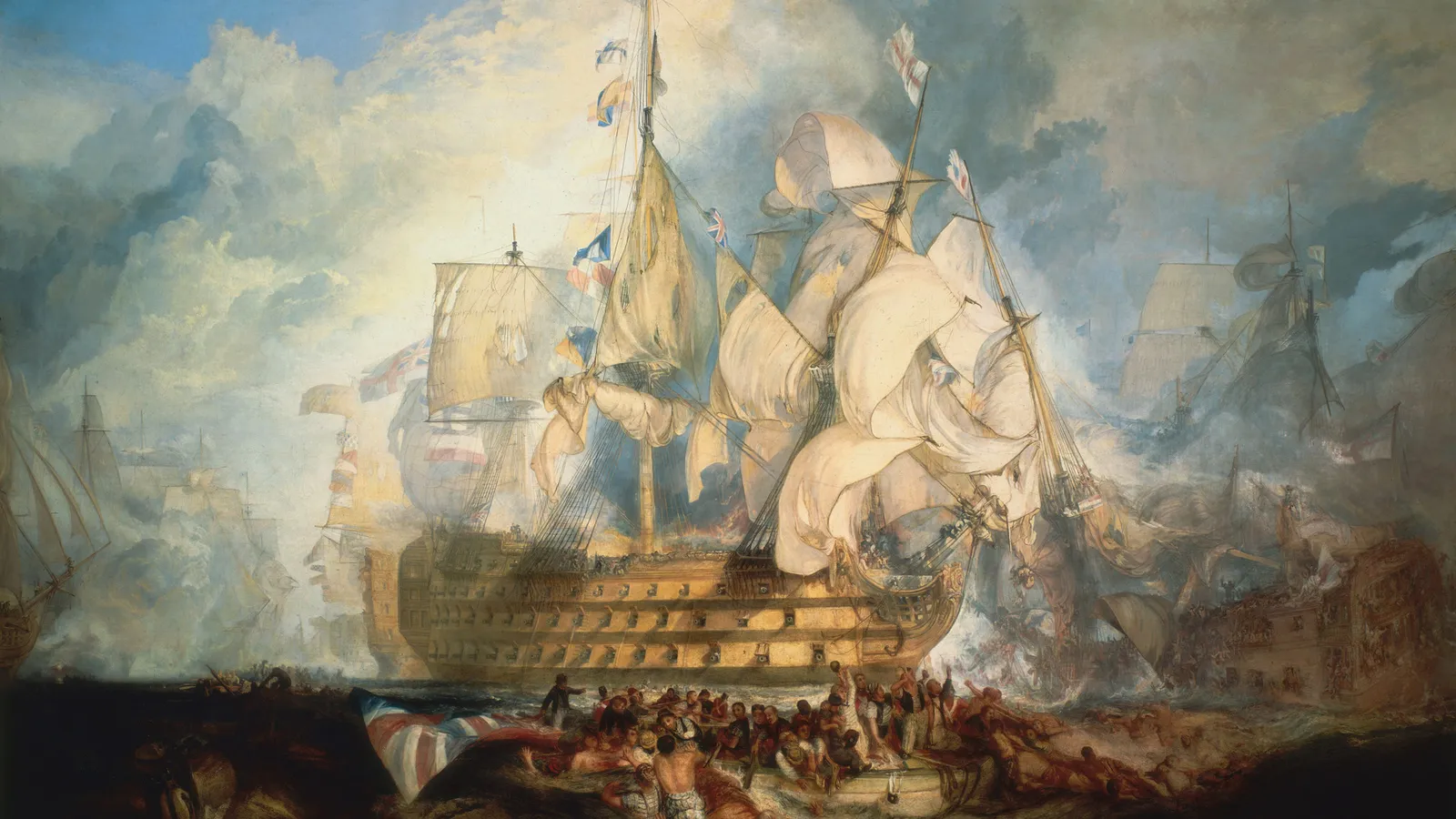
On October 21, 1805, off the southwestern coast of Spain, a British fleet under Vice-Admiral Horatio Nelson destroyed a combined French and Spanish fleet in one of the most decisive naval battles in history. The victory secured British naval dominance for the remainder of the Napoleonic Wars, permanently ended any realistic prospect of a French invasion of Britain, and cost Nelson his life at the moment of his greatest triumph. More than two centuries later, Trafalgar remains a fixed point in naval history—studied not only for its outcome but for the audacity of the tactics that produced it.
Quick Facts
- Date: October 21, 1805
- Location: Off Cape Trafalgar, southwestern Spain
- Commanders: Horatio Nelson (Britain) vs. Pierre-Charles Villeneuve (France/Spain)
- Result: Roughly 22 French and Spanish ships captured or destroyed; no British ships lost
- Outcome: Decisive British victory; Nelson killed in action
The Strategic Stakes
By 1805, Napoleon Bonaparte had assembled a large invasion force—the Armée d’Angleterre, more than 150,000 men—encamped at Boulogne on the French coast, awaiting only naval control of the English Channel to cross into Britain. Napoleon’s strategic problem was straightforward but, in practice, nearly insoluble: Britain’s Royal Navy, though smaller in total tonnage than the combined fleets of France and Spain, maintained a close and highly effective blockade of French and Spanish ports, preventing France’s scattered naval squadrons from concentrating into a force capable of contesting the Channel.
Napoleon’s plan for 1805 called for the French Toulon fleet, joined by Spanish squadrons allied to France under the terms of their alliance, to break out of the Mediterranean, sail to the West Indies to draw off British defenders, then double back across the Atlantic and combine with additional French squadrons at a rendezvous point, achieving—even if only briefly—the local naval superiority in the Channel needed to escort the invasion barges across. That control depended entirely on the combined French and Spanish fleet, commanded by Vice-Admiral Pierre-Charles Villeneuve, both evading the Royal Navy in open water and successfully concentrating enough ships to challenge British control of the Channel.
The campaign that preceded Trafalgar—a transatlantic chase in which Nelson pursued Villeneuve’s fleet to the West Indies and back without managing to bring it to battle—ended inconclusively at the Battle of Cape Finisterre in July 1805, after which Villeneuve, his fleet battered and his confidence in the overall plan shaken, retreated to the Spanish port of Cádiz rather than attempting to force the Channel. Napoleon, increasingly focused on a new campaign against Austria and Russia in central Europe, effectively abandoned the invasion plan by late summer 1805, though the combined fleet at Cádiz remained a strategic asset—and, in Napoleon’s eyes, an embarrassment—that needed to be put to use.
By the time Villeneuve’s fleet finally left Cádiz in October, then, the outcome of Trafalgar would not decide whether Britain was invaded that year—Napoleon had already turned his army east, toward the campaign that would culminate in his victory over Austria and Russia at Austerlitz just weeks later. What Trafalgar decided instead was something more durable: which power would control the world’s oceans, and therefore global trade, colonial empire, and the ability to project military force overseas, for the following century. Britain’s blockade strategy in the years before Trafalgar had already worn down French and Spanish naval readiness through years of enforced idleness in port; Trafalgar converted that gradual strategic advantage into an outright, and effectively permanent, naval supremacy.
Nelson’s Plan
When Villeneuve’s fleet finally sailed from Cádiz on October 19–20, 1805—prompted by orders from Napoleon to move into the Mediterranean in support of French operations in Italy, and reportedly by Villeneuve’s own knowledge that he was about to be replaced in command—Nelson intercepted it off Cape Trafalgar on October 21 with 27 British ships of the line against 33 French and Spanish vessels. Despite being outnumbered in ships and in total guns, Nelson had a decisive advantage in crew training, gunnery speed, and fleet tactics honed over years of blockade duty at sea, during which British crews had maintained a level of readiness and gunnery practice that their more port-bound French and Spanish counterparts could not match.
Rather than engage in the traditional naval battle formation of the era—two opposing lines of ships sailing parallel to each other and exchanging broadsides, often for hours without a decisive result, since ships arrayed in parallel lines could rarely inflict losses severe enough to force a clear-cut outcome—Nelson adopted a radical and risky approach that came to be known, after the fact, as the “Nelson touch.” He divided his fleet into two divisions and planned to sail them roughly perpendicular into the enemy’s line, cutting through it at two separate points rather than engaging it broadside-to-broadside along its full length.
The intent was to break the combined fleet into isolated, disorganized clusters that British ships—superior in gunnery and crew discipline—could then overwhelm individually in a series of close-range melees, rather than allow Villeneuve’s numerically larger force to fight a coordinated, mutually supporting action in line. It was a plan Nelson had discussed and refined with his captains in the weeks before the battle, and one that depended heavily on the initiative and skill of individual captains once the fleets became engaged and centralized signaling broke down amid the smoke and chaos of close combat—a risk Nelson was willing to accept precisely because he trusted the captains under his command, the group of officers he and his fleet had come to call, borrowing a phrase from Shakespeare’s Henry V, a “band of brothers.”
Before the fleets closed for battle, Nelson ordered a signal run up Victory’s masts, flown by flag-hoist across the fleet. He had originally wanted the message to read “England confides that every man will do his duty,” using “confides” in the now-archaic sense of “trusts” or “is confident in”—but the signal officer, Lieutenant John Pasco, pointed out that “confides” was not in the signal code book and would have to be spelled out letter by letter, whereas “expects” was a single coded flag, saving considerable time. Nelson agreed to the change, and the signal was hoisted as:
“England expects that every man will do his duty.”
The message, relayed flag by flag down the length of the British fleet, was reportedly greeted with cheers from the crews as they prepared for action. In the confusion of the day and its aftermath, several ships recorded slightly different wordings, and the more clipped version—“England expects every man to do his duty”—became so widely repeated in the years after the battle that it is the phrasing inscribed on Nelson’s tomb in St. Paul’s Cathedral, even though the flag signal as actually transmitted read “that every man will do his duty.”
Weather, Waters, and the Approach to Battle
Cape Trafalgar lies on Spain’s Atlantic coast near the entrance to the Strait of Gibraltar, a stretch of open water with few natural obstacles to complicate fleet maneuvering—a fitting stage for the kind of large-scale, decisive fleet action Nelson had spent his career seeking and rarely finding. The morning of October 21 brought a long, slow Atlantic swell and only a light wind, conditions that suited neither side’s preference exactly but that particularly disadvantaged Villeneuve’s plan: the combined fleet, formed into an irregular and somewhat ragged line as it attempted to work toward the safety of Cádiz upon sighting the British, could not maneuver quickly enough in the faint breeze to avoid the two oncoming British columns or to reform into a more cohesive defensive posture before contact was made.
Nelson, watching the combined fleet’s formation from Victory’s deck through the morning, is reported to have recognized that the light winds meant his own approach would be slow and dangerous—the British columns would spend a long, exposed period sailing directly at the enemy line, absorbing fire they could not yet return—but that the same conditions would make it equally difficult for Villeneuve’s fleet to escape or reform once battle was joined. It was a trade-off Nelson judged worth accepting, given his confidence in his crews’ ability to survive the approach and dominate the close-range fighting that would follow.
The Opposing Forces and Commanders
Nelson’s fleet, though outnumbered, was a formidable instrument shaped by more than a decade of continuous wartime service. British crews at Trafalgar were, on average, seasoned professionals accustomed to years of blockade duty, and Royal Navy gun crews had developed a rate of fire that frequently allowed British ships to load and fire two or even three broadsides in the time it took a less-practiced French or Spanish crew to manage one—an advantage that, once the melee began, proved more decisive than any disparity in ship numbers or gun counts. Nelson’s own flagship, HMS Victory, a 104-gun first-rate ship of the line, led the northern (weather) column, while HMS Royal Sovereign, under Vice-Admiral Cuthbert Collingwood, Nelson’s deputy and one of the Royal Navy’s most respected officers, led the southern (lee) column and was, in fact, the first British ship to break the enemy line.
The combined Franco-Spanish fleet under Villeneuve, though numerically superior with 33 ships of the line to Britain’s 27, suffered from problems that numbers alone could not overcome: French and Spanish crews had spent much of the preceding years blockaded in port rather than at sea, limiting opportunities for the kind of continuous gunnery and seamanship practice that had sharpened their British counterparts; the alliance between French and Spanish squadrons, while formally unified under Villeneuve’s command, lacked the years of shared operational experience and mutual trust that characterized Nelson’s fleet; and Villeneuve himself, an experienced and by most accounts capable officer, commanded a fleet whose morale had been badly shaken by the inconclusive campaign of the preceding months and by growing awareness—shared by Villeneuve—that Napoleon had lost confidence in him. Villeneuve’s own flagship, the Bucentaure, and the formidable Spanish four-decker Santísima Trinidad, among the largest warships afloat at the time, anchored the center of the combined fleet’s line.
Breaking the Line
As the two British columns bore down on the Franco-Spanish fleet on the morning of October 21, they were forced to endure a prolonged approach under fire without being able to effectively return it—since a ship advancing bow-first toward an enemy line could bring only its limited forward guns to bear, while the ships it approached could fire full broadsides down the length of the oncoming column. Victory in particular took heavy damage and casualties during this approach, and Nelson’s decision to lead from the front, sailing his flagship directly at the heart of the enemy line rather than commanding from a position of greater safety, exposed him personally to the same danger faced by his crew.
Collingwood’s Royal Sovereign, sailing somewhat ahead of the rest of the southern column, broke through the Franco-Spanish line first, engaging the Spanish ship Santa Ana at extremely close range. Victory broke through shortly after, passing so close under the stern of Villeneuve’s flagship Bucentaure that Victory’s guns, fired directly through the Bucentaure’s stern windows and along the length of her unprotected gun decks, inflicted catastrophic damage and casualties in a single devastating broadside—a maneuver known as “raking” that was among the most destructive possible in the age of sail, since a raking broadside traveled the length of an enemy ship’s decks rather than being absorbed by its reinforced hull sides.
Once the British columns had penetrated the Franco-Spanish line at multiple points, the coordinated, mutually supporting formation that had given Villeneuve’s numerically larger fleet its theoretical advantage collapsed into a series of separate, close-range ship-to-ship engagements—precisely the outcome Nelson’s plan had been designed to produce. In these individual melees, the superior speed and accuracy of British gunnery crews proved decisive again and again: ship after ship in the combined fleet was battered into submission, dismasted, or forced to strike its colors, while British losses, though real, remained comparatively limited. By early afternoon, the battle had effectively been decided, even as fighting continued in isolated pockets across a chaotic, smoke-shrouded seascape stretching for miles.
The Death of Nelson
At approximately 1:15 in the afternoon, as Victory remained locked in close combat with the French ship Redoutable, Nelson was struck by a musket ball fired by a French marksman stationed in Redoutable’s rigging. The ball entered Nelson’s left shoulder, passed through his chest, severing a major blood vessel and lodging near his spine—a wound that Nelson, an experienced and knowledgeable observer of battlefield injuries himself, reportedly recognized immediately as mortal. He was carried below to Victory’s cockpit, where the ship’s surgeon, William Beatty, could offer little beyond making him comfortable; there was no surgical means in 1805 of addressing a wound of that severity.
Nelson lived for approximately three hours after being struck, conscious for much of that time and repeatedly asking those attending him how the battle was progressing. According to the eyewitness accounts of several of those present at his deathbed, including Beatty, Nelson’s flag captain Thomas Hardy visited him below decks during the final hours and, in a moment of personal tenderness recorded by multiple witnesses, is said to have kissed Nelson on the cheek or forehead at Nelson’s request—an episode that gave rise to the famous, if imprecisely worded, phrase “Kiss me, Hardy.” Nelson’s own last coherent words, according to the converging testimony of the eyewitnesses present, were a repeated declaration:
“Thank God, I have done my duty.”
He died at approximately 4:30 that afternoon, shortly after receiving confirmation that the battle had been won—dying, in other words, in the full knowledge that the victory he had planned and led had been achieved, even as it cost him his own life.
Immediate Aftermath
The scale of the British victory at Trafalgar was overwhelming by the standards of naval warfare in the age of sail. Of the 33 ships in the combined Franco-Spanish fleet, roughly 22 were captured or destroyed in the battle itself, and not a single British ship of the line was lost—an outcome that stunned contemporaries on both sides and cemented the battle’s reputation as one of the most one-sided major fleet actions in naval history. British casualties totaled approximately 449 killed and 1,217 wounded across the fleet; French and Spanish losses were far heavier, with roughly 4,400 killed, over 2,500 wounded, and approximately 20,000 men killed, wounded, or taken prisoner in total when captured crews are included.
The victory, however, came at enormous cost in the days that followed, largely due to weather rather than combat. A violent storm swept the battle area in the days immediately after October 21, scattering the British fleet and its many captured prizes, several of which—already battered from the battle and now undermanned by British prize crews struggling to control damaged, unfamiliar ships in heavy seas—were wrecked, recaptured by their original crews, or deliberately sunk to prevent recapture, meaning that a number of the ships nominally “captured” at Trafalgar never actually reached a British port. Villeneuve himself was taken prisoner and transported to England, where he was held for several months before being repatriated to France in April 1806; ten days after his return, he was found dead in his lodgings at Rennes from multiple stab wounds, in a death officially ruled a suicide but which some historians have long regarded as suspicious given both the number of wounds and Villeneuve’s likely fear of Napoleon’s displeasure over his conduct of the campaign.
Nelson’s body, preserved in a cask of brandy for the voyage home, was returned to England and given a state funeral of extraordinary scale at St. Paul’s Cathedral in January 1806, an outpouring of national mourning and commemoration that reflected the degree to which Nelson had already, in his own lifetime, become a figure of near-mythic stature in British public life.
- Key dates surrounding the battle:
- 1803 — Renewed war between Britain and Napoleonic France; Napoleon assembles invasion forces at Boulogne
- 1805 — Villeneuve’s fleet attempts to draw off British defenders via a transatlantic campaign to the West Indies and back
- July 22, 1805 — Inconclusive Battle of Cape Finisterre
- August 1805 — Villeneuve’s combined fleet retreats to Cádiz; Napoleon shifts focus to the campaign against Austria
- October 19–20, 1805 — Combined fleet sails from Cádiz
- October 21, 1805 — Battle of Trafalgar
- Late October 1805 — Storm scatters the British fleet and many captured prizes
- January 9, 1806 — Nelson’s state funeral at St. Paul’s Cathedral
Why Trafalgar Still Matters
Trafalgar effectively ended Napoleon’s hopes of invading Britain and secured British command of the seas for the rest of the Napoleonic Wars and well beyond—a dominance that underpinned the growth of the British Empire throughout the 19th century and that would not be seriously challenged by another naval power until the buildup to the First World War nearly a century later. With the combined French and Spanish fleets destroyed as an effective offensive force, Britain was free to blockade the European continent, project military power overseas, and fund allied land campaigns against Napoleon without fear of invasion at home—a strategic freedom that shaped the entire remaining course of the Napoleonic Wars, even though the wars on land would continue for another decade after Trafalgar was fought at sea.
Nelson’s tactics at Trafalgar, particularly his willingness to abandon rigid line-of-battle doctrine in favor of a decisive, higher-risk maneuver that broke the enemy formation into isolated engagements, are still studied in naval academies as a model of bold, well-calculated risk-taking grounded in a realistic assessment of his own fleet’s superior training and his opponent’s weaknesses—rather than as reckless gambling. The battle is also frequently cited as an illustration of the broader principle, since generalized well beyond naval warfare, that a smaller, better-trained, and more cohesively led force can decisively defeat a larger but less prepared and less unified one when the engagement is fought on terms that neutralize the larger force’s numerical advantage.
Nelson himself became a lasting symbol of British naval heroism, memorialized in Trafalgar Square and atop Nelson’s Column in London, unveiled decades after his death, and his signal to the fleet before the battle—“England expects that every man will do his duty”—remains one of the most famous messages in military history, still invoked in British popular and political culture more than two centuries later as shorthand for duty performed under pressure.
Nelson’s Rise to Command
Nelson’s presence at Trafalgar was the culmination of a naval career already legendary by 1805. Having entered the Royal Navy as a boy of twelve, he rose through a combination of genuine tactical brilliance, personal courage bordering on recklessness, and a talent for winning the loyalty of the officers and sailors who served under him. He had lost the sight in one eye during operations at Calvi in 1794 and his right arm during a failed assault on Santa Cruz de Tenerife in 1797, injuries that did nothing to slow his advancement and that, if anything, added to his growing public reputation for fearlessness. His decisive victory at the Battle of the Nile in 1798, in which he trapped and destroyed a French fleet supporting Napoleon’s Egyptian campaign, and his role at the Battle of Copenhagen in 1801, established him as Britain’s preeminent naval commander well before the Trafalgar campaign began. It was during the Nile campaign that Nelson first described the captains serving under him as a “band of brothers,” a phrase drawn from the St. Crispin’s Day speech in Shakespeare’s Henry V, and one that came to characterize the close working relationship and mutual trust between Nelson and his officers that made the risky, decentralized tactics of Trafalgar workable in practice.
By the time he took command of the fleet blockading Cádiz in 1805, Nelson was not merely an admiral but something closer to a national celebrity, his exploits followed in the British press and his personal life—including his well-publicized relationship with Emma Hamilton—a subject of considerable public fascination. That combination of proven tactical judgment and personal magnetism gave Nelson a degree of latitude, both from his own captains and from the Admiralty in London, to attempt a plan as unconventional as the one he executed at Trafalgar.
Frequently Asked Questions
Why did Nelson divide his fleet into two columns instead of forming a traditional line of battle?
The traditional naval tactic of the era—two fleets sailing in parallel lines exchanging broadsides—rarely produced a decisive result and tended to favor whichever fleet had more ships, since it allowed every vessel in a line to support its neighbors. Nelson, aware that his fleet was outnumbered but confident in his crews’ superior gunnery and training, instead divided his ships into two columns and drove them perpendicular into the enemy line to break it into isolated clusters, where superior British gunnery and seamanship could be brought to bear in a series of close, individual engagements rather than one prolonged, indecisive exchange along parallel lines.
What exactly did Nelson’s famous signal say?
The flag signal, hoisted from HMS Victory shortly before the battle began, read “England expects that every man will do his duty.” Nelson had originally wanted the wording “England confides that every man will do his duty,” but changed it at the suggestion of his signal officer, Lieutenant John Pasco, because “confides” was not available as a single coded flag and would have taken far longer to spell out letter by letter. A shortened version, “England expects every man to do his duty,” became more widely repeated afterward and is the wording inscribed on Nelson’s tomb, even though it was not the phrasing actually signaled to the fleet.
How did Nelson die, and what were his last words?
Nelson was struck by a musket ball fired from the rigging of the French ship Redoutable at around 1:15 p.m., the ball passing through his shoulder and chest and lodging near his spine. He was carried below decks and lived for roughly three hours, remaining conscious for much of that time. According to converging eyewitness accounts from those present at his deathbed, his final words were a repeated declaration, “Thank God, I have done my duty,” spoken after learning that the battle had been won.
Why were there no British ships lost at Trafalgar despite being outnumbered?
The superior speed and accuracy of British gunnery, the product of years of continuous sea duty and gunnery practice during the blockade of French and Spanish ports, allowed British crews to inflict damage on their opponents far faster than they received it once the melee began. Nelson’s tactic of breaking the enemy line into isolated, disorganized clusters also prevented the more numerous Franco-Spanish fleet from concentrating its firepower effectively against any single British ship, so that even though individual British vessels, including Victory, took serious damage and casualties, none were sunk or captured.
Was Trafalgar really a bigger naval victory than other famous battles of the age of sail?
By the standard measures used to compare fleet actions of the period—the proportion of the defeated fleet destroyed or captured, weighed against the victor’s own losses—Trafalgar stands out even among Nelson’s own earlier victories at the Nile and Copenhagen. Roughly two-thirds of the combined Franco-Spanish fleet was captured or destroyed, and not a single British ship of the line was lost in the engagement itself, an unusually lopsided outcome even by the standards of a period in which British fleets frequently outperformed their continental opponents.
What happened to the ships captured at Trafalgar?
Although roughly 22 French and Spanish ships were captured or destroyed during the battle itself, a violent storm in the days immediately afterward scattered the fleet and its prizes; several captured ships, damaged in the fighting and undermanned by the British sailors assigned to sail them, were wrecked in the storm, recaptured by their original crews, or deliberately sunk to prevent recapture, so that not all of the ships nominally taken at Trafalgar were successfully brought into a British port.
Recommended Reading
Roy Adkins’s Trafalgar: The Biography of a Battle offers a detailed account drawing on firsthand accounts from sailors on both sides. Adam Nicolson’s Seize the Fire: Heroism, Duty, and the Battle of Trafalgar focuses on the culture of the Royal Navy that made the victory possible. Andrew Lambert’s Nelson: Britannia’s God of War provides a comprehensive biographical study situating Trafalgar within the full arc of Nelson’s naval career and its lasting influence on British strategic thought.
Read Next

August 8, 2026
Genghis Khan and the Mongol Conquests
How Genghis Khan built the largest contiguous land empire in history through speed, discipline, and a radically mobile army.
August 8, 2026
The Battle of Stalingrad: The Turning Point of World War II's Eastern Front
How the brutal battle for Stalingrad in 1942-43 destroyed a German army and turned the tide of World War II in Europe.
August 8, 2026
The Battle of Agincourt: Longbows Against Chivalry
How a small, exhausted English army under Henry V destroyed a much larger French force at Agincourt in 1415.