Military History
The Battle of Agincourt: Longbows Against Chivalry
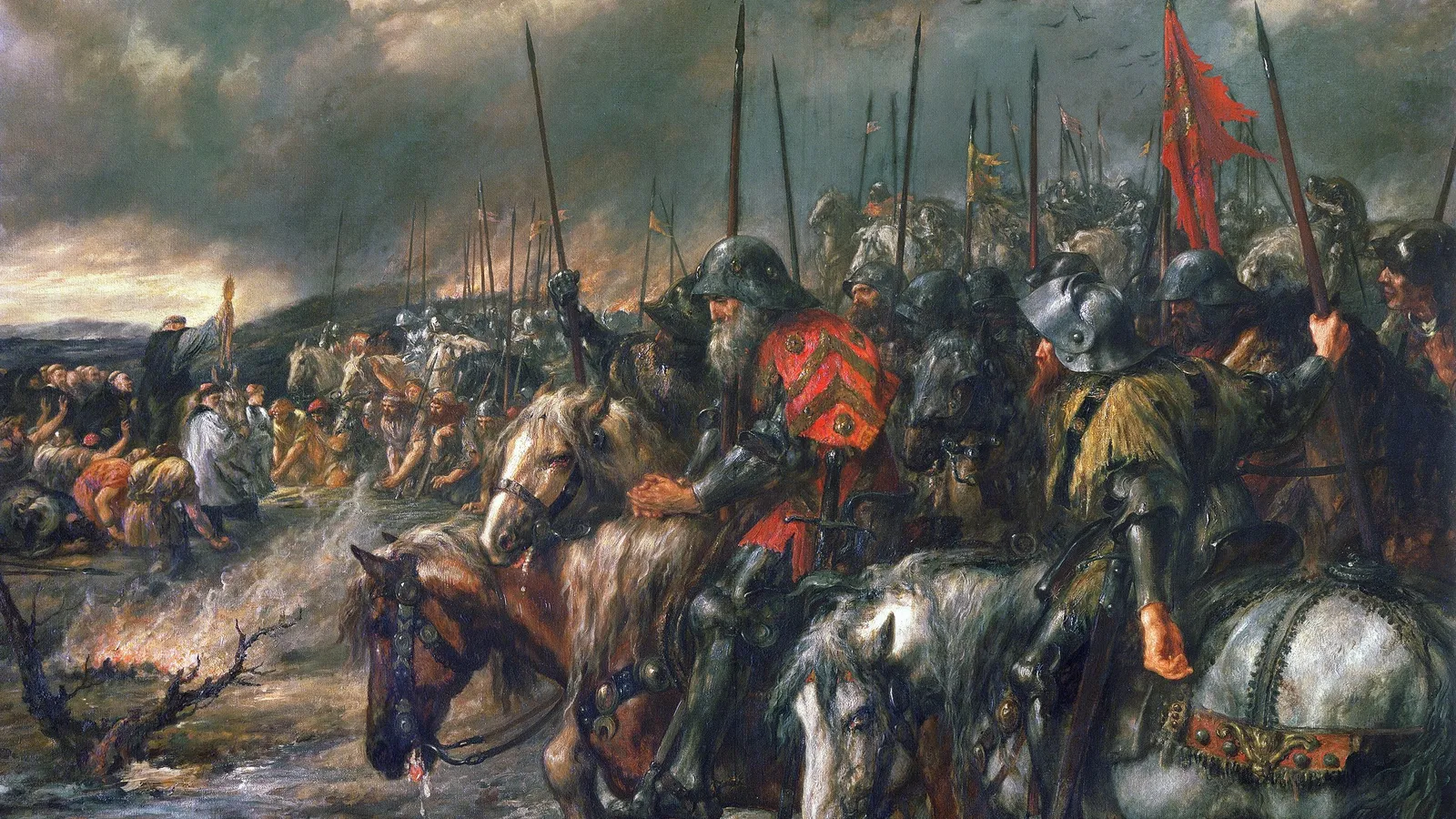
On October 25, 1415, an exhausted, disease-weakened English army under King Henry V defeated a much larger French force near the village of Agincourt in northern France. The battle became one of the most celebrated English military victories in history, immortalized centuries later in Shakespeare’s Henry V, and remains a landmark case study in how disciplined ranged infantry could shatter the era’s heavily armored knightly cavalry. It has been retold and reimagined so many times in English literature, theater, and film that the historical event and its cultural mythology have become almost inseparable—yet the underlying military reality, pieced together from surviving administrative records and eyewitness chronicles, is in many ways just as striking as the legend.
The battle occupies a peculiar place in military history: a victory won not by superior numbers, cavalry, or fortification, but by a combination of terrain, weather, discipline, and a weapon—the English longbow—that took a lifetime of training to master and could not simply be copied by an opposing army in time to matter.
The Hundred Years’ War
Agincourt did not occur in isolation. It was one battle within the much longer Hundred Years’ War (1337–1453), a sprawling, intermittent conflict between the kingdoms of England and France rooted in a tangle of dynastic claims, feudal obligations, and territorial disputes stretching back to the Norman Conquest of 1066. English kings, as dukes of Normandy and later Aquitaine, held substantial territory within France and owed feudal homage to the French crown for it—an awkward and unstable arrangement that repeatedly produced friction. The war’s opening phase, beginning under Edward III in 1337, had already produced famous English victories at Crécy (1346) and Poitiers (1356), both of which, notably, also featured English longbowmen playing a decisive role against French forces built around armored cavalry.
By the time Henry V ascended the English throne in 1413, decades of intermittent warfare, a devastating civil conflict within France between the rival Armagnac and Burgundian factions, and periods of fragile truce had left the overall situation unresolved. Henry, a capable and ambitious young king eager to assert his authority and revive England’s dormant claims to French territory and even to the French crown itself, saw an opportunity in France’s internal divisions. In August 1415, he led an invasion force across the English Channel, landing near the mouth of the Seine with the stated aim of pressing his dynastic claims and reasserting English control over disputed territories in Normandy and beyond.
Henry’s claim rested on a genealogical argument dating back to Edward III, who through his mother was a grandson of the French king Philip IV and had asserted a right to the French throne itself under a disputed reading of succession law that French jurists rejected on the grounds that inheritance could not pass through a female line. That claim had lain dormant for years amid England’s own domestic troubles, including the deposition of Richard II and the contested reign of Henry’s father, Henry IV, but the younger Henry revived it aggressively upon taking the throne, seeing a French crown wracked by the king’s periodic bouts of insanity and the bitter Armagnac-Burgundian rivalry as unusually vulnerable to renewed English pressure.
- 1337: The Hundred Years’ War begins.
- 1346: English longbowmen play a decisive role in victory at the Battle of Crécy.
- 1356: England wins again at the Battle of Poitiers, capturing the French king.
- August 1415: Henry V lands in northern France and besieges Harfleur.
- September 22, 1415: Harfleur surrenders after a costly, prolonged siege.
- October 25, 1415: The Battle of Agincourt.
- 1420: The Treaty of Troyes recognizes Henry V as heir to the French throne.
- 1422: Henry V dies of dysentery, never becoming King of France.
- 1453: The Hundred Years’ War ends with French victory, ejecting England from nearly all its French territories.
A Campaign Gone Wrong
Henry V had landed in northern France in August 1415, reviving English claims to French territory dating back to the Hundred Years’ War. His campaign started poorly: the siege of Harfleur took far longer than expected, and dysentery ravaged his army, reducing his effective fighting force significantly. The siege, intended as a quick opening move before a broader campaign, instead consumed more than a month, during which disease—almost certainly dysentery, spread through the insanitary conditions of a static army camped in low-lying, waterlogged ground—tore through the English ranks. Several senior nobles died of illness during the siege, and by the time Harfleur finally surrendered on September 22, Henry’s army had been reduced by a substantial margin, with many sick soldiers shipped home rather than continuing the campaign.
Rather than press further into France as originally planned, Henry decided to march his depleted army roughly 160 miles overland toward the English-held port of Calais, both to demonstrate his continued claim to French territory by traversing it and to bring his campaign season to a face-saving close before winter. It was, in essence, a calculated risk dressed up as a chevauchée, the traditional raiding march through enemy territory that English commanders had used throughout the war to assert their presence and provoke a response.
A large French force, determined to intercept and destroy the English before they could escape, cut off Henry’s route near the village of Agincourt (in modern French, Azincourt). English estimates of the opposing forces vary, but Henry’s army—likely around 6,000 to 9,000 men, the majority of them longbowmen—faced a French army that may have numbered 20,000 to 30,000, heavy with armored knights and men-at-arms, according to many traditional accounts, although more recent scholarship using French and English administrative records has argued for somewhat smaller, though still substantially larger, French numbers. The historian Anne Curry, drawing on surviving pay and muster records, has argued for a narrower gap between the two forces—an English army of roughly 8,000 to 9,000 against a French force of perhaps 12,000—though her figures remain debated among specialists, and many historians continue to regard the traditional chronicler estimates of a much larger French disparity as closer to the truth.
The Armies and Their Commanders
Henry V, 28 years old at the time of the battle, commanded the English force in person. Having spent years as a young prince fighting in the Welsh wars against Owain Glyndŵr’s rebellion, he was already a battle-tested commander by the time he took the throne, and at Agincourt he displayed both tactical patience—waiting for the French to commit to an attack on unfavorable ground rather than risking his exhausted army in an assault of his own—and a hands-on willingness to fight in the front rank alongside his men, reportedly suffering a blow to his helmet during the fighting.
The core strength of Henry’s army lay in its longbowmen, drawn overwhelmingly from the English and Welsh countryside, where archery had been encouraged (and at times legally mandated for practice) for generations specifically to produce men capable of drawing the powerful English longbow. Reaching draw weights that modern estimates place well above 100 pounds, the longbow required years, often a lifetime, of training from childhood to use effectively at the rate of fire and accuracy needed in battle—a skill that could not be quickly replicated by any rival army, giving England a genuine and durable military advantage wherever longbowmen could be recruited and fielded in sufficient numbers.
On the French side, command was fragmented among a coalition of nobles rather than unified under the French king, Charles VI, who suffered from recurring bouts of mental illness and did not personally lead the army into battle. Nominal command fell to Charles d’Albret, the Constable of France, though in practice authority was shared uneasily among a large number of French dukes, counts, and noble commanders, many of whom were eager for glory and reluctant to defer to any single leader—a command structure that would prove a serious liability once the battle began. D’Albret himself was killed in the fighting, one of a staggering number of France’s senior nobility to die at Agincourt.
This contrast in command structure mattered as much as any difference in equipment. Henry’s army, though smaller and physically depleted, operated under a single unquestioned authority who had personally overseen its planning, discipline, and deployment from the outset of the campaign. The French army, despite its far greater numbers and the individual bravery of many of its nobles, struggled throughout the campaign to agree on a coherent strategy, with rival factions disagreeing over whether to risk open battle at all before eventually committing to an attack that most modern historians regard as poorly coordinated relative to the size of the force involved.
“We few, we happy few, we band of brothers.” — from Henry V’s speech before the battle in Shakespeare’s Henry V (1599), a literary dramatization rather than a verified historical quotation
The March to Calais
The eleven-day march from Harfleur toward Calais was grueling even before any fighting began. Henry’s army, already weakened by dysentery and short on supplies, moved quickly through hostile territory, avoiding direct confrontation while French forces shadowed and eventually moved to block their path. Rivers proved a persistent obstacle: French forces had broken or guarded key crossings of the Somme, forcing Henry’s army into a lengthy detour upstream before they were finally able to ford the river, buying additional time for French forces to concentrate against them.
By the time the two armies converged near Agincourt on October 24, Henry’s men were hungry, sick, and had marched roughly 260 miles in just over two weeks. Contemporary accounts describe the English as spending the eve of battle in near silence, in contrast to reports of confident revelry in the French camp, where many of the assembled nobility apparently anticipated an easy victory over an exhausted and heavily outnumbered opponent. Whether or not the accounts of French overconfidence are entirely reliable—chroniclers on both sides had reasons to shape the narrative after the fact—the disparity in the two armies’ physical condition and morale on the eve of the battle appears to have been real and significant.
The Muddy Field
The battlefield itself worked against the French. A narrow strip of open, recently plowed farmland, flanked by dense woods on both sides, funneled the French advance into a tight space where their numerical advantage could not be brought to bear effectively. Overnight rain had turned the field into thick mud. The choice of ground, situated between the woods of Agincourt and Tramecourt, was in some respects forced on both sides by the geography of the area, but it favored Henry’s smaller army enormously: the narrowing funnel of open ground between the trees meant that the larger French force could not deploy its full numerical superiority on a wide front, while the churned, saturated mud—worsened by the passage of thousands of men and horses—turned the ground into a nightmare for heavily armored soldiers advancing on foot or on horseback.
Henry positioned his longbowmen on the flanks, protected by sharpened wooden stakes driven into the ground to break up cavalry charges, with dismounted men-at-arms in the center. This defensive arrangement, learned from earlier English successes at Crécy and Poitiers, was designed specifically to draw the French into an attack against a fixed position rather than to seek open battle, playing to the strengths of a smaller, more exhausted force that could not have hoped to win a war of maneuver or attrition against a larger enemy.
The Longbowmen’s Volleys
As the French knights and men-at-arms advanced across the muddy, narrowing field—weighed down by heavy armor and increasingly bunched together as the terrain constricted them—English longbowmen unleashed devastating volleys of arrows. The initial French advance was led by a cavalry charge intended to disrupt and scatter the English archers before the main body of dismounted men-at-arms closed in, but the sharpened stakes and the sheer weight of arrow fire broke the charge before it could reach the English line, sending riderless and wounded horses crashing back into the advancing French infantry behind them and adding to the chaos.
Exhausted, bogged down in mud, and crowded so tightly that many could barely raise their weapons, the French vanguard was cut down or captured in staggering numbers. As successive ranks of French men-at-arms pressed forward into the narrowing killing ground, the sheer density of the advancing mass—compounded by the mud, the fallen bodies of earlier casualties, and the funnel created by the woods on either side—meant that many soldiers in the rear ranks could not effectively engage the English line at all, while archers, having exhausted their arrows, discarded their bows and joined the melee with swords, hatchets, and mallets, cutting down heavily armored but exhausted and immobilized French soldiers struggling to rise from the mud. English men-at-arms then closed in on the disorganized survivors, and what had begun as a formal battle between armored ranks degraded, in the crush of the French formation, into a prolonged and one-sided slaughter.
“Such a great heap grew of the slain and of those lying crushed in between that our men climbed up those heaps which had risen above a man’s height, and butchered their enemies down below with swords, axes, and other weapons.” — the Gesta Henrici Quinti, an eyewitness Latin chronicle written by a chaplain in Henry V’s retinue, c. 1417
The Killing of the Prisoners
In the middle of the fighting, as large numbers of French soldiers surrendered and were taken prisoner by the advancing English line, an alarm arose—whether a genuine threat or a false report remains debated by historians—that a fresh French force was regrouping at the rear of the battlefield and might counterattack, potentially freeing the prisoners and outnumbering Henry’s remaining fighting men from behind. Fearing exactly this outcome, Henry ordered the execution of a large portion of the French prisoners already taken, sparing only the most valuable and high-ranking nobles who could be ransomed.
Many of Henry’s own knights and men-at-arms reportedly refused the order, regarding the killing of unarmed, surrendered prisoners as dishonorable and a violation of the conventions of chivalric warfare, and the task was carried out instead by a detachment of archers. The episode, controversial even by some contemporary accounts and increasingly scrutinized by modern historians as an early example of what would today be considered a war crime, nonetheless was not treated as a major scandal at the time; even French chroniclers writing about the battle generally did not single out the killings for particular condemnation, reflecting a medieval military culture in which the safety of an army in the field, particularly a badly outnumbered one deep in hostile territory, was widely accepted to take precedence over the preservation of prisoners’ lives.
Quick Facts
- Date: October 25, 1415
- Location: Near Agincourt, northern France
- Commanders: Henry V (England) vs. Charles d’Albret, Constable of France
- Forces: English army of roughly 6,000–9,000 (the large majority longbowmen) vs. a French force traditionally estimated at 20,000–30,000, though some modern scholarship suggests a narrower gap of roughly 9,000 to 12,000
- Casualties: French losses vastly exceeded English losses; estimates of French dead commonly range from around 6,000 to well over 8,000, including much of the senior French nobility, against English losses usually estimated in the low hundreds
- Outcome: Decisive English victory despite being significantly outnumbered
Immediate Aftermath
The scale of the French defeat was staggering, particularly among the French nobility. Among the dead were the Constable of France, Charles d’Albret; three dukes; multiple counts; and a substantial portion of the upper ranks of French chivalry, a loss so severe it disrupted French aristocratic and political life for a generation. A number of prominent French nobles were also captured and held for ransom, including Charles, Duke of Orléans, who would remain a prisoner in England for the next twenty-five years, using his long captivity to become an accomplished poet.
Henry, having won a stunning and unexpected victory, nonetheless continued his march to Calais rather than pressing the advantage immediately, and returned to England to a triumphant reception, his standing as king dramatically strengthened both domestically and in his ongoing negotiations and campaigns against France. The victory did not, on its own, end the war or immediately deliver Henry the additional French territory he sought, but it fundamentally altered the balance of prestige and negotiating leverage between the two crowns.
Henry returned to France in subsequent campaigning seasons to press his advantage more methodically, conducting a lengthy and successful conquest of Normandy over the following years rather than relying on another single dramatic battlefield victory. This patient, resource-intensive follow-up campaign, often overshadowed in popular memory by Agincourt itself, was in many ways more directly responsible for the territorial and political gains Henry ultimately secured than the battle that made his reputation.
Why Agincourt Still Matters
Agincourt is remembered as a triumph of disciplined ranged infantry and terrain over heavily armored, numerically superior cavalry—a lesson that would echo through the rest of the Hundred Years’ War as the era of the mounted knight as the dominant force on the battlefield began to decline. The English longbow, requiring years of training to use effectively at power, proved that a well-drilled, less socially prestigious force could decisively defeat a traditional feudal army built around the assumption that armored, mounted nobility represented the pinnacle of military effectiveness.
The victory also had major political consequences, strengthening Henry V’s negotiating position and eventually leading to the 1420 Treaty of Troyes, which recognized him as heir to the French throne and arranged his marriage to Catherine of Valois, daughter of the French king. Henry’s death from dysentery in 1422, however, meant he never lived to actually wear the French crown, and the gains from Agincourt and the Treaty of Troyes proved impermanent: within a few decades, a resurgent France under figures including Joan of Arc reversed most of England’s territorial gains, and the Hundred Years’ War ultimately ended in 1453 with England expelled from virtually all of its former French territory except Calais.
Beyond the battlefield, Agincourt has endured in popular memory largely through Shakespeare’s play Henry V, written around 1599, particularly the King’s rallying speech before the battle—often called the “St. Crispin’s Day” speech after the feast day on which the battle fell—which contains the enduringly famous line invoking “we few, we happy few, we band of brothers.” It is worth noting for readers that this specific speech, however stirring, is Shakespeare’s own dramatic invention rather than a transcript of anything Henry V is verified to have said; no contemporary source records the king’s exact words before the battle. Even so, Shakespeare’s dramatization has done more than any historical chronicle to cement Agincourt in popular memory as a cultural touchstone for stories of victory against overwhelming odds, an association reinforced by later film adaptations starring Laurence Olivier and Kenneth Branagh.
Militarily, Agincourt is studied today alongside Crécy and Poitiers as part of a broader pattern in which English longbow tactics repeatedly defeated larger, more heavily armored French forces during the Hundred Years’ War—a pattern that nonetheless did not, in the end, allow England to permanently hold its French territorial ambitions, underscoring that tactical battlefield superiority, however dramatic, does not by itself guarantee long-term strategic success in a prolonged war.
The battle also holds a particular place in the social history of medieval warfare. The English longbowmen who did most of the killing at Agincourt were drawn largely from the yeoman class—free but non-noble farmers and tradesmen—rather than from the mounted, aristocratic ranks that had traditionally dominated European battlefields and enjoyed the greatest social prestige in war. Their decisive role in defeating an army built around the flower of French nobility contributed, over the following decades, to a slow and uneven but real shift in how European societies thought about the relationship between social rank and military effectiveness, part of a longer trend—continued later by the rise of pike formations, gunpowder weapons, and professional standing armies—that gradually eroded the mounted knight’s centuries-long claim to battlefield supremacy.
The Longbow as a Weapon of War
Much of Agincourt’s enduring fame rests on the technical qualities of the English longbow itself, a weapon that, despite its simplicity, gave England a battlefield advantage French armies struggled for decades to counter. Typically made from a single stave of yew, often imported from continental Europe because English-grown yew rarely produced wood of sufficient quality, the longbow could reach draw weights that modern experimental archaeology, including tests conducted on bows recovered from Henry VIII’s warship the Mary Rose, suggests may have exceeded 100 to 150 pounds—far beyond what an untrained archer could draw at all, let alone repeatedly in the middle of a battle.
Producing archers capable of using such a weapon effectively required sustained, often compulsory practice over years, reinforced in England by royal statutes that periodically mandated archery practice among the common population and restricted competing sports on Sundays and holidays specifically to keep archery skills sharp across the kingdom. A skilled longbowman could loose multiple aimed arrows per minute, creating a rate and density of fire that no contemporary crossbow, which required a slower mechanical reloading process, could match. France, lacking a comparable tradition of mass longbow training among its own population, relied instead on crossbowmen, often mercenaries hired from Genoa, and on the armored cavalry and infantry that formed the traditional core of French feudal armies—a mismatch in archery capability that repeated itself at Crécy, Poitiers, and Agincourt alike.
Frequently Asked Questions
Why did the English win at Agincourt despite being outnumbered?
A combination of factors favored Henry V’s smaller army: a narrow, wooded battlefield that prevented the larger French force from using its numbers effectively, thick mud that exhausted and immobilized heavily armored French soldiers advancing on foot, and devastating volleys from English longbowmen who could fire far more rapidly than French crossbowmen and were protected behind sharpened defensive stakes.
How many soldiers fought at Agincourt?
Estimates vary. Henry’s army is generally put at roughly 6,000 to 9,000 men, the large majority longbowmen. Traditional chronicler accounts put the French army at 20,000 to 30,000, though some modern historians, using surviving administrative and pay records, argue for a smaller French force of around 9,000 to 12,000 men—still a clear numerical majority, but a narrower gap than the traditional figures suggest.
Did Henry V really order the killing of French prisoners?
Yes, this episode is recorded across multiple contemporary chronicles. Amid fears that regrouping French forces at the rear of the battlefield might counterattack and free the prisoners, Henry ordered a large number of captured French soldiers executed, sparing only the most valuable nobles. Many of his own men reportedly refused to participate, and the task was carried out by a detachment of archers.
Is Shakespeare’s “St. Crispin’s Day” speech historically accurate?
No. The speech, including the famous “band of brothers” line, is a dramatic composition written by William Shakespeare around 1599 for his play Henry V, roughly 180 years after the battle. No contemporary account records Henry V’s actual words before the battle, though English chroniclers do describe him addressing his troops.
What happened to Henry V after Agincourt?
Henry continued campaigning in France over the following years, eventually securing the 1420 Treaty of Troyes, which recognized him as heir to the French throne and married him to the French king’s daughter, Catherine of Valois. He died of dysentery in 1422, before ever becoming king of France, and his infant son inherited a war that England would ultimately lose.
Why did the longbow give England such an advantage?
The English longbow required years of dedicated training from a young age to draw effectively at the power levels needed in battle, producing archers capable of firing multiple aimed shots per minute at ranges that could penetrate much of the era’s armor at closer distances. This training requirement meant the weapon could not be quickly adopted by rival armies, giving England a durable advantage wherever it could field large numbers of trained longbowmen, as it could at Crécy, Poitiers, and Agincourt.
Recommended Reading
Juliet Barker’s Agincourt: The King, the Campaign, the Battle is widely considered the definitive modern account, drawing on extensive primary sources from both the English and French sides. Anne Curry’s Agincourt: A New History offers a meticulously researched reassessment of the battle based on surviving administrative and muster records, challenging some traditional assumptions about army sizes, while her earlier The Battle of Agincourt: Sources and Interpretations provides an extensive collection of primary source chronicles in translation for readers wanting to examine the original accounts directly.
Read Next
August 8, 2026
The Battle of Cannae: Hannibal's Perfect Victory
How Hannibal's double envelopment at Cannae in 216 BC destroyed a much larger Roman army and became history's model encirclement.
August 8, 2026
The Battle of Waterloo: The End of Napoleon
How Wellington and Blücher defeated Napoleon at Waterloo in 1815, ending the Napoleonic Wars for good.
August 8, 2026
The Battle of Gettysburg: The Civil War's Turning Point
How the three-day Battle of Gettysburg in July 1863 broke Lee's invasion of the North and turned the tide of the American Civil War.