Military History
The Battle of Cannae: Hannibal's Perfect Victory
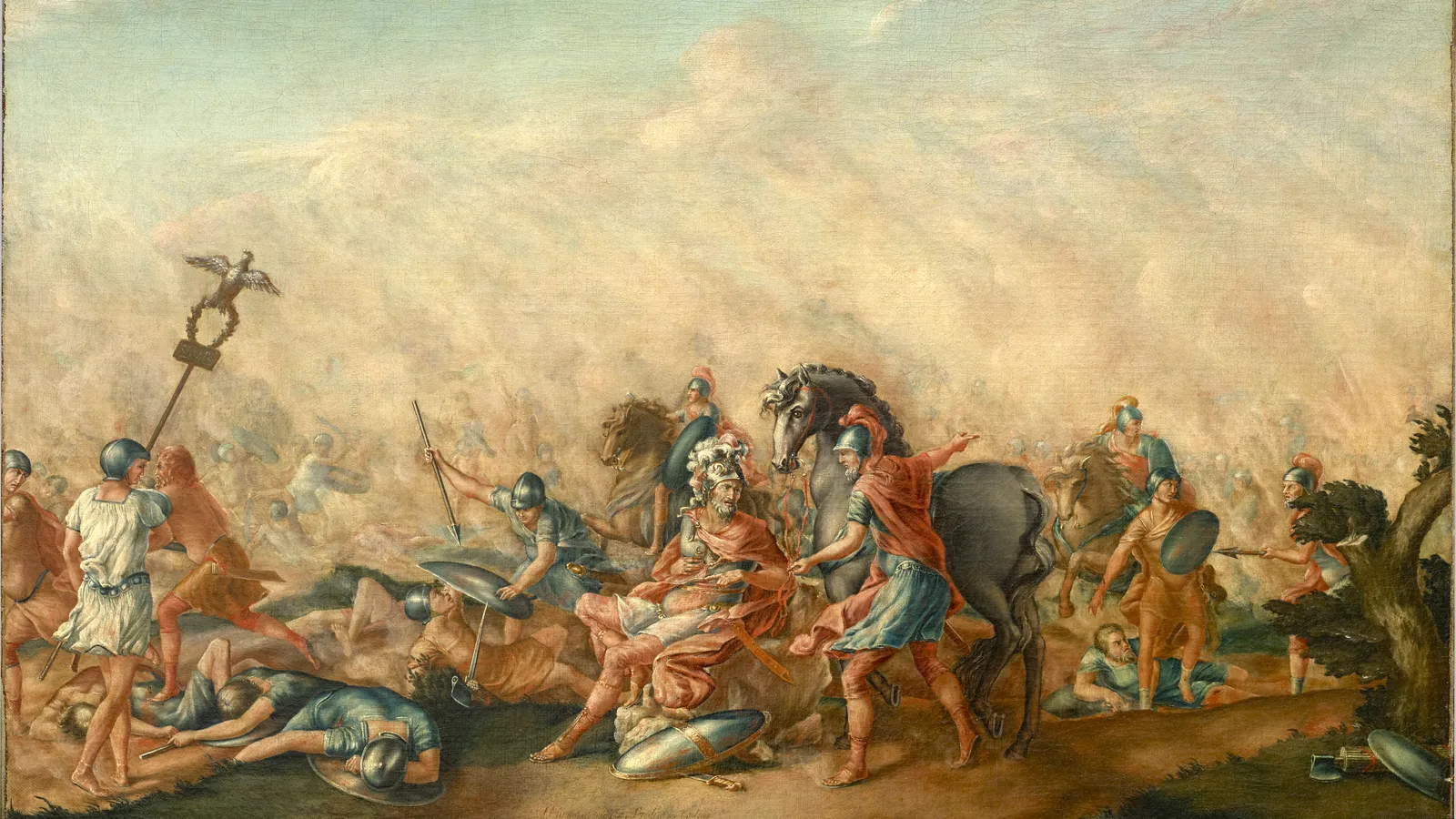
In August 216 BC, on a dusty plain in southeastern Italy, the Carthaginian general Hannibal Barca inflicted one of the most complete tactical defeats in military history on a Roman army that vastly outnumbered his own. The Battle of Cannae has been studied by military commanders for more than two thousand years as the textbook example of a double envelopment—a maneuver still referred to today simply as a “Cannae,” discussed in military academies from West Point to Sandhurst alongside battles fought two millennia later.
What makes Cannae remarkable is not simply that Hannibal won, but how completely and how deliberately he won. This was not an accident of terrain or a lucky break in the fighting. It was a battle plan, conceived in advance and executed with near-perfect discipline by an army of mixed nationalities and languages, that turned Rome’s greatest strength—the sheer mass of its legions—into the very trap that destroyed them.
More than two thousand years later, the battle still occupies a unique place in military history curricula. Unlike many ancient battles, whose details survive only in fragmentary or contradictory accounts, Cannae is described in reasonable detail by two major ancient historians writing in different eras and from different perspectives, giving modern historians an unusually rich, if still imperfect and occasionally contradictory, picture of how the battle actually unfolded. That level of detail is part of why the battle has endured so vividly in the imagination of soldiers and strategists across the centuries, from Roman generals studying their own history to nineteenth-century Prussian staff officers looking for a template of annihilation warfare.
Hannibal’s War Against Rome
The roots of Cannae lie in the long rivalry between Carthage, a wealthy maritime trading power based in North Africa, and the rising Roman Republic. The two powers had already fought one grinding, decades-long conflict, the First Punic War (264–241 BC), which Rome won, stripping Carthage of Sicily and imposing a punishing war indemnity. The humiliation of that defeat, and Rome’s subsequent seizure of Sardinia and Corsica in violation of the peace terms, left a deep well of resentment in Carthage—one that a young general named Hannibal, raised on his father’s stated hatred of Rome, was determined to avenge.
In 218 BC, Hannibal launched the audacious campaign that would define the Second Punic War: marching an army, including a contingent of war elephants, overland from Iberia (modern Spain), across the Pyrenees, through hostile Gallic territory in southern France, and over the Alps into Italy itself—a route no one expected and few believed possible. The crossing cost him dearly in men, pack animals, and most of his elephants, but it delivered him into Italy with a hardened, battle-tested force at Rome’s back door, catching the Republic almost entirely off guard.
According to a story recorded by several ancient historians, Hannibal’s father, the Carthaginian general Hamilcar Barca, made his young son swear an oath of eternal enmity toward Rome before an altar as a boy, a story that later Roman writers seized on to explain the almost singular focus of Hannibal’s later career. Whatever its literal truth, Hannibal grew up steeped in the Carthaginian military tradition in Spain, where his family had built a personal power base and army following Carthage’s losses in the First Punic War, and by his mid-twenties he had risen to supreme command of Carthaginian forces on the peninsula.
Once in Italy, Hannibal proceeded to inflict a series of humiliating defeats on Roman armies sent against him. At the Battle of the Trebia in December 218 BC, he lured a Roman army into a freezing river crossing and ambush, destroying much of it. At Lake Trasimene in June 217 BC, he executed one of history’s most successful large-scale ambushes, trapping an entire Roman army in a narrow lakeside defile shrouded in morning mist and annihilating it, killing the consul Gaius Flaminius in the process. Rome, reeling, appointed the dictator Quintus Fabius Maximus, who adopted a deliberately cautious strategy of avoiding pitched battle and harassing Hannibal’s supply lines instead—a strategy so associated with delay and patience that it gave rise to the term “Fabian strategy,” still used today to describe attritional, battle-avoiding approaches to conflict. Fabius’s caution, however, proved deeply unpopular with a Roman public and Senate desperate for a decisive victory, and by 216 BC political pressure had turned against his approach.
- 264–241 BC: First Punic War; Rome defeats Carthage and annexes Sicily.
- 218 BC: Hannibal crosses the Alps into Italy, beginning the Second Punic War.
- December 218 BC: Hannibal defeats a Roman army at the Trebia.
- June 217 BC: Hannibal ambushes and destroys a Roman army at Lake Trasimene.
- August 2, 216 BC: The Battle of Cannae.
- 216–203 BC: Hannibal remains in Italy but fails to capture Rome or break the alliance system holding the Roman confederation together.
- 202 BC: Rome, under Scipio Africanus, defeats Hannibal at the Battle of Zama, ending the war.
Rome’s Response to Disaster
By 216 BC, Hannibal had already spent two years rampaging through Italy, having famously crossed the Alps with his army and war elephants in 218 BC and inflicting major defeats on Roman forces at the Trebia and Lake Trasimene. Determined to finally crush him, Rome raised an unusually large army—estimates suggest roughly 86,000 men—under the joint command of consuls Lucius Aemilius Paullus and Gaius Terentius Varro, who alternated daily command by Roman custom. It was, by ancient accounts, the largest army Rome had ever put into the field up to that point, assembled from an extraordinary mobilization of the Roman citizenry and its Italian allies in the belief that overwhelming numbers alone would finally crush Hannibal’s smaller force.
Hannibal’s army, by contrast, numbered around 50,000, a mixed force of Carthaginian, Gallic, Spanish, and Numidian troops. Heavily outnumbered, Hannibal needed a tactical solution rather than a battle of attrition. This diversity was, in the hands of a lesser commander, a potential weakness—an army speaking half a dozen languages and following different traditions of warfare risked disintegrating under pressure. Hannibal instead turned it into a strength, assigning each contingent a role suited to its particular fighting style and holding the entire force together through his own personal authority and the loyalty his officers had built over years of shared campaigning.
The Opposing Commanders
The Roman command structure at Cannae was itself a source of weakness. Rome’s constitution required two consuls to share command, alternating authority day by day—a system designed to prevent any single individual from accumulating too much military power, but poorly suited to fighting a single, focused enemy commander with none of those constraints. Paullus, the more cautious and experienced of the two consuls, reportedly favored a more careful approach, wary of committing to open battle on ground that favored Hannibal’s cavalry. Varro, by contrast, was eager for a decisive engagement, reflecting the impatience of a Roman public and Senate that had grown frustrated with Fabius’s earlier delaying strategy and wanted Hannibal’s army destroyed outright. On the day of the battle, command rotated to Varro, who committed the Roman army to open engagement on the plain near Cannae.
Hannibal Barca, by contrast, commanded with total, undivided authority over his own army, and had spent years studying Roman tactics, dispositions, and psychology through direct combat experience against them. He was assisted by capable subordinates, including his cavalry commander Maharbal, who led the decisive cavalry actions on the day of the battle, and his brother Mago, who according to ancient accounts commanded troops concealed for an ambush during the fighting. Hannibal’s genius at Cannae lay not in any single tactical innovation but in his read of Roman psychology: he correctly anticipated that a numerically superior Roman army, eager to force a decision, would advance directly into a formation designed to swallow it.
Terrain and the Eve of Battle
The armies met near the small town of Cannae in the region of Apulia, in southeastern Italy, on a broad, flat plain bordering the Aufidus River (the modern Ofanto). The open terrain, largely free of the hills and forests that might have broken up large formations or provided cover for ambush, seemed to favor Rome’s heavier infantry-based approach—exactly the kind of ground on which a larger, more disciplined mass of legionaries might expect to grind down a smaller opposing force through sheer weight of numbers. It was, in other words, terrain that appeared to play to Roman strengths, which is likely why Varro was willing to commit to battle there.
What the open ground also favored, though less obviously to the Romans at the time, was cavalry maneuver—and it was in cavalry that Hannibal held his single greatest advantage. His Numidian and Iberian-Gallic horsemen substantially outclassed and outnumbered the Roman and allied cavalry on the wings. This imbalance, more than any other single factor, would prove decisive once the battle was underway.
The two armies also differed fundamentally in composition and fighting style. The Roman legion of this period fought as heavy infantry organized into maniples, armed with the short thrusting sword (the gladius), javelins (pila), and large shields, relying on discipline, formation integrity, and the sheer density of the citizen-soldier line. Hannibal’s army, by contrast, was a genuinely multinational force: Libyan and Carthaginian heavy infantry equipped in a style influenced by captured Roman equipment from earlier victories, Spanish infantry fighting with the falcata, a curved slashing sword, Gallic warriors known for ferocious but less disciplined charges, and Numidian light cavalry from North Africa whose speed and skirmishing tactics had no real Roman equivalent. Hannibal’s genius lay partly in recognizing which parts of this diverse force were suited to which roles on the battlefield, rather than trying to force a uniform tactical approach onto troops with very different traditions of war.
The Roman Deployment
Varro, seeking to maximize the impact of Rome’s numerical advantage in infantry, deployed the legions in an unusually deep and narrow formation—compressing his maniples closer together than was typical, sacrificing maneuverability for the sheer weight and momentum a densely packed mass of heavy infantry could bring to bear against Hannibal’s center. Roman and allied cavalry were placed on the two wings, heavily outnumbered by Hannibal’s horsemen but positioned according to standard Roman practice.
Hannibal arranged his infantry in a convex crescent formation, with his weaker Gallic and Spanish troops in the center, bulging forward toward the Romans, and his more disciplined African infantry held back on the flanks. This was an extraordinary gamble: the troops placed at the point of contact with the main Roman advance were deliberately his least reliable, expected only to hold long enough to give ground in a controlled, orderly fashion rather than to win the fight outright. As the dense Roman legions pushed into the center, the crescent gradually gave ground and bent backward under the pressure—by design.
The Double Envelopment
As the Roman advance flattened Hannibal’s center into a concave shape, his African infantry on the flanks wheeled inward, attacking the Roman formation from both sides. At the same time, Hannibal’s cavalry, which had already routed the outnumbered Roman cavalry on the wings, swept around and struck the Roman army from the rear. The Roman army, pressed from front, both flanks, and behind, was completely encircled with almost no room to maneuver or fight back effectively.
The cavalry action that made this possible unfolded in two stages. On one wing, Hannibal’s heavier Iberian and Gallic cavalry, under commanders including Hasdrubal (a Carthaginian officer distinct from Hannibal’s brother of the same name), crushed the Roman cavalry opposing them in a hard-fought clash. Rather than pursuing the fleeing Roman horsemen off the field, this cavalry force then swung around behind the Roman infantry mass and struck the Roman cavalry on the opposite wing from the rear, routing it as well. With both Roman cavalry wings destroyed or driven off, Hannibal’s cavalry was now free to complete the encirclement by falling on the rear of the Roman infantry—a degree of discipline and coordination, choosing to regroup and redirect rather than chase a beaten enemy off the field, that ancient and modern historians alike have singled out as the single most decisive tactical decision of the entire battle.
The Encirclement Closes
With Roman cavalry eliminated from the field entirely and Carthaginian infantry closing in on three sides, the Roman formation—so deep and densely packed that many soldiers toward the center and rear could not even reach the fighting to defend themselves—collapsed into a crushed, immobile mass. Ancient accounts describe men so tightly compressed that they could barely lift their weapons, trampling one another in the panic as the perimeter of the formation was cut down from every direction at once. The battle, by most ancient accounts, turned into a prolonged massacre rather than a contested fight once the encirclement was complete, with the fighting and killing continuing for hours as the Carthaginian ring tightened.
Consul Lucius Aemilius Paullus was killed in the fighting, along with a staggering proportion of Rome’s senior political and military leadership—according to ancient sources, as many as eighty senators fell at Cannae, a loss so severe it threatened the functioning of Roman government itself. Varro, the consul whose eagerness for battle had led Rome into the trap, survived by fleeing the field with a small escort of cavalry, and would live to serve Rome again in later, more cautious capacities—a fact later Roman writers found difficult to reconcile with his responsibility for the disaster.
“Such was the end of the battle of Cannae, in which both sides fought with the most conspicuous gallantry, the conquered no less than the conquerors.” — Polybius, The Histories, Book III, Chapter 117
“You know how to win, Hannibal; you do not know how to use your victory.” — Maharbal, according to the Roman historian Livy (History of Rome, Book 22)
Casualties: What the Ancient Sources Say
Ancient historians disagree sharply on the precise scale of the Roman disaster at Cannae, and modern historians caution against treating either figure as a precise count. The Greek historian Polybius, writing decades closer to the events and drawing partly on the account of Fabius Pictor, a Roman senator who lived through the war, put Roman infantry dead at roughly 70,000, with about 10,000 more captured and perhaps 3,000 escaping the field—including a devastating toll on the Roman cavalry, of which he says only 370 survived. The Roman historian Livy, writing around two centuries after the battle, gives a somewhat lower and more granular figure: roughly 45,500 infantry dead and 2,700 cavalry dead, with several thousand more captured at the Roman camps and the nearby village of Cannae itself, totaling losses in the range of 55,000.
Modern historians generally regard both ancient figures as likely inflated to some degree, whether through scribal transmission errors, ancient rhetorical convention, or patriotic exaggeration of the scale of catastrophe, and some argue that the true size of the Roman army itself has been overstated in the sources. Even accounting for that uncertainty, however, most modern estimates still place Roman dead in the tens of thousands—commonly cited in a range from roughly 30,000 to 50,000—making Cannae by any reasonable estimate one of the deadliest single days of battle in the ancient world, and likely the costliest single day of battle Rome ever suffered against a foreign enemy.
Quick Facts
- Date: August 2, 216 BC
- Location: Cannae, Apulia, southeastern Italy
- Commanders: Hannibal Barca (Carthage) vs. Lucius Aemilius Paullus and Gaius Terentius Varro (Rome)
- Forces: Roughly 86,000 Romans and allies vs. roughly 50,000 Carthaginians and allies
- Roman losses: Ancient sources disagree substantially—Polybius records roughly 70,000 killed, Livy roughly 55,000 total losses including prisoners; modern historians generally estimate Roman dead in the tens of thousands, with Paullus among those killed
- Outcome: Decisive Carthaginian victory
Why Rome Did Not Surrender
Perhaps the most surprising element of the Cannae story is not the battle itself but what came after. In the aftermath of a defeat of this magnitude, many ancient states would have sued for peace or collapsed entirely. Rome did neither. According to Livy, when Hannibal’s cavalry commander Maharbal urged an immediate march on Rome itself, arguing that the city could be taken within days while it lay defenseless and in shock, Hannibal hesitated, saying he needed time to consider the plan. Maharbal’s reported reply—that Hannibal knew how to win a battle but not how to use a victory—has echoed through military history ever since as a byword for the danger of failing to exploit a decisive success. Whether or not a rapid march on Rome would truly have succeeded remains debated among historians, since Hannibal’s army, though victorious, was itself battered and lacked the siege equipment and reserves needed to take a heavily fortified city.
Rome’s response to Cannae was instead one of grim, disciplined resolve. The Senate refused to consider negotiating with Hannibal and took extraordinary measures to keep the war effort going: banning public mourning to preserve morale, raising new legions from freedmen and even slaves in a break from tradition, and appointing Fabius Maximus to renew his earlier strategy of avoiding open battle with Hannibal while wearing down his position in Italy through attrition, denial of supplies, and the gradual erosion of his alliance network among Rome’s Italian allies. This refusal to negotiate after a catastrophe that would have broken most ancient states is, in the view of many historians, the single most important strategic fact of the entire Second Punic War—more consequential, in the long run, than the tactical brilliance Hannibal displayed at Cannae itself.
Over the following years, Hannibal remained undefeated in Italy but found himself unable to translate his battlefield victories into a war-winning strategy: Rome’s alliance system across Italy largely held, denying him the recruits and support he needed, and Roman forces under commanders like Fabius and later Marcus Claudius Marcellus gradually reclaimed the initiative elsewhere in the Mediterranean theater, including in Spain and Sicily. The war was ultimately decided not in Italy but in North Africa, where a young Roman general named Scipio Africanus, who had studied Hannibal’s tactics closely, defeated Hannibal decisively at the Battle of Zama in 202 BC, forcing Carthage to accept a punishing peace and effectively ending Carthage’s status as a major Mediterranean power.
There is a note of historical irony in Scipio’s victory at Zama, since ancient accounts describe him deliberately adapting elements of Hannibal’s own tactics—including flexible infantry deployment and coordinated cavalry action—to defeat the master tactician on his own terms. Hannibal himself survived Zama and continued to serve Carthage in a political capacity for a time before ultimately going into exile, spending his final years advising various Hellenistic kings against Rome until, cornered by Roman pursuit decades later, he is said to have taken poison rather than be captured. Carthage itself would not survive the century: a Third Punic War in 149–146 BC ended with the Romans razing the city entirely, a final coda to the rivalry that Cannae had once seemed to tip decisively in Carthage’s favor.
Why Cannae Still Matters
The scale of the Roman defeat at Cannae was almost without precedent—ancient historians describe it as one of the deadliest single days of battle in Western military history. Yet the battle is remembered less for its casualty count than for the tactical brilliance of the double envelopment itself, a maneuver that requires holding a numerically superior enemy in place while surrounding it on multiple sides simultaneously—an extraordinarily difficult feat of coordination and discipline that few commanders in history have managed to replicate against a comparably matched or larger opponent.
Military commanders and theorists have referenced Cannae for centuries, and “seeking a Cannae” became shorthand among nineteenth- and twentieth-century strategists—including Alfred von Schlieffen, chief of the German general staff and architect of Germany’s initial World War I strategy—for the ambition to annihilate an enemy army in a single decisive battle rather than wear it down through prolonged attrition. Schlieffen studied Cannae extensively and wrote at length about its double-envelopment maneuver, and echoes of Hannibal’s tactics have been identified by historians in battles as far removed in time as the German encirclement of Soviet forces early in the Second World War.
Despite the catastrophic loss, Rome refused to negotiate and eventually turned the war around, defeating Hannibal at Zama in 202 BC. Cannae remains a cautionary lesson in overconfidence and rigid tactics as much as it is a case study in the offense—a reminder that tactical genius on a single day, however complete, does not automatically translate into strategic victory in a longer war, and that a state’s resilience and capacity to absorb catastrophic losses can ultimately outweigh even the most brilliant single battlefield triumph.
Frequently Asked Questions
Why is Cannae considered the perfect example of a double envelopment?
Hannibal deliberately arranged his weaker troops in a convex, forward-bulging center designed to give ground gradually, drawing the Roman army deep into his formation while his stronger flank infantry and superior cavalry closed around the sides and rear. The result trapped a much larger Roman force with almost no room to fight back, making it the model against which later double-envelopment maneuvers are measured.
How many Roman soldiers actually died at Cannae?
Ancient sources disagree: Polybius records roughly 70,000 Roman dead, while Livy gives a lower figure of around 55,000 total losses including prisoners. Modern historians regard both figures with some caution and generally place Roman dead somewhere in the tens of thousands, though the exact number cannot be established with certainty from surviving sources.
Why didn’t Hannibal march on Rome after his victory?
According to Livy, Hannibal’s cavalry commander Maharbal urged an immediate march on the city, but Hannibal hesitated, and the moment passed. Historians debate whether Hannibal’s army, though victorious, had the manpower, siege equipment, and supply capacity to actually take a heavily fortified city the size of Rome, meaning the decision may have been a realistic assessment of his limitations rather than simple timidity.
Why did Rome not surrender after such a catastrophic defeat?
The Roman Senate made a deliberate political and strategic decision to continue the war, refusing to negotiate with Hannibal, raising new legions through unprecedented measures, and reverting to the cautious, battle-avoiding strategy associated with Fabius Maximus. Rome’s alliance network across Italy also largely held together, denying Hannibal the additional troops and support he needed to press his advantage.
Who ultimately defeated Hannibal?
Hannibal remained undefeated in Italy for years after Cannae but was never able to force Rome to terms. The war was eventually decided in North Africa, where the Roman general Scipio Africanus defeated Hannibal at the Battle of Zama in 202 BC, ending the Second Punic War.
Is the term “a Cannae” still used by military strategists today?
Yes. “Seeking a Cannae”—the pursuit of a single, decisive battle of annihilation rather than a prolonged war of attrition—became an influential concept among military theorists, most notably German field marshal Alfred von Schlieffen, and the double-envelopment tactic itself remains part of standard military education.
What role did elephants play in Hannibal’s campaign, and were they used at Cannae?
Hannibal famously brought war elephants across the Alps during his invasion of Italy in 218 BC, but most of them died from the harsh conditions of the crossing and the fighting and disease that followed in the following months. By the time of Cannae in August 216 BC, ancient sources do not describe elephants playing any significant role in the battle; the animals most associated with Hannibal’s campaign had largely been lost well before this engagement, and the victory at Cannae was won through infantry and cavalry maneuver rather than through the use of elephants.
Recommended Reading
Adrian Goldsworthy’s Cannae: Hannibal’s Greatest Victory offers a detailed, focused military history of the battle itself, while his earlier The Fall of Carthage situates Cannae within the full sweep of the Second Punic War. Robert L. O’Connell’s The Ghosts of Cannae focuses specifically on the battle and its long shadow over Roman history, and Philip Freeman’s Hannibal: Rome’s Greatest Enemy offers an accessible full biography of Hannibal for readers wanting the broader arc of his campaigns in Italy and Spain.
Read Next
August 8, 2026
The Battle of Waterloo: The End of Napoleon
How Wellington and Blücher defeated Napoleon at Waterloo in 1815, ending the Napoleonic Wars for good.
August 8, 2026
The Battle of Gettysburg: The Civil War's Turning Point
How the three-day Battle of Gettysburg in July 1863 broke Lee's invasion of the North and turned the tide of the American Civil War.
August 8, 2026
The Battle of Hastings: The Norman Conquest of England, 1066
How William the Conqueror defeated King Harold II at Hastings in 1066, ending Anglo-Saxon rule and transforming English history.