Military History
The Battle of Hastings: The Norman Conquest of England, 1066
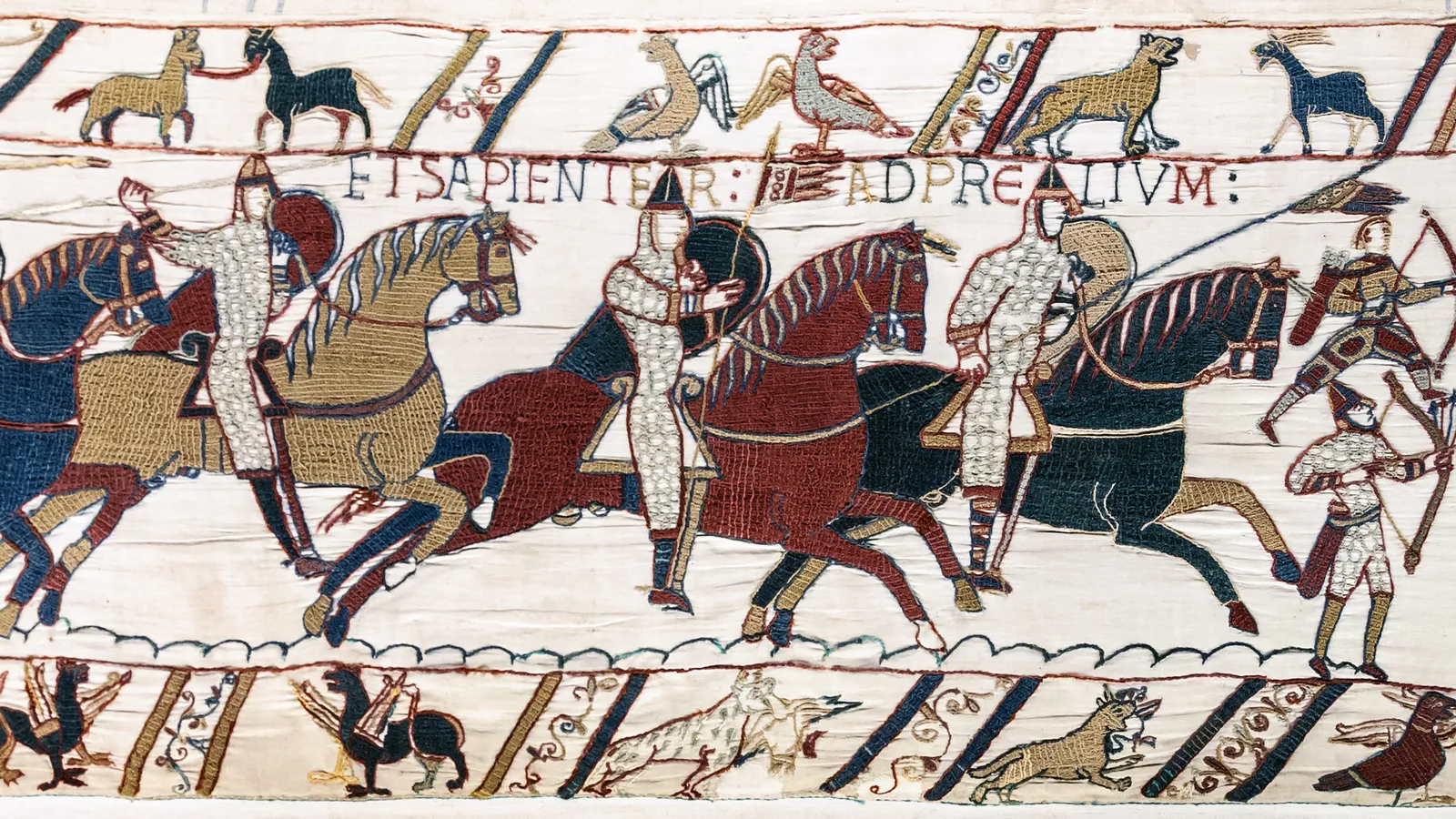
On October 14, 1066, near the English town of Hastings, an invading Norman army led by Duke William of Normandy defeated the forces of King Harold II of England in a single day of fighting that would permanently reshape English history. Fought on a low ridge some seven miles from the coast, the battle ended Anglo-Saxon rule of England, installed a new Norman aristocracy, and set in motion changes to the English language, legal system, and culture whose effects are still visible nearly a thousand years later. Few single days of fighting anywhere in medieval Europe changed as much, as quickly, as this one did.
A Kingdom Without an Heir
The roots of the crisis lay in the childless marriage of King Edward the Confessor, whose death in early January 1066 left the English throne without an obvious successor. Edward had spent years of his youth in exile in Normandy, and that Norman connection would prove decisive to everything that followed. England in the mid-11th century was a wealthy, well-organized kingdom by contemporary European standards, with an effective system of royal government, a functioning currency, and a professional core of household troops—but its throne was, by 1066, claimed by rival candidates with genuinely competing arguments, any one of whom could plausibly assert a right to rule.
Chief among them was Harold Godwinson, Earl of Wessex, the most powerful nobleman in England and, by most accounts, the dying Edward’s own preference on his deathbed. England’s governing council, the Witan, moved quickly to confirm Harold as king the day after Edward died, and he was crowned at Westminster Abbey on January 6, 1066. But two other men believed the throne was theirs. Duke William of Normandy, a cousin of Edward’s, claimed the king had promised him the succession years earlier, and further claimed that Harold—shipwrecked on the Norman coast in 1064 and taken into William’s custody—had personally sworn an oath to support William’s claim to the throne, an oath the Bayeux Tapestry later depicted in vivid detail. Harald Hardrada, the formidable King of Norway, pressed a separate and more tenuous claim, based on an old agreement between earlier English and Norwegian kings, and found an unlikely ally in Harold’s own estranged brother, Tostig Godwinson, who had been driven out of his earldom in Northumbria the previous year and was eager for revenge.
Two Invasions, One Exhausted Army
Harold spent the summer of 1066 watching the English Channel, where William was known to be assembling an invasion fleet, reportedly numbering in the hundreds of ships. William’s preparations were bolstered by a genuine diplomatic coup: he secured the blessing of Pope Alexander II for his invasion, having persuaded Rome that Harold was an oath-breaker and promising reform of the English church—a papal banner is recorded as accompanying the Norman fleet, lending the invasion something of the character of a sanctioned holy enterprise. Unfavorable winds kept William’s ships in port through the late summer, a delay that, as it turned out, mattered enormously to how the campaign eventually unfolded.
While William waited, the threat from the north materialized first. In September 1066, Harald Hardrada’s fleet landed in Yorkshire, and—with Tostig’s help—defeated a hastily assembled English force at the Battle of Fulford on September 20. Harold responded with an extraordinary display of logistics and willpower, marching his army roughly 185 miles from London to Yorkshire in only four days. On September 25, at the Battle of Stamford Bridge, Harold’s army achieved a crushing victory, killing both Harald Hardrada and Tostig and effectively destroying the Norwegian threat in a single afternoon.
It was a major triumph—and a poorly timed one. Just three days later, on September 28, William’s fleet finally caught favorable winds and landed unopposed at Pevensey on England’s south coast, more than 250 miles from where Harold’s victorious but exhausted army stood in Yorkshire. Harold had no real choice but to force-march his army south again, gathering what reinforcements he could along the way, and arrived near Hastings in early October leading troops who had already marched the length of the country and fought a major pitched battle within the space of roughly three weeks.
The Opposing Forces and Commanders
Medieval chroniclers, prone to exaggeration on all sides, offered wildly inflated figures for both armies—English hosts numbering in the hundreds of thousands and Norman fleets in the tens of thousands are routinely dismissed by modern historians as rhetorical flourishes rather than reliable counts. Careful modern estimates instead put both armies at roughly comparable strength, each in the range of 7,000 to 8,000 men, though some historians argue for figures as high as 10,000–12,000 on the Norman side, and English estimates range as widely as 5,000 to 13,000 depending on the source consulted. What is reasonably clear is that neither army held an overwhelming numerical advantage over the other; the battle was decided by composition and tactics rather than sheer weight of numbers.
Harold’s army was built around the housecarls, elite professional troops loyal to the king and his earls, armed with mail, shields, and the fearsome two-handed Dane axe, capable of felling a horse or splitting a shield in a single blow. Around this core fought the fyrd, a levy of free English landowners of varying training and equipment, from well-armed thegns to lightly equipped local militia. Notably, the English army at Hastings fielded no cavalry or archers of its own in any significant number; it fought, almost entirely, as a single dense mass of infantry—a tactical simplicity that had served English kings well against earlier Viking raiders but that would prove a serious liability against William’s more varied order of battle. Alongside Harold at Hastings fought his two younger brothers, Gyrth and Leofwine Godwinson, both of whom would die alongside him before the day was done.
William’s army, by contrast, was a genuinely combined-arms force typical of the emerging Norman military system: heavy infantry, companies of archers and crossbowmen, and—critically—a substantial force of mounted, mailed knights, a battlefield combination the static English shield wall had no real precedent for facing. William himself commanded from close to the front and had two of his own half-brothers in the field with him: Odo, Bishop of Bayeux, shown in the Bayeux Tapestry wielding a mace rather than a bladed weapon, reportedly to observe the medieval clergy’s prohibition on shedding blood, and Robert, Count of Mortain. Both survived the battle and were rewarded with vast English estates after the conquest.
Terrain and the Eve of Battle
Harold chose his ground with evident care. He positioned his army on Senlac Hill, a low ridge running roughly east to west along the road to London, its flanks protected by boggy ground and steep slopes that narrowed the Norman approach and prevented easy encirclement. The English formed a dense shield wall along the ridge’s crest—a defensive formation that had served Anglo-Saxon armies well for generations, presenting an unbroken wall of shields and axes to any attacker foolish enough to charge uphill into it. Whatever advantages Harold’s rapid march had cost him in fresh troops, the position he chose gave his tired army about as strong a defensive stance as the landscape around Hastings could offer.
William, camped a short distance away, had comparatively little choice but to attack; his army was living off a hostile countryside, his supply situation would only worsen the longer he waited, and retreat back across the Channel was not a realistic option after burning some of his own ships, according to at least one chronicle tradition, to remove the temptation. Battle was effectively inevitable by the morning of October 14.
Harold, for his part, has long been debated by historians for choosing to give battle so quickly rather than waiting in London for reinforcements to swell his ranks further. Some have argued he was simply eager to repeat the swift, decisive success he had just achieved at Stamford Bridge; others suggest he could not politically afford to let William’s army range unopposed through his own earldom in Sussex, burning and foraging, without responding. Whatever his reasoning, the decision to meet William quickly, with the army he had rather than the larger one he might eventually assemble, remains one of the most second-guessed choices of the entire campaign.
The Battle Begins
Fighting opened around 9 a.m. on October 14, 1066, with William sending forward his archers and crossbowmen to soften the English line, followed by waves of infantry and then cavalry attempting to break the shield wall by direct assault. The uphill approach blunted much of the Norman advantage; English housecarls, fighting from a static, disciplined formation on high ground, inflicted heavy losses on the attacking infantry and repelled repeated cavalry charges that could gain no real purchase against a solid wall of shields. William of Poitiers, a Norman chaplain who had served in William’s own household and wrote one of the earliest surviving accounts of the campaign, described the English defense in admiring terms:
“The English fought confidently with all their might, striving particularly to prevent a gap being opened by their attackers. They were so tightly packed together that there was hardly room for the slain to fall.” — William of Poitiers, Gesta Guillelmi
That density was both the shield wall’s greatest strength and, as the day wore on, part of its undoing—a formation that tight could absorb enormous punishment from the front, but it depended entirely on every man holding his position, and any section that broke ranks left a gap the rest of the line could not easily close.
At some point in the fighting, a rumor swept through the Norman ranks that William himself had been killed—a moment of real crisis that threatened to unravel the entire invasion in a single afternoon. According to the traditional accounts, William tore off his helmet and rode along his lines bare-headed to prove he was alive, restoring order and momentum to an army on the verge of panic. It was, by most retellings, one of the decisive personal interventions of the battle.
The Feigned Retreats
Unable to break the shield wall through direct assault, the Norman forces began using—whether by design or by an improvisation later formalized into tactics—a series of feigned retreats, pulling back from the English line as if in genuine flight. Sections of the fyrd, less disciplined and more eager for a decisive pursuit than the professional housecarls around Harold, broke ranks to chase the retreating Normans down the slope. Once in the open, isolated from the protective mass of the shield wall, these English detachments were exposed to Norman cavalry, which wheeled and cut them down in the open ground below the ridge. Whether the retreats were a deliberate stratagem from the outset or a battlefield accident that Norman commanders learned to exploit and repeat is still debated by historians, but the tactical effect is not in dispute: each feigned retreat thinned the English line and eroded the cohesion that had made the shield wall so effective in the first place.
The Death of Harold and the Collapse of the Shield Wall
By late afternoon, hours of fighting, mounting casualties, and the repeated feigned retreats had worn the English position down. At some point in this final phase of the battle, King Harold was killed. The most famous depiction of his death, in the Bayeux Tapestry, shows a figure struck in the eye by an arrow beneath the Latin caption “Hic Harold Rex Interfectus Est”—“Here King Harold is killed”—an image that has shaped popular memory of the battle for centuries. Modern historians are considerably less certain about the exact circumstances: some argue the tapestry’s arrow-struck figure is not actually meant to be Harold at all, and that the true depiction of his death lies in an adjacent figure being cut down by a mounted knight, or that both images together represent a single, composite account of his death rather than two different men. What is agreed upon is that Harold died on the field, along with his brothers Gyrth and Leofwine, and that his death—whatever its exact manner—broke the will of the remaining English defenders to continue fighting in an organized way.
With the king dead and the royal standard fallen, the shield wall disintegrated. Some English troops fled the field outright; others made a final, desperate stand around fragments of their broken line. The Anglo-Saxon Chronicle—compiled by English monks and the only surviving contemporary English-language account of the battle—recorded the outcome in a single grim entry for the year, written not long after the events it describes:
“Nevertheless the king fought very hard against him with those men who wanted to support him, and there was a great slaughter on either side. There were killed King Harold, and Earl Leofwine his brother, and Earl Gyrth his brother, and many good men. And the French had possession of the place of slaughter, just as God granted them because of the people’s sins.” — The Anglo-Saxon Chronicle (Worcester manuscript), entry for 1066
Later medieval accounts, most fully developed a century or more after the battle, describe a dramatic postscript to the fighting known as the Malfosse incident, in which pursuing Norman horsemen, chasing fleeing English troops in the fading light, blundered into a hidden ditch or ravine and suffered further losses of their own—a footnote to the day’s fighting that later chroniclers seized on as a small, bitter consolation for the defeated English.
The Bayeux Tapestry as a Historical Source
Much of what the modern public “sees” when it pictures the Battle of Hastings comes from a single, extraordinary artifact: the Bayeux Tapestry, an embroidered (not woven, despite its name) linen frieze over 68 meters long, depicting the events of 1066 from the death of Edward the Confessor through William’s coronation in a continuous visual narrative stitched in colored wool. Most historians believe it was commissioned in the 1070s by Odo, Bishop of Bayeux, William’s own half-brother and a participant in the battle, likely to decorate the nave of Bayeux Cathedral, which was consecrated in 1077—placing its creation within living memory of the events it depicts, probably produced by English embroiderers working under Norman direction.
That closeness to the events is precisely what makes the tapestry both invaluable and slippery as a historical source. It is unmatched as a visual record of 11th-century arms, armor, ships, and battlefield tactics, and its inscriptions provide some of the only near-contemporary labels for specific moments in the fighting. But it was created for a patron on the winning side, and its narrative choices—what to include, what to omit, whom to depict sympathetically—reflect a Norman perspective on a conquest that had displaced an entire English ruling class, Odo’s own family included among the beneficiaries. Historians treat it as an essential source that nonetheless has to be read critically, alongside written chronicles like William of Poitiers’s Gesta Guillelmi and the Anglo-Saxon Chronicle, rather than as a neutral photographic record of the battle.
Quick Facts
- Date: October 14, 1066
- Location: Near Hastings, East Sussex, England (Senlac Hill / Battle, East Sussex)
- Commanders: Harold II (England) vs. William, Duke of Normandy
- Approximate forces: Roughly 7,000–8,000 men on each side, by most modern estimates
- Outcome: Decisive Norman victory; Harold II killed
- Aftermath: William crowned King of England on December 25, 1066
The Aftermath: A Conquered England
William’s victory at Hastings did not immediately secure all of England—pockets of resistance continued for years, met with brutal campaigns such as the “Harrying of the North” in 1069–70, in which Norman forces devastated large swaths of Yorkshire and the surrounding region to crush rebellion, a campaign later chroniclers described in terms of famine and mass death across the countryside. But the battle itself broke the back of Anglo-Saxon military power and cleared William’s path to the throne. He marched on London, secured the submission of the city’s remaining nobles and clergy, and was crowned King of England at Westminster Abbey on Christmas Day, 1066, becoming William the Conqueror.
The Norman Conquest that followed transformed England profoundly. A new French-speaking aristocracy replaced most of the Anglo-Saxon nobility within a generation—by most estimates, only a small handful of major English landholders retained their estates by the end of William’s reign—and Norman castles, first simple earth-and-timber motte-and-bailey structures thrown up within weeks of the conquest, later replaced by stone keeps such as the Tower of London, were built across the country to secure control of a resentful population. The feudal system William imported from Normandy reorganized English landholding around a strict hierarchy of military obligation owed to the crown, replacing the somewhat looser Anglo-Saxon system of local lordship that had preceded it.
The English language itself was permanently reshaped. Old English, the Germanic language spoken across the kingdom before 1066, absorbed thousands of Norman French words over the following centuries as the new aristocracy’s language filtered down through law, government, cuisine, and culture—modern English pairs like “cow” and “beef,” or “sheep” and “mutton,” are frequently cited as linguistic fossils of this Conquest-era split between the English-speaking peasants who raised livestock and the French-speaking nobility who ate it at table. The Domesday Book, commissioned by William in 1086, remains one of history’s most remarkable administrative surveys, cataloguing the land, livestock, and resources of his new kingdom in extraordinary, village-by-village detail—a document historians still mine for information about 11th-century England nearly a thousand years later.
William also founded Battle Abbey on the site of the fighting, reportedly with its high altar positioned at the very spot where Harold was believed to have fallen, a lasting physical monument to the battle that still stands, now maintained by English Heritage, on the ground where it was fought.
Why Hastings Still Matters
Few single battles have reshaped a nation’s language, law, and ruling class as thoroughly as Hastings did for England. Militarily, the battle is often studied as an example of how combined-arms tactics—infantry, archers, and cavalry working together, along with disciplined feigned retreats—could overcome a well-positioned but less flexible defensive force. It also stands as one of the last successful invasions of England by a foreign power, a distinction that has lent it an outsized place in English national memory for nearly a millennium.
Beyond the battlefield, Hastings is remembered as the hinge on which an entire society turned. Anglo-Saxon England, with its own distinct legal traditions, aristocracy, and written vernacular literature, was largely swept away within a generation and replaced by a Norman-French ruling culture whose institutions—feudal landholding, a centralized system of royal justice, and eventually a hybridized English language absorbing enormous amounts of French and Latin vocabulary—shaped the country’s development for centuries afterward. It is difficult to identify another single day of fighting in medieval European history with a comparably durable legacy.
William’s grip on his new kingdom was secured as much by administration as by the sword. Facing rebellions in the years after Hastings, he and his followers built hundreds of motte-and-bailey castles—earthwork mounds topped with timber, later stone, fortifications—across England at a pace the country had never seen, giving the new Norman aristocracy fortified strongpoints from which to control the surrounding countryside. In 1085, twenty years after the invasion, William commissioned the Domesday Book, an extraordinarily detailed survey of landholding, population, and resources across most of England, compiled so thoroughly and so quickly that its findings were treated by later generations as close to final legal authority, giving it the nickname “Domesday” after the biblical Last Judgment. Together, the castles and the survey illustrate how completely the conquest reordered not just who ruled England but how the country was governed, taxed, and recorded.
The battlefield itself is preserved today at Battle Abbey in East Sussex, built, according to tradition recorded by later medieval chroniclers, on William’s orders with its high altar positioned on the spot where Harold fell—a penance for the bloodshed as much as a monument to victory. The abbey and battlefield are maintained by English Heritage and remain a popular destination for visitors tracing the last successful invasion of England by a foreign power.
Frequently Asked Questions
Why did Harold have three rival claimants to deal with in 1066?
Edward the Confessor died without a son to succeed him, leaving the throne open to interpretation. Harold Godwinson had the backing of the English Witan and, by most accounts, Edward’s own deathbed preference. William of Normandy claimed an earlier promise from Edward plus an oath of support from Harold himself. Harald Hardrada of Norway based his claim on an older agreement between former English and Norwegian kings. All three had genuine, if not equally strong, arguments by the standards of the time.
Why was Harold’s army so exhausted by the time it reached Hastings?
Harold had just force-marched his army roughly 185 miles north to fight and win the Battle of Stamford Bridge against Harald Hardrada on September 25. Only days later, learning that William had landed in the south, he marched the same army more than 250 miles back south to confront the Norman invasion, arriving at Hastings with troops who had covered an enormous distance and fought a major battle within about three weeks.
How did William win if the armies were roughly the same size?
Historians generally credit a combination of factors: William’s combined use of infantry, archers, and cavalry against a purely infantry-based English defense; the Norman use of feigned retreats to draw disciplined English troops out of their strong defensive position; and the death of Harold late in the battle, which caused the English line to collapse. Harold’s chosen defensive position on Senlac Hill was actually very strong, and the battle remained close for hours before these factors turned it decisively.
Is the Bayeux Tapestry an accurate historical record?
It’s the single most detailed contemporary visual source for the battle, created within a few decades of the event, likely commissioned by Bishop Odo of Bayeux. But it was made by and for the winning side, and historians treat its narrative choices—including its famous depiction of Harold’s death—as a Norman perspective on events rather than a neutral photographic record. Even the identity of the figure struck by an arrow in the tapestry’s death scene is disputed among specialists.
What happened to Harold’s family and the old English nobility after the battle?
Most of the senior Anglo-Saxon nobility was killed at Hastings or dispossessed in the years that followed, as William redistributed land to his Norman followers to secure his new kingdom. Resistance continued in pockets for several years, most seriously in the north, and was suppressed with considerable brutality during the Harrying of the North in 1069–70.
Why is it called the Battle of Hastings if it wasn’t fought in Hastings itself?
The fighting actually took place about seven miles northwest of the town of Hastings, on a ridge that came to be called Senlac Hill, near the site where the town of Battle, East Sussex now stands. Hastings was the nearest significant landmark and the site of William’s coastal camp, so it gave the battle its name in the chronicles that recorded it.
Did William really have the pope’s backing for the invasion?
The Bayeux Tapestry depicts a banner among William’s forces that is traditionally identified with a papal banner sent by Pope Alexander II, and several near-contemporary sources describe the pope endorsing William’s cause on the grounds that Harold had broken a sacred oath. Some modern historians have questioned exactly how formal or public this endorsement really was, since the earliest surviving sources are not entirely consistent on the point, but the broad claim that William secured some degree of papal sympathy before he sailed is widely accepted.
What happened to William’s rivals for the throne?
Harald Hardrada was killed at the Battle of Stamford Bridge on September 25, 1066, along with Tostig Godwinson, ending the Norwegian claim before William had even landed. Harold Godwinson, the crowned English king, was killed at Hastings less than three weeks later, along with his brothers Gyrth and Leofwine, leaving William as the last claimant standing.
Recommended Reading
The Bayeux Tapestry itself remains the most vivid contemporary depiction of the battle, while modern accounts such as Marc Morris’s The Norman Conquest offer a detailed narrative history of the campaign and its lasting consequences. David Howarth’s 1066: The Year of the Conquest remains a widely read popular account of the events surrounding the battle, and M.K. Lawson’s The Battle of Hastings 1066 offers a more specialized, historiographically careful examination of the fighting itself and the many surviving—and often conflicting—medieval sources historians must weigh against one another.
Read Next

August 8, 2026
Sun Tzu's The Art of War: Key Principles Explained
A breakdown of the core strategic principles in Sun Tzu's The Art of War, and why this 2,500-year-old text still shapes military and business strategy.
August 8, 2026
The Fall of the Roman Empire: How the World's Superpower Collapsed
Explore the military and political decline that led to the fall of the Western Roman Empire in 476 AD, from civil wars to barbarian invasions.
August 8, 2026
D-Day: Inside the Normandy Invasion of June 6, 1944
A look at the planning, landings, and lasting impact of the D-Day invasion of Normandy, the largest seaborne invasion in history.