Military History
The Fall of the Roman Empire: How the World's Superpower Collapsed
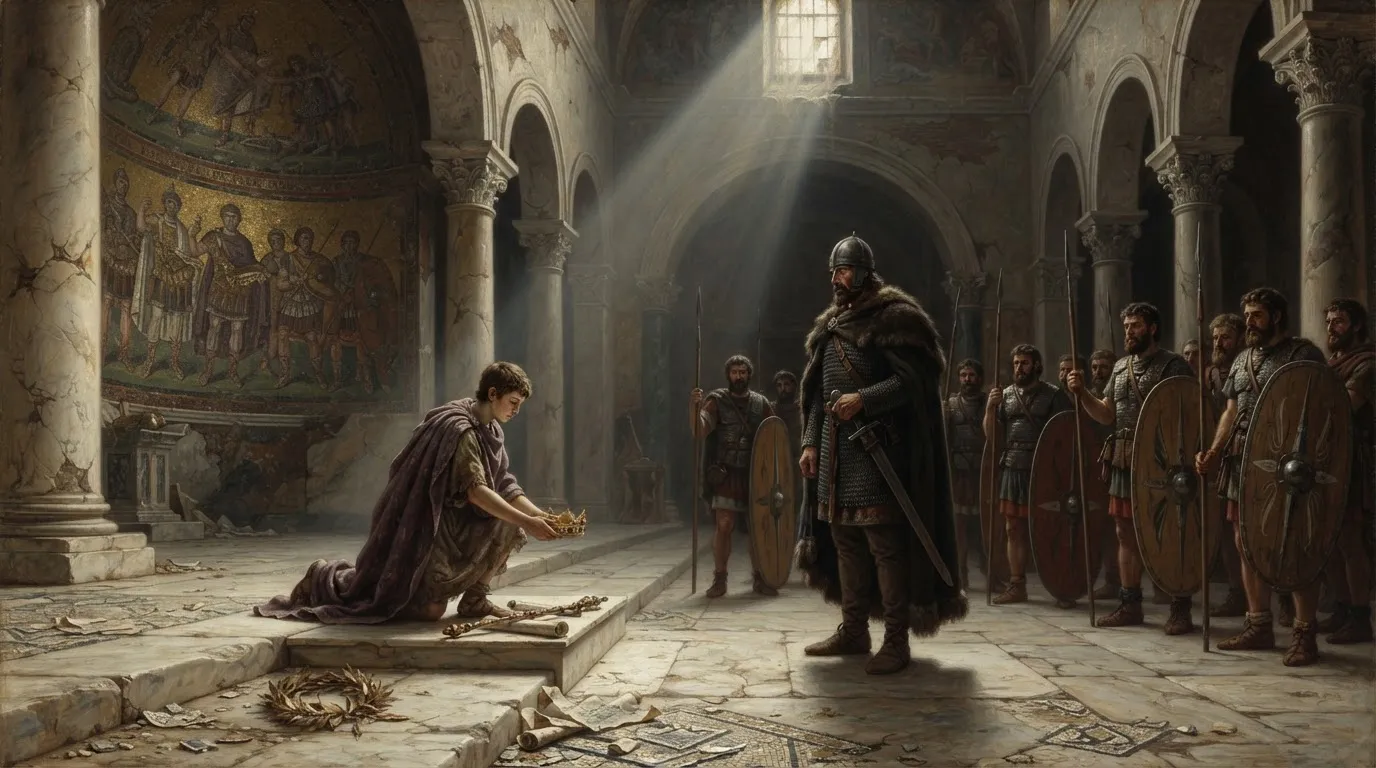
For nearly five centuries, Rome dominated the Mediterranean world through the strength of its legions. Yet by 476 AD, the Western Roman Empire had ceased to exist as a political entity, its last emperor deposed by a Germanic chieftain. The fall of Rome was not a single event but the end point of a long military and institutional decline—one shaped as much by internal decay as by the “barbarian” invasions that finally delivered the fatal blows.
No single battle, betrayal, or bad emperor caused an empire that had stood for centuries to unravel. Instead, the fall of Rome resulted from the accumulation of pressures across two centuries: civil wars that hollowed out the treasury, a military system that came to depend on the very peoples it once conquered, a currency debased into near worthlessness, and frontiers that finally gave way under a wave of migrations set in motion by events thousands of miles to the east. Historians still argue, sometimes fiercely, over which of these threads mattered most. What is not in dispute is that the empire’s end, when it finally came in the West, arrived not with the bang its earlier defeats might have predicted, but with something closer to a shrug.
A Slow Unraveling, Not a Single Collapse
It’s tempting to picture Rome’s fall as a dramatic siege, and the Sack of Rome by Alaric’s Visigoths in 410 AD is often treated as the symbolic moment the unthinkable happened—the Eternal City, unconquered by a foreign army for nearly 800 years, was plundered. But by 410, Rome’s political capital had already shifted to Ravenna, and the empire had been absorbing shocks for decades. The city’s sack was a devastating blow to Roman prestige, but the empire limped on for another 66 years.
The roots of decline stretched back further. Chronic civil wars during the third-century Crisis of the Third Century (roughly 235–284 AD) saw dozens of claimants fight for the throne, hollowing out the treasury and the professional army alike. This period saw the empire briefly fracture into three competing states, its currency collapse through relentless debasement, and plague and invasion strike simultaneously with civil war. Emperor Diocletian’s reforms at the end of that century—splitting the empire into eastern and western halves for administrative efficiency, and eventually establishing a four-ruler power-sharing system known as the Tetrarchy—stabilized things temporarily, but the division also meant the wealthier, more defensible Eastern Empire increasingly looked after its own interests, leaving the West to fend for itself. The historian Edward Gibbon, writing in the eighteenth century, framed the entire arc of Roman history in terms that still shape how many people think about the empire’s trajectory:
“The decline of Rome was the natural and inevitable effect of immoderate greatness. Prosperity ripened the principle of decay; the causes of destruction multiplied with the extent of conquest.” — Edward Gibbon, The History of the Decline and Fall of the Roman Empire, Chapter XXXVIII
Military Overextension and a Changing Army
Rome’s military system, once built on disciplined citizen-legionaries, changed dramatically over the fourth and fifth centuries. Manpower shortages and the sheer cost of maintaining a professional standing army pushed Rome to rely increasingly on foederati—allied or mercenary troops recruited from the same Germanic peoples the empire had once fought as enemies. These troops were often loyal to their own commanders first, and the practice blurred the line between “Roman” and “barbarian” forces in ways that weakened central authority. By the fifth century, some of the most powerful men in the Western Empire—figures like the general Stilicho, himself of part-Vandal ancestry, and later Ricimer, who effectively controlled a succession of puppet emperors—were career soldiers of Germanic origin who commanded loyalty from foederati troops the state itself could no longer fully control.
At the same time, pressure on Rome’s frontiers intensified. The migration of the Huns into Europe in the late fourth century displaced Gothic tribes, pushing them into Roman territory as refugees and, eventually, as invaders. In 376 AD, tens of thousands of Goths, fleeing the advancing Huns, petitioned Emperor Valens for permission to cross the Danube and settle within imperial territory. Roman mismanagement of the resulting refugee crisis—exploitation and mistreatment by corrupt local officials—turned desperate migrants into an armed and furious enemy within two years.
Rome’s catastrophic defeat at the Battle of Adrianople in 378 AD, where a Gothic army destroyed a Roman field army and killed the Eastern Emperor Valens, is often cited as the moment the empire’s military invincibility was shattered for good. Ancient sources describe the scale of the disaster in stark terms: the contemporary historian Ammianus Marcellinus, who wrote one of the fullest surviving accounts of the battle, compared it to the worst catastrophe in Rome’s long military history.
“Never, except at the battle of Cannae, had there been so destructive a slaughter recorded in our history.” — Ammianus Marcellinus, Res Gestae, Book 31
Modern historians debate the precise casualty figures at Adrianople—ancient claims that roughly two-thirds of the Roman force was destroyed are difficult to verify with exact numbers, and estimates of the dead range considerably depending on the source—but there is little dispute that the battle wiped out a substantial Eastern field army, along with much of its senior officer corps, and that a Roman emperor dying in battle against Rome’s own subjects-turned-enemies was itself an almost unprecedented psychological blow.
Key Figures in Rome’s Long Decline
Rome’s final two centuries produced a cast of emperors, generals, and adversaries whose individual decisions shaped how the collapse unfolded, even if none of them could have reversed it alone. Diocletian (reigned 284–305 AD) pulled the empire back from the brink of the third-century crisis through sweeping reforms: he divided supreme authority among four co-rulers in the Tetrarchy, reorganized the army and tax system, and attempted, with only partial and temporary success, to control runaway inflation through fixed wage and price controls. Constantine I (reigned 306–337 AD), who reunified the empire under his own rule after a period of renewed civil war, moved the imperial capital eastward to a new city on the Bosphorus that would bear his name—Constantinople—a decision that permanently shifted the empire’s center of gravity and ensured the eastern provinces would outlast the western ones.
On the military side, the general Flavius Aetius, sometimes called “the last of the Romans” by later historians for his role in checking Attila, dominated Western Roman politics for two decades in the mid-fifth century, holding the crumbling western frontiers together through a combination of diplomacy, alliance-building with Gothic and other foederati forces, and outright military skill—only to be murdered in 454 AD by Emperor Valentinian III, who reportedly feared Aetius’s growing power. Valentinian was himself assassinated the following year by supporters of Aetius, a cycle of political violence that further destabilized the Western court in the years immediately before Rome’s second sacking. Earlier, the general Stilicho, of part-Vandal descent, had served as the power behind the throne for the Western Empire in the years around 400 AD, defending Italy from Alaric’s Goths on several occasions before his own execution in 408 AD on charges of treason—a decision that, by removing one of the West’s few remaining capable defenders, arguably opened the door to Alaric’s successful sack of Rome just two years later.
The Political and Economic Strains Beneath the Surface
Military disasters alone do not explain an empire’s collapse; they expose weaknesses that were often already present. Rome’s currency had been debased repeatedly since the third century, as successive emperors reduced the silver content of coinage to pay for wars and donatives to the army, fueling inflation that eroded trust in Roman money and complicated tax collection across the provinces. The tax burden on agricultural land, needed to fund an army that had grown larger and more expensive even as it became less reliable, fell increasingly on a shrinking class of landowners and tenant farmers, some of whom found harsh imperial taxation scarcely more bearable than the barbarian raids the taxes were meant to fund defenses against.
Succession crises compounded the problem. Rome had no reliable constitutional mechanism for transferring imperial power, and the office of emperor was won as often through military coup, assassination, or civil war as through orderly succession. Between 235 and 285 AD alone, the empire cycled through more than twenty legitimate and rival emperors, the vast majority of whom died violently. Even after Diocletian’s reforms imposed temporary order, the pattern of usurpation and civil war persisted intermittently through the fourth and fifth centuries, diverting military resources that might otherwise have defended the frontiers into internal power struggles between rival Roman claimants.
The Final Decades: Losing the West
By the mid-fifth century, the Western Empire controlled only a fraction of its former territory. Vandals, under their king Gaiseric (sometimes rendered Genseric), had crossed from Spain into North Africa in the 420s and seized the region by 439, capturing Carthage and, critically, cutting off the grain shipments that had long fed the city of Rome and much of Italy—a devastating economic and strategic blow delivered by a single, relatively small barbarian kingdom.
Attila’s Huns, having built a vast confederation of subject peoples across central Europe, turned west into Gaul in 451, where they were checked—not decisively defeated, but stopped—by a coalition of Roman and Visigothic forces under the Roman general Flavius Aetius and the Visigothic king Theodoric I at the Battle of the Catalaunian Plains, fought near modern-day Châlons-en-Champagne. Theodoric was killed in the fighting, and the battle is often described by historians as the last significant military achievement the Western Roman Empire would ever manage, even though it required an alliance with the very Gothic peoples Rome had fought for generations. Attila invaded Italy the following year before withdrawing, and his death in 453 AD fractured the Hunnic confederation into rival successor groups, removing one major threat even as others intensified.
Rome itself was sacked a second time in 455 AD, this time by the Vandals under Gaiseric, following the assassination of Emperor Valentinian III and a political crisis over his succession. Pope Leo I, who had reportedly helped persuade Attila to withdraw from Italy three years earlier, again negotiated directly with an invading leader, securing an agreement from Gaiseric to spare the city from mass killing and burning in exchange for two weeks of systematic, unopposed looting—a sack ancient sources describe as more thorough in its plunder, if less violent in its destruction, than Alaric’s sack 45 years before. Roman power in the West by this point rested less on the authority of the emperor in Ravenna than on the personal loyalty commanded by powerful generals of barbarian origin, who increasingly made and unmade emperors as it suited their own interests.
The Legions: How Rome’s Army Transformed
The army that lost at Adrianople in 378 bore only a partial resemblance to the legions that had conquered the Mediterranean world under Julius Caesar and Augustus. The classical legion of the early empire—a self-contained unit of roughly 5,000 heavy infantry, Roman citizens serving a fixed term of enlistment, drilled to a standard of discipline that outmatched most opponents it faced—had by the fourth century given way to a more fragmented and varied military structure. Emperors from Diocletian onward expanded the army’s overall size while dividing it into mobile field armies, the comitatenses, held in reserve behind the frontiers, and lower-quality static frontier garrison troops, the limitanei, whose training and equipment increasingly lagged behind their predecessors.
Recruiting enough Roman citizens willing to serve in this expanded, more geographically dispersed army proved increasingly difficult, particularly as landowners resisted losing agricultural labor to military conscription and as the financial burden of maintaining the army strained an already stretched tax base. The resulting reliance on foederati—entire allied barbarian groups serving under their own leaders in exchange for land, payment, or legal status within the empire—was in some ways a pragmatic solution to a genuine manpower shortage, but it came at the cost of long-term cohesion. By the early fifth century, a substantial share of the soldiers defending Roman territory in the West had closer cultural and personal ties to Gothic, Vandal, or other Germanic leaders than to the distant imperial court in Ravenna, a structural weakness that became catastrophic once those leaders’ interests diverged from Rome’s.
Society and Economy Under Strain
Behind the military and political drama, ordinary life across the Western Empire’s provinces reflected the same gradual unraveling. Archaeological evidence from Britain, Gaul, and other western provinces shows a marked decline in the quality and distribution of manufactured goods, coinage, and long-distance trade during the fifth century, consistent with a broader collapse of the integrated economic system that Roman rule had maintained for centuries. Cities in many western provinces shrank, and some of the specialized economic infrastructure that had defined Roman provincial life—professional pottery production, widespread use of minted coin for everyday transactions, well-maintained road networks—deteriorated or disappeared within a generation or two of imperial collapse in a given region, even as other institutions, particularly the Christian Church, increasingly stepped into administrative and social roles the imperial state could no longer fill.
This decline was neither instant nor uniform. Some regions, particularly parts of southern Gaul and Italy, retained recognizably Roman administrative and cultural patterns for generations after 476 under their new Gothic and other Germanic rulers, who in many cases governed through existing Roman legal and administrative structures rather than replacing them outright. The historian Bryan Ward-Perkins has argued that this gradualist picture can obscure just how severe the economic contraction actually was in many regions, pointing to archaeological evidence of a genuine drop in material living standards across large parts of the former Western Empire—a corrective to interpretations that frame the transition from Roman to post-Roman Europe as a smooth, largely peaceful transformation rather than a genuine collapse with real human costs.
The End Came Quietly
The end came quietly compared to the drama of earlier sackings. In 476 AD, the Germanic general Odoacer, commander of the foederati troops in Italy, deposed the teenage emperor Romulus Augustulus after the boy’s father, Orestes, refused Odoacer’s soldiers’ demands for land grants in Italy. Rather than install another puppet emperor, as generations of powerful generals before him had done, Odoacer sent the imperial regalia to Constantinople and declared himself ruler of Italy under the nominal authority of the Eastern Emperor Zeno—a decision that formally ended the line of Western Roman emperors after Romulus Augustulus, an emperor whose very name, combining Rome’s legendary founder with a diminutive form of Augustus, its first emperor, later struck historians as an almost poetic bookend to the story.
The question of who, precisely, was the “last” Western Roman emperor is itself a matter of historical nuance. Romulus Augustulus is the traditional answer, and the one most often repeated, but the Eastern court in Constantinople never formally recognized his father Orestes’s decision to depose the previous emperor, Julius Nepos, who had fled to Dalmatia in 475 and continued to be recognized as the legitimate Western emperor by the East until his own assassination in 480. By that narrower legal reading, Nepos, not Romulus Augustulus, was the last emperor to hold genuine recognition—a detail that underscores just how blurred and contested the empire’s final years had become, even at the level of who actually held legitimate authority.
Contemporaries barely registered 476 as a historic turning point. The Eastern Roman Empire, later known as the Byzantine Empire, continued for nearly another thousand years, and many at the time—and many historians since—considered it the legitimate continuation of Rome rather than a separate entity. Life in much of the former Western Empire did not change overnight; Roman law, administrative practices, and the Latin language persisted for generations under the new Germanic kingdoms that replaced imperial rule, even as those kingdoms increasingly went their own separate ways.
Quick Facts
- Traditional end date: 476 AD (deposition of Romulus Augustulus)
- Key military defeat: Battle of Adrianople, 378 AD
- Major sackings of Rome: 410 AD (Visigoths under Alaric), 455 AD (Vandals under Gaiseric)
- Contributing factors: Civil wars, economic strain, reliance on foederati troops, frontier pressure from migrating peoples
Timeline of Key Events
- 235–284 AD: The Crisis of the Third Century, marked by civil war, invasion, and economic collapse
- 284–305 AD: Emperor Diocletian institutes sweeping reforms, including the division of imperial administration
- 376 AD: Gothic refugees fleeing the Huns are permitted to cross the Danube into Roman territory
- 378 AD: The Roman army is destroyed and Emperor Valens killed at the Battle of Adrianople
- 410 AD: Alaric and the Visigoths sack Rome
- 439 AD: The Vandals under Gaiseric capture Carthage and control North Africa’s grain supply
- 451 AD: Attila’s Huns are checked at the Battle of the Catalaunian Plains
- 453 AD: Attila dies; the Hunnic confederation fractures
- 455 AD: The Vandals sack Rome a second time
- 476 AD: Odoacer deposes Romulus Augustulus, ending the line of Western Roman emperors
- c. 1453 AD: The Eastern Roman (Byzantine) Empire finally falls to the Ottoman Turks
Lessons from Rome’s Decline
Military historians continue to debate how much weight to give any single cause—economic strain, political instability, army composition, or external invasion—but most agree the fall of Rome illustrates how a superpower can erode from within even as it appears outwardly dominant. The empire’s failure to reform its finances, integrate its frontier allies, and maintain stable succession created vulnerabilities that persistent external pressure eventually exploited. The historian Peter Heather, among the most influential modern voices on the subject, has argued for restoring greater weight to external pressure—particularly the disruptive effects of Hunnic expansion on Rome’s Germanic neighbors—as a genuine and largely unavoidable cause of collapse, pushing back against interpretations that treat the fall almost entirely as a story of internal Roman failure.
Other historians, following threads first laid out by Gibbon and developed by generations of scholars since, place more emphasis on internal institutional decay: a tax system that alienated the populations it was meant to protect, a military increasingly disconnected from civilian Roman identity, and a political culture in which usurpation had become almost a normal path to power. Both camps agree, broadly, that no single cause is sufficient on its own, and that the fall of Rome is best understood as the product of internal fragility meeting sustained external pressure at the worst possible moments—a pattern that has made the empire’s collapse a recurring reference point for later thinkers, and later empires, examining the durability of their own institutions.
The Byzantine Continuation
It is worth emphasizing, since the phrase “fall of Rome” so often implies a total ending, that Roman government, law, and identity did not disappear in 476—they simply contracted to the empire’s eastern half. The Eastern Roman Empire, centered on Constantinople and commonly called the Byzantine Empire by later historians (its own inhabitants continued to call themselves Romans throughout its history), preserved Roman law, administrative traditions, and imperial continuity for centuries after the West’s political collapse. Emperor Justinian I, ruling from Constantinople in the sixth century, even temporarily reconquered large portions of the former Western Empire, including Italy and North Africa, though these gains proved difficult to hold permanently. The Eastern Empire would not fall until Constantinople was captured by the Ottoman Turks in 1453, nearly a thousand years after the West’s last emperor was quietly deposed—a reminder that “the fall of Rome” describes the end of the Western Empire specifically, not the disappearance of Roman civilization as a whole.
Was the Fall of Rome Inevitable?
Ancient and modern observers alike have been drawn to the question of whether Rome’s collapse could have been avoided, and the honest answer is that historians remain divided. Some point to specific decisions—Valens’s mishandling of the Gothic refugee crisis before Adrianople, Stilicho’s execution in 408, Aetius’s murder in 454—as moments where different choices might have preserved the Western Empire in some form for longer, even if not indefinitely. Others argue that the structural pressures were simply too great by the fourth century: an economy that could not indefinitely fund an army large enough to hold thousands of miles of frontier, a political system with no reliable mechanism for peaceful succession, and a wave of Eurasian migration set in motion by the Huns that would have tested any pre-modern state’s capacity to absorb newcomers and defend its borders simultaneously.
What both camps generally agree on is that the fall of the Western Empire was a process measurable in decades, not days, and that the empire’s remarkable durability for so long—nearly five centuries from Augustus to Romulus Augustulus—makes its eventual collapse less surprising than the fact it did not happen sooner. Gibbon himself, for all the moralizing tone that later historians have criticized in his work, captured this point plainly when he suggested that the real historical puzzle was not why Rome fell, but why an empire built on such an “immoderate” scale of conquest had managed to hold together as long as it did.
Frequently Asked Questions
Did Rome “fall” in a single moment?
No. The traditional date of 476 AD, when Odoacer deposed Romulus Augustulus, marks the end of the line of Western Roman emperors, but the empire had been losing territory, revenue, and military strength for decades before that point, and Roman institutions and culture persisted in various forms for generations afterward. Most historians treat 476 as a convenient symbolic marker rather than a single decisive collapse.
What caused the fall of the Western Roman Empire?
Historians generally point to a combination of factors rather than a single cause: chronic civil wars and unstable imperial succession, a debased currency and strained tax system, a military that came to depend heavily on foederati troops of Germanic origin, and intensifying pressure on the frontiers from migrating peoples displaced by the Huns. The relative weight given to internal decay versus external invasion remains a genuine and ongoing scholarly debate.
Did the Roman Empire actually end in 476 AD?
Only the Western Roman Empire ended in 476. The Eastern Roman Empire, later called the Byzantine Empire, continued to exist, with its own emperors, army, and administration centered on Constantinople, until the city fell to the Ottoman Turks in 1453—nearly a thousand years later. Many Byzantines considered themselves simply “Romans” throughout that entire period.
Who were the “barbarians” who conquered Rome?
The term, used by Romans themselves to describe peoples outside Greco-Roman civilization, referred mainly to various Germanic groups—Visigoths, Vandals, Ostrogoths, and others—along with the Huns, a nomadic confederation from Central Asia whose westward migration set off much of the pressure on Rome’s frontiers in the first place. Many of these groups had extensive prior contact with Rome through trade, treaty, and military service before their invasions, and were not the culturally isolated outsiders the term sometimes implies.
How does the Battle of Adrianople relate to Rome’s fall?
The Battle of Adrianople in 378 AD, in which a Gothic army destroyed a Roman field army and killed Emperor Valens, is often cited as the moment Rome’s aura of military invincibility was shattered. It did not by itself cause the empire’s collapse a century later, but it marked a turning point after which Rome increasingly had to negotiate with, rather than simply defeat, the peoples on its borders.
Was there a “last Roman emperor”?
Romulus Augustulus, deposed in 476 AD, is traditionally called the last Western Roman emperor, though he was a teenager with little real power, installed by his father as a figurehead. Some historians instead point to Julius Nepos, the previous emperor recognized by Constantinople, who continued to claim the title from Dalmatia until his death in 480, as arguably the last legitimate holder of the office in a strict legal sense.
Recommended Reading
- Edward Gibbon, The History of the Decline and Fall of the Roman Empire
- Peter Heather, The Fall of the Roman Empire: A New History of Rome and the Barbarians
- Bryan Ward-Perkins, The Fall of Rome and the End of Civilization
- Adrian Goldsworthy, How Rome Fell: Death of a Superpower
- Chris Wickham, The Inheritance of Rome: Illuminating the Dark Ages, 400–1000
Read Next
August 8, 2026
D-Day: Inside the Normandy Invasion of June 6, 1944
A look at the planning, landings, and lasting impact of the D-Day invasion of Normandy, the largest seaborne invasion in history.
August 8, 2026
The Battle of Thermopylae: How 300 Spartans Held the Line
How a small Greek force held off the Persian army at Thermopylae in 480 BC, and why the last stand of the 300 Spartans still resonates today.
August 23, 2026
The Battle of Borodino: Napoleon's Bloodiest Day in Russia
Napoleon's bloodiest day: inside the 1812 Battle of Borodino, the brutal fight for the flèches and Great Redoubt, and the road to Moscow's fall and ruin.