Military History
The Battle of Thermopylae: How 300 Spartans Held the Line
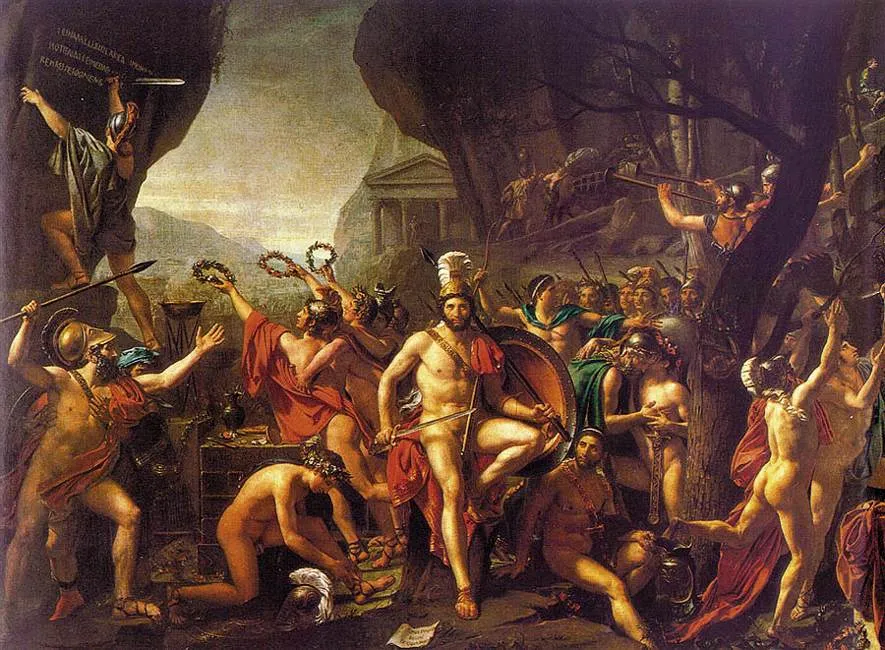
In August of 480 BC, a narrow coastal pass in central Greece became the setting for one of the most studied last stands in military history. For three days, a small Greek force—famously remembered as “the 300”—blocked the advance of the largest army the ancient world had ever assembled. The Battle of Thermopylae did not save Greece by itself, but it bought time, proved that the Persian Empire could be resisted, and gave Western military thought a permanent case study in the power of terrain, discipline, and morale.
The pass itself gave the battle its name. Thermopylae means “Hot Gates,” a reference to the sulfur springs that bubbled near the cliffs where Greek and Persian soldiers would soon meet in some of the most brutal close-quarters fighting of the ancient world. What happened there over three days in the late summer of 480 BC has been retold, mythologized, and occasionally distorted for twenty-five centuries. Stripped of embellishment, the historical record—drawn primarily from the Greek historian Herodotus, writing roughly fifty years after the event—still describes an extraordinary feat of arms: a vastly outnumbered force holding a superpower’s army at bay through sheer positioning and discipline, and a rearguard that chose annihilation over retreat.
The Road to War: Persia and Greece Before Thermopylae
To understand why a few thousand Greeks were willing to die in a mountain pass, it helps to understand the war that had already been building for two decades. By the early fifth century BC, the Achaemenid Persian Empire was the largest state the world had yet seen, stretching from the Indus Valley to the Aegean Sea. Its ruler, Darius I, had already clashed with the Greek world once, after Athens and other city-states supported an uprising by Ionian Greek cities under Persian rule known as the Ionian Revolt (499–493 BC). Darius crushed the revolt, but he did not forget who had helped it along.
In 490 BC, Darius sent a punitive expedition against Athens and Eretria, which ended in a stunning Persian defeat at the Battle of Marathon. It was a humiliation Persia’s rulers could not simply absorb. Darius began preparing a much larger invasion to subjugate Greece outright, but he died in 486 BC before he could launch it. The task fell to his son, Xerxes I, who spent the better part of four years assembling men, ships, and supplies on a scale unmatched in the ancient Mediterranean world. Engineers built a pontoon bridge across the Hellespont and cut a canal through the Mount Athos peninsula so his fleet would not have to risk the treacherous waters that had wrecked an earlier Persian expedition in 492 BC.
Herodotus, our principal ancient source, claimed Xerxes’s land forces alone numbered 1.7 million infantry, with a combined army and navy exceeding five million once support personnel were included—figures ancient audiences found awe-inspiring but that no army of the period could logistically sustain. Modern historians, working from what is known about Persian administrative capacity, road networks, and supply logistics, generally place Xerxes’s actual fighting force somewhere between 70,000 and 150,000 men—still an army of almost unimaginable scale for a Greek world whose largest individual city-states could field only a few thousand hoplites at a time.
Sparta and the Fractured Greek Alliance
Facing this juggernaut was a patchwork of city-states that spent as much energy quarreling with one another as cooperating. Greece in 480 BC was not a nation but a collection of fiercely independent poleis, many of which had already “medized”—submitted to Persian authority rather than fight. A rump alliance, later called the Hellenic League, formed under the joint leadership of Sparta and Athens, the two city-states with the most to lose and the most capable militaries.
Sparta brought something no other Greek city could match: a citizen population trained for war from early childhood under a brutal educational and military system known as the agoge. Spartan men served the state as full-time soldiers, and the resulting professionalism, discipline, and cohesion made Spartan hoplites the most feared infantry in Greece. Yet Sparta was also cautious by temperament and constitutionally slow to commit its full army to campaigns far from home, particularly during the sacred Carneia festival, which fell during the exact period the Persian invasion began, and the concurrent Olympic truce, which further complicated a full mobilization. Rather than wait for the main Spartan army, the Hellenic League dispatched an advance force under one of Sparta’s two kings to buy time while the rest of Greece organized its defenses.
The strategy the Greeks settled on was dictated by geography rather than ambition: rather than meet Xerxes in open battle, where Persian numbers and cavalry would prove decisive, the allied Greeks chose to fight at a place where those advantages would count for far less.
The Opposing Forces: Commanders and Armies
Leading the Greek defense was Leonidas I, one of Sparta’s two co-kings, drawn from the Agiad royal line that traced its ancestry, in legend, to Heracles. Leonidas commanded an advance force historians estimate at roughly 7,000 Greek allied troops, built around his personal royal bodyguard of 300 full Spartan citizens—men chosen, according to tradition, because they already had living sons to carry on their family lines. Herodotus records the composition of the wider allied contingent in some detail: alongside the 300 Spartans marched roughly 500 Tegeans and 500 Mantineans from Arcadia, 120 men from Orchomenus, a thousand more Arcadians, 400 Corinthians, 200 men from Phlius, 80 from Mycenae, 700 Thespians, 400 Thebans, and the full mobilized strength of Phocis and Opuntian Locris, whose homelands lay directly in the invasion’s path.
Opposing them was Xerxes I, King of Kings, commanding an army drawn from across an empire that spanned dozens of subject peoples—Persians, Medes, Cissians, Bactrians, Indians, and many others, each contingent armed and equipped in its own regional style. At the core of the Persian infantry stood the Immortals, an elite corps of roughly 10,000 heavy infantry so named because their numbers were always kept exactly at strength—any soldier killed, wounded, or incapacitated was immediately replaced, so the unit’s total never rose or fell. The Immortals served as the king’s personal guard and the shock troops of the Persian army, commanded at Thermopylae by a Persian noble named Hydarnes.
Xerxes also traveled with Demaratus, an exiled former king of Sparta living in the Persian court, who—according to Herodotus—warned Xerxes not to underestimate the Spartans he would face, telling him that although the Greeks were free, they were not entirely free, for they lived under one master: the law, which they feared more than Xerxes’s subjects feared him. The clash to come would pit heavily armored Greek hoplites, fighting shoulder-to-shoulder in tight phalanx formation with long spears and large round shields, against a Persian army that, for all its numbers, relied more heavily on archers, lighter infantry, and cavalry—troops less suited to the kind of fighting the terrain at Thermopylae was about to force on them.
Spartan Society: Forging an Army of Citizens
Sparta’s military reputation was not accidental; it was the product of a uniquely rigid social system built almost entirely around producing soldiers. From around the age of seven, Spartan boys were removed from their families and enrolled in the agoge, a state-run education system that emphasized physical hardship, obedience, weapons training, and group cohesion over literacy or the arts favored elsewhere in Greece. The goal was to produce men who would never break formation, never abandon a comrade, and never question an order in the heat of battle—qualities that mattered enormously in the tightly packed, shove-and-stab reality of hoplite warfare.
This military culture rested on an economic foundation that many other Greeks found troubling even at the time: the labor of the helots, a subjugated population, largely descended from conquered Messenians, who worked Spartan-owned land so that Spartan citizens could devote themselves full-time to military training rather than agriculture. Sparta was governed by an unusual dual kingship—two royal houses, the Agiads and the Eurypontids, ruling simultaneously—along with a council of elders and a board of overseers called ephors, whose approval was needed for major military undertakings. This governmental structure helps explain why Sparta’s response to the Persian invasion was initially cautious and partial: the full Spartan army was constrained by religious festival obligations, and it was only the advance guard under Leonidas that marched north while the main levy prepared to follow.
The Hoplite in Battle
The clash at Thermopylae pitted two fundamentally different styles of warfare against each other, and the pass amplified the difference. A Greek hoplite fought as part of a phalanx, a tightly packed formation of heavily armored infantry standing shoulder to shoulder, each man’s large round shield—the aspis—covering not only his own left side but part of the man beside him. Hoplites carried a thrusting spear, the dory, roughly seven to nine feet long, along with a shorter sword for close-quarters fighting if the spear broke or was lost. A full panoply of bronze helmet, breastplate, and greaves could weigh well over fifty pounds, a burden Spartan training was specifically designed to make bearable across long engagements.
Persian infantry, by contrast, generally fought in lighter armor with wicker shields, shorter spears, and a far heavier reliance on archery to soften an enemy before infantry closed the distance. This approach worked well on open ground, where numbers and mobility could be brought to bear, but it was poorly suited to the narrow confines of Thermopylae, where Persian units could not outflank or overwhelm the Greek line and where hoplite armor made Greek soldiers far more resistant to arrow fire than their opponents were to Greek spears at close range. The mismatch in equipment, as much as the terrain itself, explains why so many ancient and modern accounts treat the first two days of fighting as a lopsided affair despite the vast Persian numerical advantage.
The Battlefield: Terrain as a Weapon
Thermopylae was not chosen by accident. In 480 BC, the pass ran along a narrow strip of land squeezed between steep, nearly impassable mountains and the Malian Gulf, so tight in places that, according to ancient accounts, only a single wagon could pass through at a time. (The coastline has since shifted substantially due to sediment deposits, and the modern landscape looks quite different from the battlefield of antiquity.) At its narrowest points, called the “gates,” the pass offered barely enough width for a small number of men to stand abreast.
This geography neutralized virtually every advantage Xerxes’s army possessed. Persian cavalry, a devastating weapon on open ground, could not maneuver in the confined space. The sheer number of Persian troops became a liability rather than an asset, since only a limited number of men could engage the Greek line at any given moment, no matter how many waited behind them. An ancient defensive wall, the Phocian Wall, already stood partway through the pass, and the Greeks used it as a fortified base of operations. It was, in effect, a chokepoint engineered by nature and reinforced by earlier generations—exactly the kind of terrain a numerically inferior but disciplined force needed to make a stand.
Opening Moves: The First Two Days
When Xerxes’s army arrived at Thermopylae, the Persian king reportedly waited four days before attacking, expecting the vastly outnumbered Greeks to withdraw once they grasped the size of the force before them. They did not. When Xerxes finally sent troops forward, the Greeks met them in relays, rotating fresh units into the front line so that no single contingent bore the fighting alone for too long.
The results stunned the Persian camp. Herodotus later summarized the first day’s fighting with an observation that became one of the most quoted lines to emerge from the entire campaign:
“They made it clear to anyone, and especially to the king, that although there were many people [in the army], there were few real men.” — Herodotus, The Histories, Book 7
Persian losses mounted rapidly against the disciplined Greek phalanx, whose long spears, overlapping shields, and superior armor made a mockery of the lighter-equipped Persian infantry sent against them in the confined space. Xerxes reportedly committed the Immortals themselves on the second day, hoping his elite guard could break the deadlock where regular infantry had failed. They fared no better. The Greeks fought in relatively organized shifts, falling back in feigned retreats that drew overeager Persian units forward before turning to cut them down, according to Herodotus’s account. By the end of the second day, the pass remained firmly in Greek hands, and Xerxes was reportedly at a loss for how to proceed.
Betrayal at the Mountain Path
The deadlock broke not through combat but through local knowledge of the terrain. A Greek resident of the region named Ephialtes, motivated by the promise of reward, approached Xerxes and revealed the existence of a mountain track—the Anopaea path—that wound through the hills and would allow a force to bypass Thermopylae entirely, emerging behind the Greek position. Xerxes immediately dispatched Hydarnes and the Immortals on a night march along the path.
The Greeks had posted roughly a thousand Phocian troops to guard this very route, but according to Herodotus, the Phocians were caught off guard, believed themselves to be the primary target of the attack, and withdrew to higher ground rather than holding the path itself—allowing the Persian column to continue past them toward the rear of the main Greek position.
Word of the outflanking maneuver reached Leonidas before dawn on the third day, likely from Phocian runners or Greek scouts. With his position now compromised and encirclement imminent, Leonidas made the decision that would define the battle’s legacy. He dismissed the bulk of the allied Greek contingents—several thousand men—sending them south to preserve them for the wider war effort, while he himself chose to remain and hold the pass with a rearguard.
The Final Stand
The force that stayed consisted of the 300 Spartans, along with the 700 Thespians under a commander named Demophilus, who volunteered to remain rather than abandon the position, and roughly 400 Thebans, whose loyalty to the Greek cause was more ambivalent and whose presence in the rearguard is described by some ancient sources as involuntary. Together, this remnant force numbered somewhere around 1,400 men, later joined by helots and other attendants.
Knowing they could not hold the pass indefinitely once surrounded, Leonidas reportedly moved his remaining troops out beyond the narrowest point of the pass to meet the main Persian force in the open ground near the wall, inflicting maximum casualties before the encirclement closed. The fighting that followed was ferocious and, according to Herodotus, saw the Greeks fight first with spears until their weapons broke, and then with swords, and finally—for those who had lost even their swords—with their bare hands and teeth. Leonidas himself was killed in this fighting, and a fierce struggle reportedly broke out over his body between the Greeks and Persians, a detail Herodotus records as reminiscent of the fight over Patroclus’s body in Homer’s Iliad.
As the Immortals closed in from the rear, the surviving Spartans and Thespians withdrew to a small hill within the pass, where, surrounded on all sides, they made their final stand and were killed to the last man by Persian arrows and spears—not, in the end, primarily by close combat, since the Persians simply overwhelmed the position with missile fire once escape was impossible. According to Herodotus, Xerxes—enraged by the scale of losses his army had suffered to eliminate such a small force—ordered Leonidas’s body decapitated and displayed, an act of desecration ancient audiences would have recognized as unusual and dishonorable by the era’s own standards, since Persian kings typically honored brave enemies rather than defiling their remains.
A single Spartan epitaph, which the Greek traveler-historian Herodotus recorded as inscribed at the site and which later tradition attributed to the poet Simonides, though modern scholars are divided on whether Simonides actually composed it, has become the most famous memorial line to survive from the battle:
“Go tell the Spartans, stranger passing by, that here, obedient to their laws, we lie.” — Epitaph recorded by Herodotus, The Histories, Book 7 (traditionally attributed to Simonides)
Another line attributed by Herodotus to a Spartan soldier named Dienekes, said to be the bravest of the Greeks at Thermopylae, has likewise endured. When a Trachinian resident warned the Spartans that Persian archers were so numerous their arrows would blot out the sun, Dienekes is said to have replied that this was good news, since it meant the Greeks would fight the Persians in the shade.
“Then we shall fight in the shade.” — Dienekes, quoted in Herodotus, The Histories, Book 7.226
The Naval Battle at Artemisium: A Parallel Struggle
Thermopylae was never meant to be fought in isolation. Simultaneously, an allied Greek fleet of roughly 300 triremes engaged the much larger Persian navy off Cape Artemisium, along the coast of Euboea, in a battle fought across the same three days as the land engagement at the pass. The naval battle’s purpose mirrored the land battle’s: prevent the Persian fleet from outflanking the Greek position by sea and cutting off Leonidas’s force from behind.
The fighting at Artemisium was inconclusive and costly for both sides, worsened by a violent storm that battered the Persian fleet before the battle even began. When word reached the Greek commanders that Thermopylae had fallen and Leonidas was dead, the fleet withdrew southward, since there was no longer any strategic reason to hold a position protecting a pass that had already been lost. The coordinated Greek strategy—holding both a land chokepoint and a naval flank simultaneously—reflected a level of allied planning that belies the popular image of Thermopylae as a purely isolated, doomed gesture.
Quick Facts
- Date: August 480 BC
- Location: Thermopylae pass, central Greece
- Commanders: Leonidas I (Greek allies) vs. Xerxes I (Persia)
- Outcome: Tactical Persian victory, strategic Greek gain
- Legacy: A rallying symbol that helped unify Greek resistance, culminating in victories at Salamis and Plataea
Timeline of Key Events
- 499–493 BC: The Ionian Revolt draws Athens into conflict with Persia
- 490 BC: Persian invasion under Darius I is repelled at the Battle of Marathon
- 486 BC: Darius I dies; Xerxes I inherits the throne and the unfinished war
- 480 BC (early): Xerxes crosses the Hellespont with his invasion force
- 480 BC, August: The Battle of Thermopylae is fought over three days; the concurrent naval Battle of Artemisium takes place off Euboea
- 480 BC, September: The Greek fleet destroys the Persian navy at the Battle of Salamis
- 479 BC: A united Greek army defeats the Persian land force at the Battle of Plataea, ending the invasion
Aftermath: Salamis and Plataea
With Thermopylae lost, the road south into central Greece lay open, and Xerxes’s forces advanced to occupy and burn a largely evacuated Athens. But the delay purchased at Thermopylae—along with the parallel naval action at Artemisium—gave the rest of Greece precious weeks to prepare its next line of defense. The Athenian statesman Themistocles convinced the allied Greek fleet to make its stand in the narrow straits near the island of Salamis, where, in September 480 BC, the Greek navy inflicted a decisive defeat on the much larger Persian fleet. Xerxes, having personally witnessed the disaster, returned to Persia with a large part of his army, leaving a substantial force under his general Mardonius to complete the conquest the following year.
That conquest never came. In 479 BC, a combined Greek army—drawing on the full strength of Sparta and its allies in a way the Thermopylae expedition never had—crushed the remaining Persian land force at the Battle of Plataea, killing Mardonius and ending the invasion for good. Coordinated with a Greek naval victory at Mycale around the same time, Plataea marked the definitive collapse of Persia’s ambitions to conquer mainland Greece.
Legacy: Why Thermopylae Still Resonates
Thermopylae endures in military and popular memory not because the Greeks won the battle—they didn’t—but because of what the defense demonstrated. A small, disciplined, well-positioned force imposed disproportionate costs on a much larger one, and did so in a manner ancient and modern audiences alike found instructive rather than merely tragic. The battle has since been referenced in military academies as an early lesson in chokepoint defense and the tactical value of terrain, and it remains a cultural touchstone for ideas about sacrifice, duty, and resistance against overwhelming odds.
Historians generally agree that Thermopylae’s delay—and the symbolic defiance the last stand represented—played a meaningful role in holding the fragile, fractious Greek alliance together long enough to organize the victories at Salamis and Plataea that actually ended the war. The battle also entered the realm of legend almost immediately: within a generation, Herodotus was already recording semi-mythical details, and later Greek and Roman writers, including Plutarch centuries afterward, added further embellishments—among them a story, almost certainly apocryphal given how late it first appears in the historical record, that Leonidas responded to a Persian demand to surrender his weapons with the terse reply “molṑn labé,” or “come and take them.” Whether or not Leonidas ever spoke those specific words, the phrase has outlived its uncertain origins to become one of the most recognizable expressions of defiance in Western history.
A physical monument to the battle still stands at the site in central Greece today, inscribed with the Simonides epitaph, a permanent marker at a location whose coastline has shifted so dramatically over twenty-five centuries—due to sediment deposits from local rivers—that visitors must use their imagination to reconstruct the narrow “Hot Gates” that made the defense possible in the first place; the sea that once lapped against the cliffs now lies well over a mile away.
The battle’s afterlife extends well beyond military history classrooms. The Simonides epitaph gave its title to Go Tell the Spartans, a 1978 film about American advisors in Vietnam, an application of the Thermopylae story to a very different kind of doomed rearguard action. During the Cold War, Thermopylae was frequently invoked in Western political rhetoric as a metaphor for small, free societies resisting larger authoritarian powers, an analogy historians generally treat as more evocative than precise, given how different Persia’s fifth-century-BC empire was from any twentieth-century state. The battle’s central image—a small number of disciplined defenders making a stand against impossible odds in a defensible position—has since become a recurring reference point far beyond its original context, invoked in everything from corporate strategy seminars to depictions of other historical last stands, from the Alamo to Rorke’s Drift, even though each of those engagements had its own distinct causes and outcomes.
Frequently Asked Questions
Were there really only 300 Spartans at Thermopylae?
The 300 Spartan citizens under Leonidas were only part of a larger Greek force, which numbered roughly 7,000 at the start of the battle. The figure of “300” refers specifically to Leonidas’s royal bodyguard, the group that stayed behind on the final day along with roughly 700 Thespian volunteers and around 400 Theban troops. The rest of the allied force was dismissed before the final stand.
Why didn’t the Greeks retreat once they knew they were surrounded?
Leonidas did send most of the army away once the outflanking maneuver was discovered. Historians offer several explanations for why he and his rearguard remained: Spartan cultural norms strongly discouraged retreat in the face of the enemy, a rearguard was needed to cover the withdrawal of the larger force, and an oracle at Delphi was said to have prophesied that either Sparta would fall or a Spartan king would die—a prophecy Leonidas may have taken as sealing his own fate.
Who betrayed the Greeks at Thermopylae?
A local Greek man named Ephialtes revealed the existence of the Anopaea mountain path to Xerxes, allowing a Persian force to circle behind the Greek position. Ephialtes’s motive, according to Herodotus, was the promise of a reward. He became a byword for treachery in Greek culture, and his name is still used in modern Greek as a synonym for “nightmare.”
Did the Greeks actually win anything at Thermopylae?
Tactically, no—the Persians took the pass and the road to Athens lay open. Strategically, however, the battle bought critical time, inflicted disproportionate casualties on the Persian army, and became a powerful unifying symbol that helped hold the fractious Greek alliance together for the decisive victories at Salamis and Plataea the following year.
How historically accurate is the movie “300”?
The 2006 film 300, based on Frank Miller’s graphic novel, is a heavily stylized, fictionalized dramatization rather than a historical account. It exaggerates Persian numbers and imagery, invents characters and subplots, and omits the thousands of non-Spartan Greek allies who fought and died at Thermopylae. The core facts it draws from—the pass, the betrayal, the last stand—are rooted in Herodotus, but the film’s tone and visual style should not be mistaken for a documentary record.
What is the main historical source for the battle?
Nearly everything known about Thermopylae comes from the Greek historian Herodotus, writing his Histories roughly 50 years after the battle, supplemented by later ancient writers such as Diodorus Siculus and Plutarch. Herodotus interviewed participants and their descendants but also recorded legend alongside fact, which is why modern historians treat some details—precise dialogue, exact troop counts—with caution even while accepting the broad outline of events.
Recommended Reading
- Herodotus, The Histories (the essential primary source; Penguin Classics and Oxford World’s Classics both offer accessible modern translations)
- Paul Cartledge, Thermopylae: The Battle That Changed the World
- Ernle Bradford, The Year of Thermopylae
- Tom Holland, Persian Fire: The First World Empire and the Battle for the West
Read Next
August 23, 2026
The Battle of Borodino: Napoleon's Bloodiest Day in Russia
Napoleon's bloodiest day: inside the 1812 Battle of Borodino, the brutal fight for the flèches and Great Redoubt, and the road to Moscow's fall and ruin.
August 23, 2026
The Battle of Hattin: Saladin's Victory That Doomed the Crusader Kingdom
How Saladin lured the Crusader army into the waterless hills of Galilee in 1187, destroyed it at Hattin, and set up Jerusalem's fall three months later.
August 23, 2026
The Battle of Salamis: The Naval Victory That Saved Greece
Themistocles tricked Xerxes's fleet into a narrow Greek strait in 480 BC, delivering the naval victory at Salamis that broke Persia's invasion of Greece.