Military History
The Battle of Salamis: The Naval Victory That Saved Greece
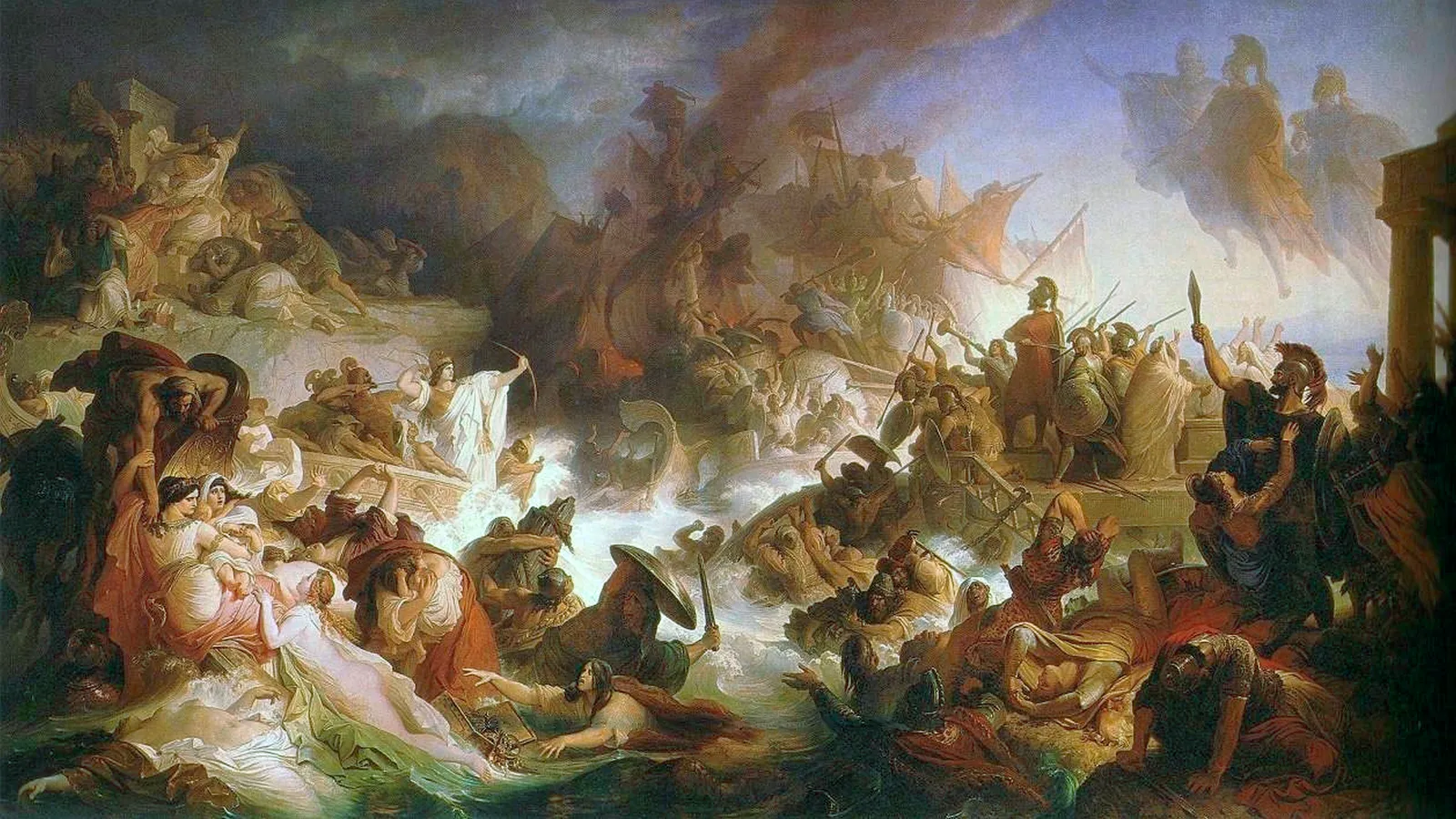
Smoke Over an Empty City
By the third week of September in 480 BC, Athens was on fire. Not the whole city — the lower town had already been stripped of anything valuable, and most of its people were gone — but the Acropolis burned, and the smoke was visible for miles across the water. From the island of Salamis, packed with refugees, rowers, and a fleet that didn’t yet know if it was going to fight or scatter, you could watch it happen.
This is the detail that tends to get lost when people talk about 480 BC. Thermopylae gets the movies and the epigrams. But the war didn’t end at the pass. It kept going, and about a month after Leonidas and his men died holding the narrows, the fate of Greece came down to a few hours in a strait so narrow that a modern container ship could barely turn around in it. The battle that decided it is the Battle of Salamis, and it’s arguably the single most consequential naval engagement in ancient history — the moment a fractured, quarreling coalition of city-states stopped a Persian king who had, by any reasonable measure, already won.
Xerxes I had reason to think the war was effectively over. He held Attica. His army was intact. His fleet, even after storm losses off Artemisium, still dwarfed anything the Greeks could put to sea. He had a throne set up on the slopes of Mount Aigaleos, overlooking the strait, so he could watch the last resistance get swept aside.
It didn’t go that way.
From Thermopylae to the Bay of Salamis
The land and sea campaigns of 480 BC ran on parallel tracks. While Leonidas held the pass at Thermopylae, the Greek fleet was engaged simultaneously at Artemisium, off the northern coast of Euboea — an indecisive, bloody few days of fighting that cost both sides ships and gave the Greeks their first real look at how the Persian navy handled itself in a fight. When word reached the fleet that Thermopylae had fallen, holding Artemisium any longer made no sense. The ships withdrew south.
Athens itself was already being evacuated. This was not a small logistical footnote — it was, according to Herodotus, one of the more remarkable civic decisions of the whole war. The Athenians packed the city’s population onto Salamis, onto the Peloponnesian coast at Troezen, and onto the island of Aegina, and left their homes to whatever came next. Themistocles had pushed for exactly this outcome for years, arguing that Athens’s real strength lay in its fleet and its citizens, not its walls. Now the theory was being tested for real, with the Acropolis burning to prove the stakes.
Xerxes marched into an empty city. Herodotus says a small garrison of Athenians too poor or too stubborn to leave had barricaded themselves on the Acropolis behind makeshift defenses and held out for a while before the Persians found a way up and finished them off. The temples went up in flames shortly after. It was a genuine catastrophe, and news of it reached the Greek fleet at Salamis within days, which did nothing to calm nerves that were already fraying.
Because here is the problem: the Greek fleet was sitting in the strait between Salamis and the Attic mainland, and a large number of the men making decisions about what to do next did not actually want to be there.
A Council on the Edge of Panic
The Greek alliance in 480 BC was not a unified command in any modern sense. It was a coalition of city-states, mostly Peloponnesian, that had agreed to cooperate against the Persian invasion but disagreed constantly about how. The nominal commander of the combined fleet was Eurybiades, a Spartan — Sparta held the ceremonial leadership of the alliance on land and sea alike, regardless of the fact that Sparta had contributed a comparatively small squadron of ships. Athens had provided by far the largest single contingent, well over half the fleet by most counts, but Athenian command of the whole navy was politically unthinkable to the other Greeks in 480 BC. So Eurybiades chaired the councils. Themistocles, representing Athens, did most of the arguing.
And there was a lot to argue about. With Athens burning and the Persian army now free to march into the Peloponnese, many of the Peloponnesian commanders wanted to abandon Salamis, sail south, and make their stand at the Isthmus of Corinth instead — behind a wall the Peloponnesians were already building across the isthmus, with their own home territories directly at their backs. Fighting at Salamis meant fighting to defend Attica, which, from a Corinthian or Spartan point of view, had already been lost. Why die for a city that no longer existed as a functioning polis?
Themistocles’s counterargument was tactical rather than sentimental, whatever the emotional stakes for him personally. He knew — or believed, which under the circumstances amounted to the same thing — that the Greek fleet would be annihilated in the open water off the Isthmus, where Persian numbers would tell. In the cramped channel at Salamis, that advantage evaporated. He said so, repeatedly, in council after council, and according to Herodotus he was not always polite about it. At one particularly heated meeting, the Corinthian commander Adeimantus reportedly told him a man without a city had no business giving orders to men who still had one — a jab at Themistocles representing an Athens that no longer physically existed. Themistocles’s recorded response, that Athens still had two hundred manned ships and therefore a city and land greater than Corinth’s for as long as the Athenians chose to use them, is the kind of line that sounds a little too polished for a transcript, and it’s worth remembering Herodotus wrote decades after the fact from testimony, not a court stenographer’s notes. Whether the exchange happened word for word, the disagreement it captures was real.
The debate dragged on long enough, and grew heated enough, that Themistocles apparently concluded he could not win it through argument alone. So he changed the terms.
The Fleets and the Men Who Led Them
Getting exact numbers for either fleet at Salamis is one of the persistent headaches of ancient military history, and readers should treat any figure quoted with confidence — including ones on this page — as an estimate.
Herodotus puts the Greek fleet at 380 ships, and a count he gives elsewhere of contributions by city works out closer to 371. Modern historians generally accept a figure in that range, call it somewhere between 300 and 380 triremes, with Athens supplying the largest single contingent by a wide margin — Herodotus credits the Athenians alone with 180 ships, more than any other two city-states combined.
The Persian fleet is a much thornier question. Herodotus’s headline figure, 1,207 ships, is almost certainly inflated — it’s suspiciously close to the number he gives for the fleet’s size at the start of the campaign, months earlier and hundreds of miles away, without accounting for storm losses off Magnesia and the fighting at Artemisium. Modern historians who’ve tried to reconstruct the numbers from what’s plausible logistically tend to land somewhere between 500 and 800 ships at Salamis, some going as low as the 400s. What almost everyone agrees on is the shape of the imbalance: the Persian fleet significantly outnumbered the Greeks, likely by something on the order of two to one, maybe more.
The command structure on the Persian side was, on paper, simpler — one king, one decision-maker — but in practice Xerxes relied on a a council of subordinate commanders and had installed his own half-brother, Ariabignes, as one of the fleet’s senior admirals. The fleet itself was a patchwork of contingents from across the empire: Phoenician squadrons, considered the finest sailors available to Persia, Egyptian ships, Cilician and Ionian Greek crews serving under Persian command, and a scattering of smaller Anatolian contingents.
Themistocles is the figure the battle is remembered through, and deservedly. He wasn’t a naval officer in any technical sense — Athens didn’t really have those yet as a distinct professional class — but he was the politician who had talked Athens into building the fleet in the first place, several years earlier, using proceeds from a lucky silver strike at Laurion that could easily have been spent on something else entirely. Without that fleet, there is no Salamis. Without Themistocles pushing the strategy through the Athenian assembly against real opposition, there is probably no fleet.
Eurybiades doesn’t get nearly as much attention, which is a little unfair to him. He held a genuinely difficult job — commanding a coalition fleet where the largest contingent wasn’t his own — and by Herodotus’s account he was at least willing to be argued with, which is not nothing. At one particularly tense moment, when Themistocles pushed him hard in council, Eurybiades reportedly raised his staff as if to strike him. Themistocles, unbothered, told him to strike if he wanted, but to listen first. Herodotus records that Eurybiades listened.
Then there’s Artemisia I of Halicarnassus, who deserves more space than a battle narrative usually gives her. She was the ruler of Halicarnassus, a Greek city on the Anatolian coast under Persian suzerainty, and she commanded her own squadron of ships at Salamis in person — one of the very few women in the ancient world known to have held independent naval command in a major battle. Herodotus, who was himself from Halicarnassus and presumably had better access to local memory of her than to most other figures in the campaign, clearly found her fascinating. He records that in the war council before the battle, she was the only commander to advise Xerxes against fighting at Salamis at all, arguing the Greeks would defeat themselves through their own internal divisions if the Persians simply waited them out or moved on the Peloponnese by land. Xerxes didn’t take her advice, but according to Herodotus he admired her for giving it. During the battle itself, with a Greek ship bearing down on her own, she rammed and sank a ship from her own side — an allied vessel from Calyndus — apparently to convince her pursuer she was actually a Greek ally and slip away in the confusion. It worked. Watching from the shore, Xerxes reportedly saw the kill and assumed she’d sunk an enemy, prompting a line Herodotus records him saying about the rest of his commanders: that his men had turned into women, and his women into men.
The Message of Sicinnus
With the war council still split and the Peloponnesians openly talking about pulling out to the Isthmus, Themistocles made a decision that, if it had gone wrong, would have ended his career and possibly his life. He sent a slave named Sicinnus, described as the tutor to his children, across the strait to the Persian camp with a message for Xerxes.
The message, as Herodotus records it, was roughly this: the Greek fleet was terrified and divided, its commanders were on the verge of abandoning Salamis to slip away under cover of darkness, and if the Persian fleet moved now to block the exits from the strait, it could trap and destroy the entire Greek navy in one stroke. Sicinnus presented this as intelligence from a secret well-wisher to the Persian king, without disclosing that the well-wisher was the Athenian who had, in reality, engineered the whole thing.
It’s worth sitting with how strange this gambit was. Themistocles was betting the war on Xerxes believing a report that happened to align exactly with what a nervous, divided Greek high command was already discussing openly in its own councils. That’s precisely what made the message credible — it wasn’t a wild claim, it matched the gossip the Persians could presumably confirm through other channels. Xerxes took the bait. He ordered his fleet to move that night, sending a squadron of Egyptian ships to block the western exit near Megara and stationing the main fleet to seal the strait from the east, boxing the Greeks in rather than letting them slip away toward the Isthmus.
The irony, which Herodotus seems to enjoy pointing out, is that the Persian move to prevent a Greek retreat is exactly what made the coming battle unavoidable for the Greeks who still wanted to retreat. Some of the Peloponnesian commanders reportedly only learned the fleet was surrounded the next morning, from Aristides, an Athenian political rival of Themistocles who happened to sail in from Aegina with the news and, to his credit, set his rivalry aside to deliver it. There was no longer an Isthmus option. The debate was over, not because anyone had won the argument, but because the water itself had closed the exits.
“He bids me tell you that fear has seized the Greeks and they are meditating a hasty flight, wherefore he counsels you, if you would not let your victory slip from your grasp, to lose no time in cutting off their escape.” — Themistocles’s message to Xerxes, via Sicinnus, as recorded by Herodotus (Histories, Book 8)
Why the Narrows Favored the Greeks
None of this works without the geography, so it’s worth being specific about what the strait actually looks like. The channel between the island of Salamis and the Attic coast near Eleusis and Piraeus narrows in places to roughly a mile or so of open water, pinched further by small islets and shoals that made the navigable channel even tighter than the raw distance suggests. A trireme wasn’t a small vessel — over a hundred oarsmen, a heavy bronze ram at the bow, not far short of 40 meters long depending on class — and a fleet of hundreds of them needs room to maneuver, to build speed for a ramming run, to turn without fouling the ship next to it.
The Persian fleet’s core advantage all campaign long had been numbers, plain and simple, and open water is where numbers matter most: you can outflank, encircle, and bring overwhelming local superiority to bear at whatever point the enemy is weakest. Compress that same fleet into a mile-wide channel and the advantage doesn’t just shrink, it can actively work against you. Ships in the rear can’t reach the fighting. Ships in the front have nowhere to retreat to if they’re pushed back, because their own second and third lines are jammed in behind them. A formation that looks unstoppable from a throne on a hillside becomes, in a strait, a traffic jam waiting to happen.
The Greeks, with their smaller and more homogeneous fleet of largely Athenian and Peloponnesian triremes, could form a tighter, more disciplined line across the width of the channel and simply wait. This is more or less exactly what Themistocles seems to have understood and the Persian high command, fatally, did not appreciate until oars were already in the water.
The Persian Fleet Enters the Strait
The battle was fought in late September of 480 BC — Herodotus’s account and modern reconstructions of the campaign calendar put it around the 26th or 27th, though ancient dating this far back always carries some uncertainty. Acting on the false intelligence from Sicinnus, the Persian fleet moved into and around the strait during the night, rowing in the dark to get into blocking position before dawn, expecting to catch a fleeing enemy rather than a waiting one.
That night move alone was likely exhausting for the crews — hours at the oar in the dark, in unfamiliar or half-familiar water, with no combat yet to show for it. By the time the sun came up and the Persian commanders realized the Greek fleet was not fleeing but forming a battle line across the channel, their own rowers had already been working for hours. The Greeks, by contrast, had reportedly spent the night on shore or at rest and came to their ships in the morning comparatively fresh.
Xerxes, watching from his throne on the slope of Mount Aigaleos with scribes on hand — Herodotus says specifically to record the names of commanders who distinguished themselves, for reward or punishment later — had a grandstand view of a fleet sailing into a channel it had never fought in, against an enemy that had chosen the ground.
The Greek Triremes Turn to Fight
Accounts describe the Greek line initially backing water — pulling back as if in retreat, drawing the leading Persian squadrons further into the strait and further from any chance of orderly support from the ships behind them. Whether this was a deliberate tactical maneuver or simply the natural rhythm of a fleet forming up under pressure is genuinely disputed among historians; Aeschylus, writing within a decade of the battle and who fought in it himself, describes the Greeks advancing to the sound of a war chant rather than retreating first. Either way, at some point the retreat, real or apparent, reversed, and the Greek line drove forward into contact.
“On, sons of Greece! On, for your country’s freedom! Strike to save wives, children, temples of ancestral gods, graves of your fathers! Now is all at stake.” — Aeschylus, The Persians, the war cry of the Greek fleet as reported by the Messenger (trans. E.D.A. Morshead)
Aeschylus wrote The Persians in 472 BC, eight years after the battle, for an Athenian audience that would have included men who had actually rowed at Salamis. That doesn’t make it a battle report — it’s a tragedy, staged from the Persian court’s point of view, and it compresses and dramatizes events the way any stage play does. But it’s also the closest thing that survives to an eyewitness account, and its broad strokes — the narrow water, the Greek line holding formation, the Persian fleet crowding itself into chaos — line up with what Herodotus describes independently a generation later.
Once the fleets closed, the fighting turned into exactly the kind of grinding, ship-to-ship chaos the terrain had been built to produce. Triremes rammed, oars snapped against enemy hulls, and marines fought hand to hand across locked or colliding decks. Among the Persian dead early in the engagement was Ariabignes, Xerxes’s half-brother and one of the fleet’s senior commanders, killed in the opening phase of the fighting — a serious blow to Persian command and control at exactly the moment coordination mattered most.
Rout in the Narrows
What had been a fight became a collapse. As the leading Persian ships were driven back by the Greek advance, they ran into their own second and third lines still trying to push forward into the strait, and the channel that had seemed to offer Persian numbers a decisive edge now turned that same mass of ships into a liability. Vessels fouled each other’s oars. Ships trying to back away collided with ships still trying to advance. Some Persian crews, drawn from conquered or subject peoples with limited enthusiasm for dying on Xerxes’s behalf, seem to have broken and fled at the first real sign the battle was going badly — Herodotus is fairly blunt about which contingents he thought fought hardest and which didn’t, though his sympathies (Greek, and specifically favorable to Athens) should be read with that bias in mind.
The Aeginetan squadron, stationed to catch exactly this outcome, fell on Persian ships trying to flee back down the strait and cut a number of them apart as they went. By the time the fighting wound down in the afternoon, the Persian fleet had lost, by most modern estimates, somewhere in the range of 200 to 300 ships — sunk, captured, or run aground and abandoned. Greek losses were far lighter, commonly cited around 40 ships, though as with most figures from this campaign that number should be read as an estimate rather than a certainty.
Xerxes watched a large portion of his navy come apart in a few hours, in full view of his own throne. There isn’t good evidence for exactly what he said in the moment — later writers embellished the scene considerably, and it’s the kind of thing that invites invention — so it’s safer to just note the fact of it: the fleet that had seemed unstoppable a day earlier had been broken in a channel a few hundred meters wide, in front of the man who’d built it.
Aftermath: Xerxes Goes Home, Mardonius Stays
The immediate strategic consequence was almost as dramatic as the battle itself. With his fleet shattered and his supply lines across the Aegean now vulnerable to a Greek navy that hadn’t gone away, Xerxes made the decision to withdraw the bulk of his army back toward Asia, retreating north through Thessaly and Thrace over the following weeks. This wasn’t an unconditional Persian withdrawal from Greece, though it’s sometimes remembered that way. Xerxes left behind a substantial land force under his general Mardonius, with instructions to finish the conquest the following campaigning season, wintering in Thessaly and Boeotia rather than trying to hold the whole of newly-occupied Greece through the winter with a fleet no longer able to guarantee supply.
Mardonius spent the winter of 480–479 BC trying, unsuccessfully, to peel Athens away from the Greek alliance through diplomacy, offering favorable terms if Athens would switch sides or simply stand aside. The Athenians refused, twice, and evacuated their city a second time when Mardonius’s army marched south again in the spring. The following summer, in August of 479 BC, the Greek alliance’s combined land army broke Mardonius’s force decisively at the Battle of Plataea, killing Mardonius in the fighting. Ancient tradition holds that on the very same day, a Greek fleet operating off the Anatolian coast destroyed the remnant Persian naval and land presence at the Battle of Mycale — a claim historians treat with some skepticism as a literary flourish, though the two victories did fall within the same general window and together they ended the invasion for good.
None of that happens the way it did without Salamis. A Persian fleet still able to contest the Aegean in the winter of 480–479 BC would have kept Xerxes’s supply and reinforcement options open in a way that might have changed Mardonius’s entire campaign the following year. Salamis didn’t win the war by itself. It made the war winnable.
Quick Facts
- Date: Late September 480 BC (traditionally 26th or 27th)
- Location: The strait between the island of Salamis and the Attic coast, near Athens
- Combatants: The Achaemenid Persian Empire under Xerxes I vs. an alliance of Greek city-states
- Greek fleet size: Roughly 300–380 triremes (Herodotus: 380; Athens alone supplied around 180)
- Persian fleet size: Disputed; ancient sources claim over 1,200, modern estimates generally range 500–800
- Key Greek commanders: Themistocles (Athens, de facto strategist), Eurybiades (Sparta, nominal supreme commander)
- Key Persian figures: Xerxes I (observing from shore), Ariabignes (admiral, killed in battle), Artemisia I of Halicarnassus (squadron commander)
- Outcome: Decisive Greek victory; Persian fleet loses an estimated 200–300 ships against Greek losses of roughly 40
- Immediate consequence: Xerxes withdraws with most of the army; Mardonius left in command of remaining land forces
- Long-term consequence: Sets up the Greek victories at Plataea and Mycale in 479 BC, ending the Persian invasion
Timeline of Key Events
- c. 483 BC — Athens votes, at Themistocles’s urging, to spend surplus silver revenue from the mines at Laurion on building a large fleet of triremes
- 480 BC, spring — Xerxes I invades Greece with a massive combined army and navy
- 480 BC, August — Simultaneous battles at Thermopylae (land) and Artemisium (sea); Leonidas and his rearguard are killed; the Greek fleet withdraws south afterward
- 480 BC, late August/early September — Athens is evacuated to Salamis, Troezen, and Aegina; the Persian army occupies Attica
- 480 BC, September — The Acropolis is stormed and burned by Persian forces after a small holdout garrison is overcome
- 480 BC, September — Greek war councils at Salamis debate withdrawing to the Isthmus of Corinth; Themistocles argues to stand and fight in the strait
- 480 BC, night before the battle — Themistocles sends Sicinnus to Xerxes with a false message; the Persian fleet moves overnight to block the strait’s exits
- 480 BC, c. 26–27 September — The Battle of Salamis is fought; the Persian fleet is decisively defeated
- 480 BC, autumn — Xerxes withdraws the bulk of his army toward Asia; Mardonius remains in Greece with a land force
- 479 BC, winter/spring — Mardonius attempts diplomacy with Athens, then marches south again
- 479 BC, August — Battle of Plataea; Mardonius is killed and the Persian army is routed
- 479 BC — Battle of Mycale destroys remaining Persian naval strength on the Anatolian coast, traditionally dated to the same day as Plataea
The Battle That Actually Saved Greece
Ask most people to name the battle that saved Greece from Persia in 480 BC and they’ll say Thermopylae. It’s understandable. Three hundred Spartans (plus, less famously, several thousand other Greeks who don’t get their own movie) holding a mountain pass to the last man is a story that doesn’t need much embellishment to be gripping. But Thermopylae was a loss. It bought time — a real and valuable few days — and it gave the alliance a story to tell itself about what Greek resistance could look like. It did not stop the Persian army, which marched straight through the pass once Leonidas fell and went on to burn Athens with essentially nothing left standing in its way.
Salamis is different. It’s a battle the Greeks actually won, and it’s a battle that actually changed the strategic picture rather than simply delaying the inevitable. Historians have argued for a long time about which battle of 480 BC “mattered more,” and it’s a genuinely useful argument to have, because the honest answer is that Salamis probably did more to determine the war’s outcome even though Thermopylae has better name recognition. Without Salamis, there’s no reason to think Mardonius’s army gets beaten at Plataea the following year, because there’s no reason to think Xerxes’s fleet and supply lines wouldn’t still be intact enough to keep reinforcing and resupplying a Persian occupation of Greece indefinitely.
There’s also a longer arc worth tracing past 479 BC. The victory at Salamis cemented something that had been an open argument in Athenian politics for years: that Athens’s future lay with its navy. The fleet Themistocles had pushed through the assembly against real opposition had just saved the city, and the political capital that bought Athenian naval policy did not evaporate once the Persians went home. Within a generation, that same fleet became the backbone of the Delian League, the alliance system that Athens built ostensibly to continue the fight against Persia and that gradually, and not always gently, turned into something much closer to an Athenian maritime empire. The rowers who’d manned the ships at Salamis — poorer citizens who couldn’t afford hoplite armor, the demographic that benefited most directly from a state built around naval power rather than land warfare — became a political constituency in their own right, and historians have long connected the growing influence of that constituency to the radicalization of Athenian democracy over the following decades. None of that was inevitable in September of 480 BC. It’s one plausible line running from a battle in a strait to the Athens of Pericles, and like most such lines it’s cleaner in hindsight than it would have looked to anyone actually rowing that day.
Frequently Asked Questions
Why did Themistocles want to fight at Salamis instead of the Isthmus of Corinth?
He believed the Greek fleet’s only real advantage over the much larger Persian navy was maneuverability in confined water. Fighting in open water off the Isthmus would have let Persian numbers encircle and overwhelm the smaller Greek fleet; the narrow strait at Salamis instead limited how many Persian ships could engage at once, neutralizing the numerical gap.
What exactly was the trick with Sicinnus?
Themistocles sent his household slave, Sicinnus, across to the Persian camp with a fabricated message claiming the Greek fleet was divided, panicked, and about to slip away under cover of darkness. He urged the Persians to move immediately to seal the strait’s exits and trap them. Xerxes believed it and ordered his fleet to block the channel overnight, which meant that by morning the Greeks had no retreat option left and the Persians had committed to fighting on ground of Themistocles’s choosing.
Who was Artemisia of Halicarnassus and why does she matter?
Artemisia I was the ruler of the Greek city of Halicarnassus, then under Persian authority, and she personally commanded a squadron of ships at Salamis, one of the few women known to have held independent naval command in a major ancient battle. Herodotus, who came from her city, records that she advised Xerxes against fighting at Salamis and later escaped a pursuing Greek ship during the battle by ramming an allied vessel to disguise her own identity, a moment Xerxes reportedly witnessed and misread as a kill against the enemy.
How many ships were actually involved?
There’s real disagreement. Herodotus gives the Greek fleet as 380 ships, and separate figures he provides for individual city contributions add up closer to 371; modern historians generally accept a range in the low-to-mid 300s to 380. The Persian fleet is far more contested — Herodotus’s total of 1,207 ships is widely regarded by modern historians as inflated, with more cautious estimates running somewhere between 500 and 800 ships at the time of the battle. What’s not disputed is that the Persian fleet substantially outnumbered the Greek one.
Did Xerxes really watch the battle from a throne on shore?
Herodotus says he did, positioned on high ground on the slope of Mount Aigaleos with attendants recording the performance of individual commanders. It’s a detail consistent with Persian royal practice and there’s no strong reason to doubt the outline of it, though the specific staging (a literal golden throne, in some retellings) has been embellished by later writers.
What happened immediately after the battle?
Xerxes withdrew the majority of his army back toward Asia within weeks, worried about his fleet’s ability to keep the army supplied and about the security of his bridge of boats across the Hellespont. He left a large land force in Greece under his general Mardonius, who wintered in Thessaly, tried unsuccessfully to negotiate Athens out of the war, and was ultimately defeated and killed at the Battle of Plataea in August 479 BC.
Recommended Reading
- Barry Strauss, The Battle of Salamis (Simon & Schuster, 2004)
- Tom Holland, Persian Fire: The First World Empire and the Battle for the West (Little, Brown, 2005)
- Peter Green, The Greco-Persian Wars (University of California Press, 1996; earlier published as The Year of Salamis/Xerxes at Salamis, 1970)
- Herodotus, The Histories, Book 8 (any modern annotated translation, such as the Landmark Herodotus edition)
- Aeschylus, The Persians (trans. various; a near-contemporary dramatic account by a veteran of the battle)
Read Next
August 14, 2026
The Battle of Inchon: MacArthur's Amphibious Gamble
MacArthur defied his own Joint Chiefs to land at Inchon's impossible tides and seawalls, shattering North Korea's army and reversing the Korean War in days.
August 14, 2026
The Siege of Vienna: How the Ottoman Advance Into Europe Was Stopped
In 1683 a Polish-led relief army broke the Ottoman siege of Vienna in a massive cavalry charge, halting Ottoman expansion into Central Europe for good.
August 14, 2026
The Battle of Austerlitz: Napoleon's Greatest Victory
How Napoleon lured a larger Russian-Austrian army into a trap at Austerlitz in 1805, winning his most decisive victory and shattering the Third Coalition.