Military History
The Siege of Vienna: How the Ottoman Advance Into Europe Was Stopped
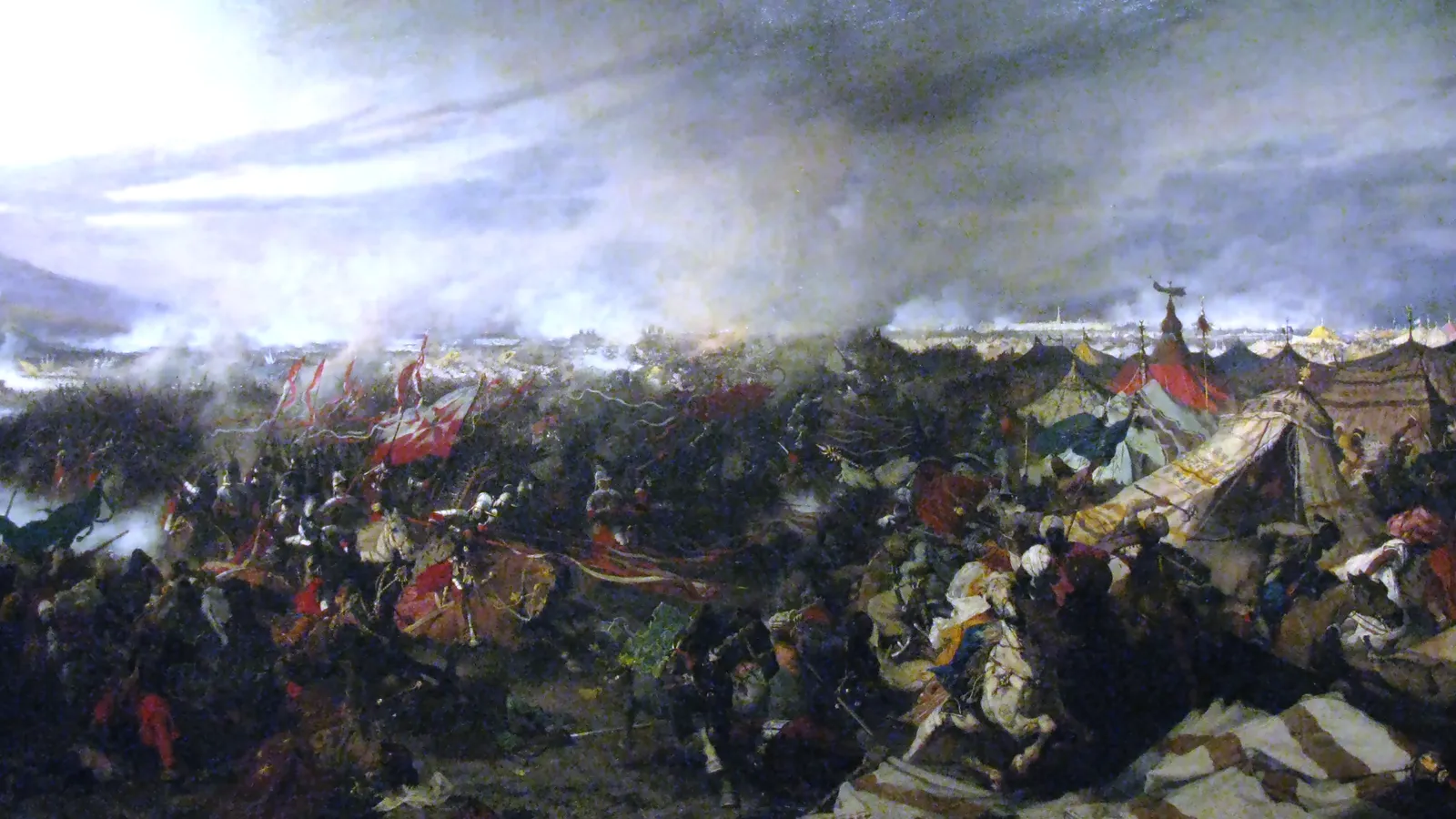
In the summer of 1683, a Habsburg capital of perhaps 60,000 residents braced for an army several times its population’s size. For nine weeks, cannon fire and underground mines chipped away at Vienna’s fortifications while its garrison, reduced by disease and combat losses, held a shrinking perimeter of rubble and hastily dug earthworks. Then, on a single September afternoon, one of the largest cavalry charges in European history swept down a forested hillside and broke the siege in a matter of hours. The Siege of Vienna did not end the Ottoman Empire’s presence in Europe — that would take more than two further centuries — but it marked the last time an Ottoman army seriously threatened to seize a major Central European capital. What began as the high-water mark of Ottoman ambition became, instead, the moment the tide turned.
The 1683 campaign was the direct descendant of an older rivalry. Two centuries earlier, the fall of Constantinople in 1453 had removed the last barrier to unchecked Ottoman expansion around the eastern Mediterranean, and the sultans who followed pushed that momentum steadily northwest into the Balkans and the Hungarian plain. Vienna sat at the edge of that expansion, a Habsburg seat that Ottoman forces had already tried, and failed, to take once before. The 1683 siege was Istanbul’s second attempt to finish what had been left undone in 1529 — and its last.
The Ottoman Empire at High Tide
By the late seventeenth century, the Ottoman Empire stretched from the Balkans to the Persian Gulf, a vast multiethnic state governed from Istanbul under Sultan Mehmed IV, who had reigned since 1648. Mehmed IV was, by most accounts, a sultan more interested in hunting than in the daily machinery of statecraft, and effective power over military and foreign policy rested largely with his grand viziers — most notably the members of the Köprülü family, whose decades of administrative and military reform had revitalized Ottoman state capacity after a period of internal crisis.
In 1676, that office passed to Kara Mustafa Pasha, who had risen through the household of the Köprülüs and became grand vizier upon the death of his brother-in-law, Fazıl Ahmed Köprülü. Kara Mustafa inherited an empire still capable of projecting enormous military force, and he was determined to use it. He found a pretext in Hungary, where Imre Thököly, a Protestant Hungarian nobleman leading a rebellion against Habsburg rule, appealed to Istanbul for support against Emperor Leopold I. Backing Thököly’s uprising gave the Ottomans a foothold and a justification for a major campaign into Habsburg territory.
The precise scope of what Kara Mustafa was authorized to attempt remains debated by historians. Ottoman planning appears to have at least contemplated an advance against Habsburg positions in Hungary, but Kara Mustafa pushed the campaign considerably further than a limited punitive expedition — aiming not merely to support Thököly or seize a border fortress, but to take Vienna itself, the symbolic and political heart of Habsburg power. Whatever the precise limits of his mandate, the scale of the force he assembled left little doubt about his ambition: this was to be a campaign aimed at the Habsburg capital, not a routine frontier raid.
The Ghost of 1529
Kara Mustafa was not attempting something unprecedented. In 1529, Suleiman the Magnificent, then at the height of Ottoman power, had marched on Vienna with a large army and besieged the city for roughly two and a half weeks in late September and October. That first siege failed for reasons that would echo, in modified form, more than 150 years later: autumn rains had bogged down the Ottoman supply train and forced the abandonment of heavy siege artillery, the defenders detected and destroyed Ottoman mining efforts beneath the walls, and a final assault in mid-October was repulsed. With winter approaching and his army exhausted, Suleiman withdrew.
The 1529 failure did not end Ottoman ambitions in Central Europe, but it established a hard ceiling on how far those ambitions could reach by land in a single campaigning season, and it fixed Vienna in the Ottoman strategic imagination as the great unfinished objective. For a century and a half afterward, the Habsburg-Ottoman frontier shifted back and forth across Hungary without either side threatening the other’s capital directly. Kara Mustafa’s 1683 campaign was, in that sense, an attempt to complete unfinished business — this time with a far larger army, and with the benefit of a Hungarian rebellion already destabilizing the region in the Ottomans’ favor.
Commanders and Combatants: Who Fought at Vienna
The 1683 campaign was defined as much by its commanders as by the armies they led.
Kara Mustafa Pasha commanded the Ottoman host in person. Contemporary and later accounts describe him as ambitious, autocratic, and eager for the personal glory that capturing Vienna would bring — reportedly to the point of favoring a prolonged siege intended to take the city intact (and its wealth undamaged) over a faster but more destructive assault. That preference for a methodical siege rather than a rapid storm would prove costly, giving the Habsburgs and their allies the weeks they needed to organize a relief.
Facing him were several separate figures rather than a single unified command. Emperor Leopold I, the Habsburg monarch in whose name Vienna was defended, did not remain in the city. As the Ottoman army approached in early July 1683, Leopold and much of the imperial court evacuated westward, eventually taking refuge at Passau, well beyond the immediate danger. This was, in seventeenth-century terms, standard practice for a monarch whose death or capture would have been catastrophic for the dynasty’s continuity — but it meant that Vienna’s defense fell to subordinates rather than to the emperor himself.
That defense was organized by Ernst Rüdiger von Starhemberg, the city’s military commander, who had been serving as Vienna’s governor since 1680. When Kara Mustafa’s forces arrived outside the walls in mid-July and demanded the city’s surrender, Starhemberg refused, choosing to trust in Vienna’s fortifications — substantially strengthened in the decades since 1529 — and in the hope that a relief army could reach the city before its defenses collapsed. Starhemberg commanded a garrison usually put at under 20,000 men, a force that had to be stretched across an extensive circuit of bastions and ravelins against an Ottoman army many times its size, and it was worn down steadily by combat, disease, and the accumulating toll of a siege that stretched through the height of summer.
Imperial field forces outside the city, too weak on their own to challenge Kara Mustafa directly, were commanded by Charles V, Duke of Lorraine, Leopold’s brother-in-law. Rather than risk his smaller army in a direct confrontation, Lorraine positioned his troops to harass Ottoman supply lines, protect what resupply could reach the city, and wait for reinforcement — a holding action that bought Starhemberg’s garrison additional time while the diplomatic effort to build a larger relief coalition proceeded.
That coalition would ultimately be led by Jan III Sobieski, King of Poland, whose Polish-Lithuanian forces — including the famous winged hussars — formed a critical component of the relief army and whose personal command, by agreement among the allied contingents, extended over the combined force once it moved to relieve the city. Sobieski’s arrival transformed a desperate holding action into a coordinated counteroffensive.
Forging the Holy League
Vienna could not be saved by Habsburg forces alone, and the process of assembling a relief army was as much a diplomatic achievement as a military one. Pope Innocent XI played a central organizing role, using papal financial subsidies and personal appeals to draw the fractured powers of Central Europe into common cause against the Ottoman advance. The pope’s diplomacy helped secure a subsidy of roughly 200,000 imperial thalers to Poland and encouraged the mobilization of tens of thousands of additional Holy Roman troops from the German states.
The essential military alliance was sealed before the siege even began. On March 31, 1683, Leopold I and Sobieski signed the Treaty of Warsaw, a mutual defense pact obligating each monarch to come to the other’s aid if either Vienna or Kraków came under direct attack. That earlier agreement is what obligated — and enabled — Sobieski to march to Vienna’s relief once the Ottoman siege began in July. Alongside Polish and Austrian forces, contingents from Saxony, Bavaria, and other German states joined the relief effort, drawn in by a combination of papal subsidy, dynastic obligation, and genuine alarm at the prospect of an Ottoman army astride the Danube.
The broader, formalized alliance that historians know as the Holy League was not signed until March 1684, several months after Vienna’s relief, when the Habsburg monarchy, the Polish-Lithuanian Commonwealth, and the Republic of Venice put their wartime cooperation on a permanent treaty footing (Russia would join in 1686). The league’s founding document named the pope as its guarantor and protector:
“The allied Powers choose the Pope and his successors, as the common father of Christendom, for the protector, guarantor and representative of the alliance.”
The 1683 relief of Vienna was, in that sense, the improvised military prelude to a coalition that would only later be given formal shape — but it demonstrated that such a coalition was possible, and it set the template for the Great Turkish War that followed.
Bastions and Countermines: Vienna’s Defenses
Vienna’s ability to survive as long as it did owed a great deal to fortification work undertaken in the century and a half since the 1529 siege. The medieval walls that had barely withstood Suleiman’s army had been substantially rebuilt along the principles of the trace italienne — low, thick earthwork-backed bastions designed to absorb artillery fire and eliminate the blind spots that plagued older vertical walls. By 1683, Vienna’s defenses consisted of a ring of angled bastions and outlying ravelins, further protected by a glacis, a cleared and sloped killing ground that denied attackers cover as they approached.
Kara Mustafa’s siege, beginning on July 14, 1683, settled into the grinding pattern typical of early modern siege warfare: rather than attempting to storm the walls directly, Ottoman engineers dug approach trenches in a zigzag pattern toward the fortifications, gradually advancing their artillery and infantry closer while minimizing exposure to defensive fire. Once close enough, Ottoman sappers turned to mining — tunneling beneath the bastions and packing the resulting chambers with gunpowder to blow breaches in the walls from below.
Starhemberg’s garrison countered with mines of its own, a brutal and claustrophobic form of combat fought largely underground and in near-total darkness. Habsburg engineers dug countermines to intercept Ottoman tunnels before they could be completed, leading to episodes of hand-to-hand fighting in cramped passages far beneath the bastions, as well as the periodic detonation of mines and countermines that collapsed tunnels and buried the men working within them. This subterranean struggle was, in its own way, as decisive as the fighting above ground: every Ottoman mine successfully detected and destroyed was a breach that never opened, and every mine that succeeded brought Kara Mustafa’s army one step closer to a stormable gap in the walls.
By early September, after nearly two months of siege, that underground war had begun to turn against the defenders. Ottoman mines had opened real breaches in the Burg bastion and the adjoining Löbel bastion, and Ottoman infantry had fought their way into the outer defenses in several places. Starhemberg’s garrison, reduced by roughly half through combat losses and disease over the course of the siege, was running out of both men and time. Vienna’s walls had held longer than Suleiman’s army had ever managed in 1529 — but they were not going to hold indefinitely.
The City Under Siege
Conditions inside Vienna deteriorated steadily as the siege wore on through July and August. The city’s population, swollen by refugees who had fled the surrounding countryside ahead of the Ottoman advance, faced crowding, disease, and the psychological strain of sustained bombardment. Disease proved a serious threat inside the walls, adding to the losses the garrison suffered in the fighting itself.
Outside the city, Charles of Lorraine’s smaller field army could not risk open battle against Kara Mustafa’s much larger force, but it was not idle. Lorraine’s cavalry harassed Ottoman foraging parties and supply columns, disrupted communications, and worked to keep open whatever thin channels of resupply and information could still reach the besieged city — efforts that included daring individual missions to slip messengers through the Ottoman lines to coordinate with the approaching relief effort. Every week that Vienna held out increased the odds that a relief army could be assembled and marched into position before the walls finally gave way, and every week also increased the strain on Kara Mustafa’s own logistics, as an army of well over 100,000 men and animals consumed the surrounding region’s resources.
By early September, the size of Kara Mustafa’s besieging force had itself begun to erode. Historians’ estimates of Ottoman troop strength during the campaign vary considerably depending on how support personnel, irregular auxiliaries, and non-combatants are counted — figures for the force that set out from Ottoman territory range from roughly 90,000 up toward 150,000 combatants, with some broader estimates of the entire campaign train, including logistical and support elements, running considerably higher still. What is clearer is that this strength did not hold constant: combat losses, desertion, and disease reduced the effective besieging force substantially by the time the relief battle arrived in mid-September, with some assessments suggesting the army available to Kara Mustafa on the eve of battle had fallen to something closer to half its peak strength.
To the Kahlenberg Heights
The relief army’s march to Vienna was itself a considerable logistical achievement. Sobieski’s Polish forces had to cover a long distance from Poland in a matter of weeks, coordinating along the way with Charles of Lorraine’s Imperial troops and the contingents arriving from Saxony, Bavaria, and other German states. Estimates of the combined relief force’s total size vary by source and by exactly which auxiliary and irregular troops are included, but a commonly cited range puts the army at roughly 70,000 to 85,000 men: Polish contingents in the range of 18,000 to 27,000, Austrian and other Imperial troops numbering perhaps 16,000 to 20,000, and further sizable contingents from Saxony and Bavaria, along with smaller detachments from other German states.
By early September, the assembled relief army had crossed the Danube northwest of Vienna and begun the difficult approach march through the wooded hills of the Vienna Woods, aiming to reach the Kahlenberg — a wooded height overlooking the city from the northwest — without being detected or intercepted by Ottoman forces. Moving a combined army of tens of thousands of men, along with its artillery and baggage, through forested and hilly terrain was slow and arduous work, and it required close coordination among commanders who had never before fought together as a single force.
Kara Mustafa, whether from overconfidence, a determination to press the siege to its conclusion before any relief could interfere, or simple failure to grasp how far the coalition army had already advanced, did not commit his full strength to blocking the passes through the hills. By the night of September 11 into September 12, the allied army had largely completed its difficult transit of the Vienna Woods and begun deploying on the slopes of the Kahlenberg, in position to descend on the besieging army from high ground the following day.
The Charge of the Winged Hussars
The battle of September 12, 1683, unfolded in stages over the course of a long day. Allied infantry and cavalry began descending from the Kahlenberg and the neighboring heights in the morning, fighting through difficult, broken terrain against Ottoman forces that Kara Mustafa had by then turned to face the new threat — while still, remarkably, maintaining pressure on Vienna’s battered walls in a bid to force the city’s surrender before the relief army could arrive. Fighting ground on through the day across vineyards, hills, and villages on Vienna’s outskirts, with the allied army gradually pressing the Ottoman lines back toward the plain below.
The decisive blow came in the late afternoon. Around five or six o’clock, with Ottoman formations already strained by a day of fighting on two fronts, Sobieski personally led a massive cavalry charge down from the high ground onto the Ottoman lines — a combined force of Polish, Austrian, and German horsemen commonly put at somewhere around 18,000 riders, among them roughly 3,000 of Sobieski’s famed winged hussars, the heavily armored lancers whose wooden wing frames, mounted on their backs or saddles, were said to produce a distinctive rattling sound intended to unnerve enemy horses and men alike. It is frequently described — including by military historians examining the scale of cavalry actions across history — as among the largest cavalry charges ever mounted, though the comparative claim is difficult to verify with precision and some historians regard the “largest in history” label as an overstatement rather than an established fact.
Whatever its exact ranking among history’s cavalry charges, its tactical effect was immediate and decisive. Already fatigued and disordered by the day’s fighting, Ottoman formations broke under the impact of the charge and could not reform. Kara Mustafa’s army, spread thin between the siege lines and the new battle to its rear, collapsed into retreat that quickly became a rout. Sobieski rode into the abandoned Ottoman camp that evening, finding it filled with supplies, treasure, and equipment abandoned in the army’s headlong flight — including, according to later accounts, the grand vizier’s own tent and personal effects.
In a letter to his wife, Marysieńka, written in the aftermath of the victory, Sobieski described the reception he received from Vienna’s grateful population:
“All the common people kissed my hands, my feet, my clothes; others only touched me, saying: ‘Ah, let us kiss so valiant a hand!’”
Sobieski’s victory dispatch is also widely remembered, in the Christian world of the time, through a Latin phrase echoing Julius Caesar’s famous boast — commonly rendered as “we came, we saw, God conquered” in place of Caesar’s “I came, I saw, I conquered.” The line is repeated across many popular and scholarly accounts of the battle, though its precise original wording and the exact document in which Sobieski used it are not as firmly documented as the letter to his wife quoted above, and readers should treat it as a widely circulated characterization of the victory dispatch rather than a verbatim, primary-sourced quotation.
Rout and Retreat
The scale of the Ottoman defeat was severe. Casualty estimates for the battle and the preceding siege vary across sources, but figures commonly cited put Ottoman losses in the battle itself at somewhere between roughly 8,000 and 20,000 killed, with several thousand more taken prisoner, on top of substantial losses already suffered during the two months of siege from combat, disease, and desertion. Christian coalition losses were far lighter by comparison — commonly estimated in the range of a few thousand killed and wounded across the combined relief army, with Polish losses reported at roughly 1,300.
Kara Mustafa’s army did not merely retreat from Vienna; it disintegrated as a coherent fighting force, abandoning enormous quantities of artillery, supplies, and baggage as it fled back toward Hungary. The defeat was catastrophic not only militarily but politically for the grand vizier personally. Ottoman practice held commanders accountable for major failures, and Kara Mustafa’s position was further weakened by rivals at court eager to see him fall. He was pursued back to Belgrade, where, on December 25, 1683, he was executed by strangulation with a silk cord — the customary method of execution for high Ottoman officials — on the order of Sultan Mehmed IV.
The defeat’s consequences reached the sultan himself, though not immediately. Mehmed IV remained on the throne for several more years, but the military crisis triggered by the failure at Vienna continued to deepen through further defeats. In November 1687, following another major Ottoman defeat at the Second Battle of Mohács, mutinous Janissary and other troops forced Mehmed IV’s deposition in favor of his brother, Suleiman II. Mehmed spent the remainder of his life confined, dying in 1693.
The Great Turkish War and the Reconquest of Hungary
The relief of Vienna did not end the fighting; it began a much longer conflict. The Great Turkish War that followed pitted the Holy League against the Ottoman Empire for the next sixteen years, and it steadily reversed a century and a half of Ottoman territorial gains in Hungary. Habsburg and allied forces recaptured Buda — the historic Hungarian capital, under Ottoman control since 1541 — after a lengthy siege in 1686. The Second Battle of Mohács in 1687, fought near the site of a catastrophic Hungarian defeat to the Ottomans in 1526, delivered another decisive victory to Habsburg-led forces and triggered the political crisis that cost Mehmed IV his throne.
The war ground on for another decade, with further Habsburg victories including Prince Eugene of Savoy’s rout of Ottoman forces at the Battle of Zenta in 1697. That defeat finally brought the Ottomans to the negotiating table, producing the Treaty of Karlowitz in 1699 — the first major treaty in which the Ottoman Empire ceded substantial European territory to Christian powers rather than the reverse. Under its terms, the Habsburgs secured control of most of Hungary, Transylvania, and Slavonia, along with portions of Croatia, fundamentally redrawing the map of Central Europe and cementing Vienna’s relief as the opening chapter of a broader Ottoman retreat rather than an isolated defensive victory.
Legacy of the Gates of Vienna
The Siege of Vienna has long occupied an outsized place in European historical memory, often described as the moment the centuries-long tide of Ottoman expansion into Central Europe finally and permanently reversed. That framing requires some care: the Ottoman Empire remained a major European and Mediterranean power for more than two further centuries, and the Great Turkish War itself dragged on for sixteen years after 1683 before the territorial reckoning at Karlowitz was finalized. What 1683 marked was not the empire’s collapse but the end of its capacity to seriously threaten Central Europe’s major capitals — the high-water mark beyond which Ottoman arms would not again advance.
The battle’s memory has also accumulated a considerable amount of folklore, most famously the enduring legend that Vienna’s celebrated coffeehouse culture originated from sacks of coffee beans left behind in the abandoned Ottoman camp. In its most popular form, the story credits a soldier and interpreter, often identified as Georg Franz Kolschitzky, with obtaining the abandoned coffee and opening Vienna’s first coffeehouse. The story is popular, evocative, and almost certainly not accurate in its familiar form. Historical research — notably by the Austrian historian Karl Teply, who traced the coffeehouse-founder version of the Kolschitzky story to an embellished account written a full century later, in 1783 — has found no solid contemporary evidence that Kolschitzky opened a coffeehouse at all; more recent scholarship instead credits an Armenian trader operating in Vienna by 1685 with opening what may have been the city’s first true coffeehouse. What does appear to be true is narrower: that Sobieski rewarded Kolschitzky, who had carried messages through Ottoman lines during the siege, with a gift of coffee recovered from the captured Ottoman camp. The leap from that gift to the founding of Viennese café culture is a later invention, and readers encountering the story elsewhere should treat it as an enduring legend rather than an established historical fact.
Set alongside that folklore, the battle’s more substantive legacy lies in its diplomatic and military template. The Holy League that coalesced around Vienna’s relief — however loosely organized in the summer of 1683 itself — demonstrated that rival Christian powers, otherwise often at odds with one another, could combine effectively against a shared Ottoman threat, and it established a pattern of coalition warfare that shaped the Great Turkish War and, more distantly, later European alliance systems. For Poland-Lithuania, the victory marked a final high point of military prestige under Sobieski before a slower national decline in the following century. For the Habsburg monarchy, it opened two decades of expansion that transformed Vienna’s rulers from an embattled dynasty defending its own capital into the master of a substantial multiethnic empire stretching deep into Hungary and the Balkans.
Quick Facts
- Conflict: Siege and Battle of Vienna, part of the wider Ottoman–Habsburg wars and the opening engagement of the Great Turkish War
- Dates: Siege began July 14, 1683; relief battle fought September 12, 1683 (roughly two months of siege)
- Location: Vienna, capital of the Habsburg monarchy (present-day Austria)
- Ottoman commander: Kara Mustafa Pasha, Grand Vizier under Sultan Mehmed IV
- Vienna garrison commander: Ernst Rüdiger von Starhemberg
- Relief army commander: Jan III Sobieski, King of Poland
- Imperial field commander: Charles V, Duke of Lorraine
- Ottoman force: Commonly estimated at roughly 90,000–150,000 combatants at the campaign’s outset, with figures varying by source and by whether support troops are included; reduced significantly by the time of the battle through losses, disease, and desertion
- Holy League relief army: Commonly estimated at roughly 70,000–85,000 troops, drawn from Poland-Lithuania, the Habsburg monarchy, Saxony, Bavaria, and other German states
- Outcome: Decisive Holy League victory; Ottoman siege broken and army routed
- Aftermath: Kara Mustafa Pasha executed in Belgrade, December 25, 1683; Great Turkish War continued until the 1699 Treaty of Karlowitz
Timeline of Key Events
- 1529 (Sept 27–Oct 15): First Ottoman siege of Vienna, under Suleiman the Magnificent, fails and the army withdraws
- 1676 (Oct 19): Kara Mustafa Pasha becomes Ottoman Grand Vizier
- 1683 (Mar 31): Treaty of Warsaw signed between Leopold I and Jan III Sobieski, pledging mutual defense
- 1683 (Jul 14): Ottoman siege of Vienna begins under Kara Mustafa Pasha
- 1683 (Jul 15): Starhemberg refuses Kara Mustafa’s demand for surrender
- 1683 (early Sept): Ottoman mines breach sections of Vienna’s bastions as the relief army approaches
- 1683 (Sept 11–12): Holy League relief army crosses the Vienna Woods and takes position on the Kahlenberg heights
- 1683 (Sept 12): Battle of Vienna; Sobieski leads the allied cavalry charge that breaks the siege
- 1683 (Dec 25): Kara Mustafa Pasha executed in Belgrade on Mehmed IV’s order
- 1684 (Mar 5): The Holy League is formally established at Linz, joining the Habsburg monarchy, Poland-Lithuania, and Venice
- 1686 (Sept 2): Buda, the historic Hungarian capital, is recaptured from Ottoman control
- 1687: Second Battle of Mohács; Ottoman defeat triggers unrest that leads to Mehmed IV’s deposition later that year
- 1697: Ottoman forces are decisively defeated at the Battle of Zenta by Prince Eugene of Savoy
- 1699: Treaty of Karlowitz ends the Great Turkish War, ceding most of Hungary, Transylvania, and Slavonia to the Habsburgs
Frequently Asked Questions
Why did the Ottomans want to capture Vienna in 1683?
Vienna was the seat of the Habsburg monarchy, one of the Ottoman Empire’s principal rivals in Europe, and its capture would have given the Ottomans control of a major strategic and symbolic prize on the Danube. Grand Vizier Kara Mustafa Pasha used a Hungarian rebellion against Habsburg rule, led by Imre Thököly, as both a pretext and a springboard for a campaign aimed not merely at securing Hungary but at taking the Habsburg capital itself.
How large were the two armies at Vienna?
Estimates vary by source. The Ottoman besieging force is commonly put at roughly 90,000 to 150,000 combatants at the campaign’s outset, with some broader tallies of the full logistical train running higher still; that strength was significantly reduced by combat losses, disease, and desertion by the time of the September battle. The Holy League relief army that broke the siege is commonly estimated at roughly 70,000 to 85,000 troops, combining Polish, Austrian, Saxon, Bavarian, and other German contingents. Because seventeenth-century armies were not counted with modern precision, and because sources differ on which support and irregular troops to include, treat all such figures as informed estimates rather than exact counts.
Who commanded the forces at the Siege of Vienna?
Kara Mustafa Pasha commanded the Ottoman army. Vienna’s defense was organized by Ernst Rüdiger von Starhemberg, while Emperor Leopold I had evacuated the city and taken refuge at Passau. The relief effort combined Imperial forces under Charles V, Duke of Lorraine, with Polish, Saxon, Bavarian, and other German contingents under the overall command of King Jan III Sobieski of Poland.
What was the winged hussar charge, and why is it famous?
The winged hussars were Poland’s elite heavy cavalry, distinguished by wing-like frames mounted on their armor or saddles. On September 12, 1683, Sobieski led a massive allied cavalry charge — including roughly 3,000 winged hussars within a combined force of around 18,000 horsemen — down from the Kahlenberg heights into the exhausted Ottoman lines. The charge shattered Ottoman formations and triggered a general rout, and it is frequently cited as among the largest cavalry charges in European history, though that particular superlative is difficult to verify with precision.
Did the Ottomans really leave coffee behind that started Vienna’s café culture?
This popular legend is best treated as folklore rather than established fact. Historical research has traced the familiar story — crediting a messenger named Georg Franz Kolschitzky with opening Vienna’s first coffeehouse using beans abandoned by the retreating Ottoman army — to an embellished account written a century after the siege, and later scholarship suggests Vienna’s first true coffeehouse was opened by an Armenian trader around 1685. Sobieski is documented as having given Kolschitzky a gift of captured Ottoman coffee in recognition of his wartime service, but the leap from that gift to the founding of Vienna’s café culture is a later, unverified addition to the story.
What happened after the siege was lifted?
The Ottoman army’s retreat from Vienna opened the Great Turkish War, a sixteen-year conflict in which the Holy League steadily reconquered Ottoman-held Hungary, retaking Buda in 1686 and winning a decisive victory at the Second Battle of Mohács in 1687. Kara Mustafa Pasha was executed in Belgrade in December 1683 for the failure, and Mehmed IV was himself deposed in 1687 amid the continuing military crisis. The war finally ended with the 1699 Treaty of Karlowitz, which transferred most of Hungary, Transylvania, and Slavonia to Habsburg control.
Recommended Reading
- Andrew Wheatcroft, The Enemy at the Gate: Habsburgs, Ottomans, and the Battle for Europe (2009)
- John Stoye, The Siege of Vienna: The Last Great Trial Between Cross and Crescent (1964; revised edition 2006)
- Simon Millar, Vienna 1683: Christian Europe Repels the Ottomans (Osprey Campaign series, 2008)
Read Next
August 14, 2026
The Battle of Austerlitz: Napoleon's Greatest Victory
How Napoleon lured a larger Russian-Austrian army into a trap at Austerlitz in 1805, winning his most decisive victory and shattering the Third Coalition.
August 14, 2026
The Battle of Zama: Scipio's Defeat of Hannibal
How Scipio Africanus out-generaled Hannibal Barca at Zama in 202 BC, using Masinissa's cavalry and elephant-countering tactics to end the Second Punic War.
August 14, 2026
The Battle of Iwo Jima: The Marines' Costliest Battle of World War II
How the Marines fought Kuribayashi's underground fortress on Iwo Jima, the true story behind the famous flag-raising photo, and the battle's staggering cost.