Military History
The Battle of Iwo Jima: The Marines' Costliest Battle of World War II
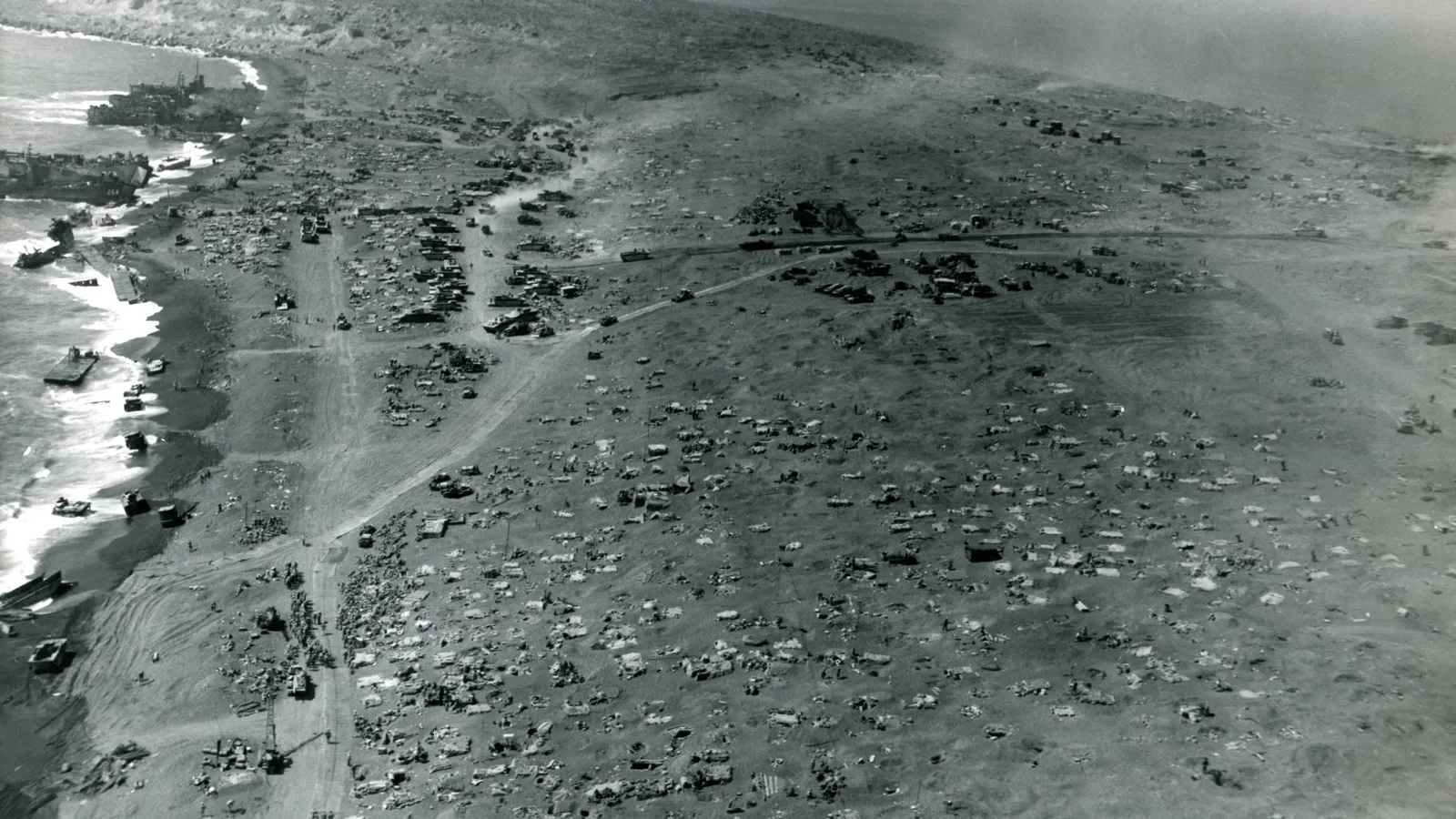
At dawn on February 19, 1945, the horizon off a tiny volcanic island 750 miles south of Tokyo filled with the largest concentration of amphibious shipping the Pacific War had yet seen. Within hours, the first waves of United States Marines were wading ashore onto black volcanic ash so soft it swallowed boots, jeep tires, and the traction of men trying to run for cover that did not exist. Iwo Jima, an eight-square-mile speck of sulfur-scented rock the Japanese had spent a year turning into a subterranean fortress, would become the site of some of the most brutal, sustained combat of the entire war—thirty-six days in which more Medals of Honor were awarded than in any other single battle in American history, and in which, for the only time in the Pacific War, American casualties outnumbered Japanese ones.
Iwo Jima has become inseparable from a single photograph: five Marines and a Navy corpsman straining to plant a flagpole atop Mount Suribachi. That image, and the monument it inspired, have in some ways overshadowed the battle itself—the weeks of grinding, yard-by-yard fighting against an enemy that had gone to ground in a network of tunnels and refused, almost to the last man, to surrender. Understanding Iwo Jima means understanding both: the photograph that became a symbol of American resolve, and the extraordinary defensive battle, engineered by a single Japanese general, that made the cost of that symbol so high.
Why Iwo Jima Mattered
By late 1944, American forces had fought their way across the central Pacific to the Mariana Islands, from which the new B-29 Superfortress bomber could reach the Japanese home islands for the first time. The Marianas-based bombing campaign against Japan faced two persistent problems, both traceable to a single piece of ground roughly halfway along the B-29s’ route: Iwo Jima. Japanese fighters based on the island’s airfields harassed the bomber formations, and Japanese radar stations there gave Tokyo early warning of incoming raids, undercutting the surprise American air commanders wanted. Capturing the island, American planners reasoned, would eliminate both threats, provide a forward base from which fighters could escort the bombers all the way to Japan, and—critically—give crippled B-29s returning from raids, often low on fuel or battle-damaged, a place to land short of the long open-ocean flight back to the Marianas.
That last argument proved itself with striking speed. Even while fighting still raged around the island’s main airstrip, a damaged B-29 named Dinah Might, returning from a raid over Japan and dangerously low on fuel, made an emergency landing at the newly captured Motoyama Airfield No. 1 on March 4, 1945—less than two weeks after the invasion began and three weeks before the island was declared secure. Over the remaining months of the war, thousands of B-29 crewmen would make use of Iwo Jima’s airfields in similar circumstances, a fact the Marine Corps and its defenders would cite for decades as vindication of the island’s cost. Not every historian has agreed that the emergency-landing rationale, as commonly told, fully justified the casualties involved—a debate addressed later in this article—but at the time, American commanders viewed Iwo Jima as an essential link in the strategic chain being built toward an eventual invasion of Japan itself.
The Opposing Forces and Commanders
Overall responsibility for the operation, codenamed Operation Detachment, rested with Admiral Chester Nimitz, commander of the Pacific Fleet, with Admiral Raymond Spruance commanding the Fifth Fleet and Vice Admiral Richmond Kelly Turner leading the joint expeditionary force that would put the troops ashore. Ground command fell to Lieutenant General Holland M. “Howlin’ Mad” Smith, a blunt, demanding officer who had led Marine amphibious forces since Guadalcanal and had a well-earned reputation for driving subordinates hard. Beneath Smith, Major General Harry Schmidt commanded the V Amphibious Corps, made up of three Marine divisions: the 3rd, under Major General Graves B. Erskine; the 4th, under Major General Clifton B. Cates; and the 5th, under Major General Keller E. Rockey. Roughly 70,000 Marines would eventually come ashore on Iwo Jima, supported by Navy corpsmen, Seabees, and a massive naval and air bombardment effort.
Facing them was a Japanese garrison of some 21,000 men under the command of Lieutenant General Tadamichi Kuribayashi, a cavalry officer who had served as a military attaché in Washington and Canada in the 1920s and, like Admiral Yamamoto before him, had come away from his time in America with a sober respect for its industrial capacity that few of his colleagues shared. Kuribayashi understood by 1944 that Japan could not win the war, and he told his family as much in letters home, but he approached the defense of Iwo Jima with the conviction that his garrison’s job was not to win, but to inflict the maximum possible cost on the American forces that came for the island, delaying the war’s endgame and, he hoped, making an eventual invasion of Japan itself seem too costly to contemplate.
That conviction produced a defensive strategy that broke sharply with earlier Japanese practice in the Pacific. At previous islands, Japanese commanders had typically tried to stop American landings at the water’s edge and, when that failed, exhausted their remaining strength in banzai charges—mass suicidal assaults that inflicted casualties but squandered manpower in single, futile bursts. Kuribayashi forbade banzai charges outright. Instead, he ordered his men to abandon any serious defense of the beaches themselves and to fight instead from a network of fortified positions dug deep into the island’s volcanic rock—a strategy of defense in depth designed to make Marines pay for every yard of ground, for as long as possible, from positions that American naval and air bombardment could barely touch. Surviving copies of his orders to the garrison, sometimes called his “Courageous Battle Vows,” told his men that their posts were to be their graves and urged each soldier to kill several American troops before he himself was killed—an exhortation that fell short of the lopsided kill ratio Kuribayashi hoped for, but that nonetheless shaped a battle unlike any the Marine Corps had fought before.
A Fortress of Volcanic Rock
Iwo Jima’s terrain shaped nearly every tactical decision made on it. The island—its name means “Sulfur Island,” after the volcanic fumes that vented from cracks in the ground in several places—was dominated at its southern tip by Mount Suribachi, an extinct volcanic cone rising some 550 feet above the surrounding beaches and giving whoever held it clear observation over the entire southern half of the island. North of Suribachi, the island widened into a rough plateau, pocked with ravines, ridgelines, and the small rise the Marines would come to call the Meat Grinder, before narrowing again toward the rocky terrain of the north.
The landing beaches themselves were composed of loose volcanic ash and cinder, soft enough that Marines sank to their ankles with every step, and it clogged rifle actions, bogged down vehicles, and made digging a foxhole for cover nearly impossible in the crucial first hours ashore. Beneath and around this surface, Kuribayashi’s engineers had spent nearly a year excavating a tunnel network that, by some estimates, ran to more than eleven miles in length, connecting gun positions, command posts, barracks, hospitals, and ammunition stores in a honeycomb that in places descended several levels underground. Pillboxes and gun emplacements were sited with overlapping fields of fire and camouflaged so effectively that Marines often could not identify the source of fire that was killing them; many positions had multiple entrances and exits, allowing defenders to abandon a position under attack, relocate through the tunnels, and reappear behind advancing Marines. It was, in the assessment of American commanders after the battle, the most heavily fortified small piece of ground they had ever assaulted.
D-Day: February 19, 1945
The invasion followed weeks of naval and aerial bombardment that American commanders had hoped would neutralize Japanese defenses before the landing—a hope Kuribayashi’s underground fortifications largely defeated. Marine commanders, including Holland Smith, had pressed for ten days of preliminary shelling; naval commanders, citing other demands on the fleet, authorized only three, a decision that would be second-guessed for years afterward, though most historians doubt even ten days of bombardment could have destroyed positions buried as deeply as Kuribayashi’s were.
On the morning of February 19, the first assault waves of the 4th and 5th Marine Divisions landed on beaches along the island’s southeastern coast, near the base of Mount Suribachi. In a striking departure from Kuribayashi’s usual practice, the landing itself met almost no resistance. Marines came ashore, struggled across the soft volcanic ash, and began pushing inland—and for the first twenty or so minutes, many believed the preliminary bombardment had done its work. It had not. Kuribayashi had ordered his gunners to hold their fire until the beaches were saturated with troops, vehicles, and equipment, maximizing the damage a sudden, coordinated barrage could inflict. When the Japanese guns opened up around 10 a.m., they did so from carefully ranged positions on the high ground overlooking the beaches, catching thousands of Marines and their equipment jammed together on open sand with nowhere to take cover.
The Landing Beaches
What followed was among the costliest single days in Marine Corps history. Artillery, mortar, and machine-gun fire raked the beaches continuously, and the volcanic ash that made digging foxholes nearly impossible also meant destroyed vehicles and equipment piled up faster than engineers could clear them, further congesting the narrow strip of beach where thousands of men were trying to move inland. By the end of the first day, some 30,000 Marines had come ashore despite the carnage, establishing a beachhead roughly a mile wide, but at a cost of approximately 2,400 casualties—a toll that made clear, on the very first day, that Iwo Jima would not resemble the quicker, if still costly, island landings that had preceded it.
Marines of the 5th Division, landing on the beaches closest to Suribachi, had a specific objective: cut the volcano off from the rest of the island and then take it. By the evening of February 19, elements of the division had fought across the island’s narrow southern neck, isolating Suribachi’s garrison from Japanese forces to the north—a crucial tactical success that set up the fight for the mountain over the days that followed, even as the broader battle for the island’s interior was only beginning.
Taking Mount Suribachi
For four days, Marines of the 28th Marine Regiment fought up the slopes of Suribachi against Japanese defenders dug into its caves and tunnels, a brutal, close-range fight for ground that offered almost no natural cover. By the morning of February 23, resistance on the mountain had weakened enough that a 40-man patrol from 2nd Battalion, 28th Marines, led by First Lieutenant Harold Schrier, was ordered to climb to the summit, secure it, and raise an American flag if the patrol reached the top.
Schrier’s patrol reached the crest of Suribachi without serious opposition and, at approximately 10:20 a.m., raised a small American flag—roughly 54 by 28 inches, taken from the transport ship USS Missoula—on a length of Japanese pipe found near the summit. The moment was captured by Staff Sergeant Louis Lowery, a photographer for the Marine Corps magazine Leatherneck, and the raising of that first flag, visible from the beaches and ships below, was met with cheers and ship whistles from the fleet offshore. It was the first foreign flag to fly over Japanese soil in the war.
The first flag, however, was small enough that it was hard to see from the northern end of the island, where fighting continued, and the battalion commander on Suribachi, Lieutenant Colonel Chandler Johnson, decided it should be replaced with a larger one—and, according to most accounts, preserved as a souvenir for the battalion rather than left to be claimed by anyone who happened to be nearby. A second, much larger flag, measuring 96 by 56 inches and sourced from a tank landing ship, LST-779, was carried up the mountain, and a second patrol climbed to the summit that same day to raise it as the first flag was lowered. Associated Press photographer Joe Rosenthal, climbing Suribachi with two Marine combat photographers, later recalled the ascent itself as uncertain, unsure whether the climb would yield anything worth the effort:
“As the trail became steeper…I began to wonder and hope that this was worth the effort.” — Joe Rosenthal
He arrived at the summit just as the second flag was being prepared, and around noon, several hours after the first flag went up, he swung his camera up and captured the moment six men hauled the second, larger flag into the air—an image taken almost by instinct, without time to compose the shot, that became “Raising the Flag on Iwo Jima,” one of the most reproduced photographs in history and the only photograph ever to win the Pulitzer Prize for Photography in the same year it was taken.
For decades, the six men in Rosenthal’s photograph were identified as Sergeant Michael Strank, Corporal Harlon Block, Private First Class Franklin Sousley, Private First Class Ira Hayes, Private First Class Rene Gagnon, and Navy Pharmacist’s Mate John Bradley. That identification proved only partly correct. In 2016, a Marine Corps investigation, prompted by amateur historians who had studied the photograph for years, concluded that Bradley was not visible in the image at all; the sixth man was Private First Class Harold Schultz, who had never spoken publicly about his role before his death in 1995. A second correction followed in 2019, when the Marine Corps determined that the figure long identified as Rene Gagnon was in fact Corporal Harold Keller. The confirmed six flag-raisers in Rosenthal’s photograph are Strank, Block, Sousley, Hayes, Schultz, and Keller. Of the six, three—Strank, Block, and Sousley—were killed in the fighting that continued on Iwo Jima in the weeks after the photograph was taken; only Hayes, Keller, and Schultz survived the battle.
“Among the Americans serving on Iwo Island, uncommon valor was a common virtue.” — Admiral Chester Nimitz, communiqué following the battle, March 1945
The Grinding Fight North
Mount Suribachi’s capture, five days into the invasion, marked only the beginning of the battle rather than its climax. The bulk of Kuribayashi’s garrison and his most formidable defenses lay north of the landing beaches, across terrain the Marines came to know by the grim nicknames they gave it: the Meat Grinder, a complex of hills and ridges including Hill 382, Turkey Knob, and the “Amphitheater,” where Japanese positions covered one another with interlocking fire from caves invisible until they opened up; Hill 362, fought over by the 5th Marine Division in a battle so costly it was compared afterward to the fighting for Suribachi itself; and the final Japanese holdout in the island’s rugged northern terrain, a ravine the Marines named Bloody Gorge, or the “Gorge,” where the last organized Japanese resistance would be crushed in the battle’s final days.
Progress across this terrain was measured in yards rather than miles, and days rather than hours. Japanese defenders, following Kuribayashi’s orders, rarely mounted large attacks; instead, they held fortified positions until they were destroyed, one at a time, by Marines using flamethrowers, satchel charges, and tank-mounted weapons to seal caves and pillboxes that could not be taken by direct assault without unacceptable losses. Combat engineers and armored flamethrower tanks, nicknamed “Zippos,” became indispensable tools in a fight where the enemy was, more often than not, simply invisible until the moment he opened fire. The 3rd Marine Division, committed to the fighting after the initial landings, bore much of the burden of clearing the island’s central airfields and high ground, while the 4th and 5th Divisions fought their own grinding advances on the eastern and western flanks. By early March, American forces held all three of the island’s airfields, but organized Japanese resistance continued for weeks longer in the island’s northern reaches.
The Death of Kuribayashi and the End of the Battle
By late March, the surviving Japanese defenders had been pushed into a shrinking pocket in the island’s rugged northern terrain, cut off from resupply, and reduced to a fraction of their original strength. In the early morning hours of March 26, 1945, the remaining Japanese troops, in what is generally believed to have been a final, coordinated attack rather than the disorganized last stand some accounts describe, struck an area near the western beaches occupied largely by Army Air Forces support personnel and sleeping service troops rather than front-line Marine infantry, inflicting significant casualties before the attack was finally broken.
General Kuribayashi’s own fate has never been conclusively established. He is generally believed to have died during or shortly after this final assault, though his body was never identified—accounts suggest he had removed his insignia of rank before the end, making recognition among the dead impossible—and some postwar accounts hold that he took his own life in the traditional manner of a defeated Japanese commander rather than falling in the fighting itself. What is certain is that he was posthumously promoted, and that his refusal to lead his men in an earlier, more conventional banzai charge, choosing instead to sustain organized resistance to the very end, set Iwo Jima apart from the pattern of previous Pacific battles. The island was declared secure by American commanders on March 26, 1945, thirty-six days after the landings began, though isolated Japanese soldiers continued to hide in the tunnel network for weeks and, in a small number of extraordinary cases, for years afterward—two machine gunners, Yamakage Kufuku and Matsudo Linsoki, did not surrender until January 1949, nearly four years after the battle officially ended.
The Cost of Victory
The scale of the casualties on both sides set Iwo Jima apart from every other battle of the Pacific War. American forces suffered roughly 26,000 casualties over the thirty-six days of fighting, including approximately 6,800 killed—more Marines killed in a single battle than in any other engagement in the Corps’ history. It was the only major battle of the Pacific War in which total American casualties exceeded Japanese losses, a grim distinction that reflected both Kuribayashi’s defensive strategy and the sheer density of the fighting on such a small piece of ground.
Japanese losses were, in absolute terms, still heavier. Of the roughly 21,000 Japanese troops on the island when the battle began, the overwhelming majority were killed; only a few hundred were taken prisoner during the fighting itself, with the total number of Japanese survivors, including stragglers who emerged from hiding over the following years, reaching just over a thousand. The battle’s severity was reflected in an unprecedented number of American decorations for valor: twenty-seven Medals of Honor were awarded for actions on Iwo Jima, the most for any single battle in United States military history, with nearly half awarded posthumously. Twenty-two went to Marines and five to Navy personnel, including hospital corpsmen who repeatedly exposed themselves to enemy fire to treat wounded Marines under conditions that offered almost no cover of any kind.
Quick Facts
- Dates: February 19 – March 26, 1945 (36 days)
- Location: Iwo Jima, Volcano Islands, roughly 750 miles south of Tokyo
- Commanders: Lt. Gen. Holland M. Smith and Maj. Gen. Harry Schmidt (United States) vs. Lt. Gen. Tadamichi Kuribayashi (Japan)
- Forces engaged: Approximately 70,000 US Marines vs. roughly 21,000 Japanese defenders
- Casualties: Around 26,000 American casualties, including roughly 6,800 killed; the vast majority of the Japanese garrison killed
- Decorations: 27 Medals of Honor awarded, the most for any single battle in US military history
- Outcome: American victory; the island’s airfields were used for the remainder of the war
Timeline of Key Events
- 1944: US planners select Iwo Jima as an invasion target to eliminate Japanese air threats to B-29 raids and secure an emergency landing field; Kuribayashi begins constructing the island’s tunnel defenses.
- February 19, 1945: Marines of the 4th and 5th Divisions land on Iwo Jima’s southeastern beaches; Japanese defenders hold fire until the beaches are crowded before opening a devastating barrage.
- February 23, 1945, ~10:20 a.m.: A patrol led by 1st Lt. Harold Schrier raises the first American flag atop Mount Suribachi, photographed by Louis Lowery.
- February 23, 1945, midday: A second, larger flag is raised on Suribachi; Joe Rosenthal photographs the moment, producing “Raising the Flag on Iwo Jima.”
- Late February–early March 1945: Marines fight north across the island’s airfields and ridgelines against heavily fortified Japanese positions.
- March 1, 1945: Sergeant Michael Strank and Corporal Harlon Block, two of the six flag-raisers, are killed in continued fighting.
- March 4, 1945: The damaged B-29 Dinah Might makes the first emergency landing on Iwo Jima’s captured airfield.
- March 21, 1945: Private First Class Franklin Sousley, another of the six flag-raisers, is killed.
- March 26, 1945: Japanese survivors launch a final attack near the western beaches; General Kuribayashi is believed to die in or shortly after the assault; the island is declared secure.
- November 10, 1954: The Marine Corps War Memorial, based on Rosenthal’s photograph, is dedicated in Arlington, Virginia.
- 2016 and 2019: The Marine Corps issues two corrections to the identities of the six men in Rosenthal’s photograph.
Legacy: Memory, the Memorial, and a Lasting Debate
Iwo Jima’s imprint on American memory owes an enormous amount to a single photograph taken almost by chance on the fifth day of a thirty-six-day battle. Rosenthal’s image was published within days and quickly became the most reproduced photograph of the war, appearing on a postage stamp, war bond posters, and, ultimately, as the model for sculptor Felix de Weldon’s Marine Corps War Memorial, a 78-foot bronze statue dedicated near Arlington National Cemetery on November 10, 1954—the Marine Corps’ birthday. The memorial bears Nimitz’s tribute to the men who fought on the island, and it remains one of the most recognizable war memorials in the United States, visited by millions of people who often know the image far better than the battle behind it.
That gap between image and battle has fueled its own historical debate. Because the flag-raising captured on film happened relatively early in the fighting, and because the photograph itself became so closely associated with victory, popular memory has sometimes compressed a thirty-six-day battle—one that continued for another month after the photograph was taken, and that claimed the lives of three of the six men shown in it—into a single triumphant moment on a mountaintop. Historians and Marine Corps veterans of the battle have periodically pushed back against that compression, noting that the fight for the island’s northern two-thirds, fought over ground far less photogenic than Suribachi’s summit, cost far more lives than the assault on the volcano itself.
A separate and more consequential debate concerns whether Iwo Jima’s strategic value justified its cost at all. The traditional case, advanced by American commanders at the time and repeated in most popular histories since, holds that the island’s airfields saved the lives of thousands of B-29 crewmen who would otherwise have ditched in the open Pacific, and that fighter escorts based on the island materially improved the bombing campaign against Japan. Some later historians, most notably Robert S. Burrell in his 2006 study The Ghosts of Iwo Jima, have challenged that narrative, arguing that the emergency-landing rationale was substantially inflated after the fact and that the island’s fighter escort missions delivered less military value than its defenders claimed—while also arguing that the battle’s true historical importance lay less in its strategic payoff than in the way its cost, and the flag-raising photograph, helped secure the Marine Corps’ institutional identity and postwar political standing. That argument remains contested among historians, but it has not dislodged Iwo Jima’s place in American memory as a byword for sacrifice, nor the fact that thousands of aircrew genuinely did use the island’s airfields, whatever the precise calculus of lives saved.
Holland Smith, who had commanded Marine landings since Guadalcanal and was not a man given to overstatement, later described Iwo Jima in his own postwar writing as the costliest battle in the history of the Marine Corps—an assessment the casualty figures bear out.
What is not contested is the scale of the fighting itself, or the price paid to secure a piece of ground smaller than many American counties. Iwo Jima remains, by the ratio of casualties to the size of the forces and territory involved, one of the costliest battles in the history of the United States Marine Corps, and it produced a body of individual acts of valor—recognized in twenty-seven Medals of Honor—unmatched by any other single American battle before or since.
Frequently Asked Questions
Why did the United States want to capture Iwo Jima?
American planners wanted the island primarily to eliminate Japanese fighter aircraft and early-warning radar that threatened B-29 bombing raids launched from the Mariana Islands, and to gain airfields that could serve as an emergency landing site for damaged bombers and, later, a base for fighter escorts flying all the way to Japan. The first emergency landing by a B-29, the aircraft Dinah Might, took place on March 4, 1945, while the battle was still underway.
Why were casualties so high compared to other Pacific battles?
General Kuribayashi abandoned the traditional Japanese strategy of defending the beaches and launching suicidal banzai charges. Instead, he built an extensive network of tunnels and fortified positions inland, ordering his men to fight from concealed, mutually supporting emplacements for as long as possible rather than in a single decisive stand. That strategy of defense in depth forced Marines to clear the island position by position, at a far higher cost than earlier island campaigns.
Were there really two flag-raisings on Mount Suribachi?
Yes. A smaller flag was raised around 10:20 a.m. on February 23, 1945, by a patrol led by 1st Lt. Harold Schrier and photographed by Louis Lowery of Leatherneck magazine. Because that flag was difficult to see from other parts of the island, a larger flag was brought up and raised in its place several hours later, an event photographed by Joe Rosenthal that became the famous image “Raising the Flag on Iwo Jima.”
Who were the six men in Joe Rosenthal’s photograph?
The six men, confirmed after corrections issued by the Marine Corps in 2016 and 2019, were Sergeant Michael Strank, Corporal Harlon Block, Private First Class Franklin Sousley, Private First Class Ira Hayes, Private First Class Harold Schultz, and Corporal Harold Keller. For decades, Navy Pharmacist’s Mate John Bradley and Private First Class Rene Gagnon were mistakenly included in the identification; investigations later determined neither man appeared in the photograph itself. Strank, Block, and Sousley were killed in fighting on Iwo Jima after the photograph was taken.
What happened to General Kuribayashi?
Kuribayashi is generally believed to have died during or shortly after a final Japanese assault on the night of March 25–26, 1945, though his body was never identified and the precise circumstances of his death remain unconfirmed. Some accounts suggest he died leading the attack; others suggest he took his own life. He was posthumously promoted by the Japanese government.
Was the flag-raising photograph staged?
No. The raising of the second, larger flag captured by Rosenthal was a genuine event, not a re-enactment; Rosenthal photographed it almost on instinct as it happened. Confusion on this point dates partly to a separate photograph Rosenthal took shortly afterward, a posed group shot of Marines cheering beneath the newly raised flag, which was sometimes conflated in later retellings with the spontaneous flag-raising image itself.
Recommended Reading
- James Bradley with Ron Powers, Flags of Our Fathers
- Bill D. Ross, Iwo Jima: Legacy of Valor
- Richard Wheeler, The Bloody Battle of Suribachi
- Robert S. Burrell, The Ghosts of Iwo Jima
Hero image: “Aerial View of Marine Corps Beachhead, Iwo Jima, 1945,” Thayer Soule Collection (COLL/2266), USMC Archives, History Division, licensed under CC BY 2.0.
Read Next
August 14, 2026
The Fall of Constantinople: The End of the Byzantine Empire
How Sultan Mehmed II's 53-day siege breached the legendary Theodosian Walls in 1453, killed Constantine XI, and ended the thousand-year Byzantine Empire.
August 14, 2026
The Battle of the Somme: World War I's Costliest Battle
The Battle of the Somme (1916) cost over a million Allied and German casualties across five brutal months, including the deadliest day in British Army history.
August 8, 2026
The Siege of Yorktown: The Battle That Won American Independence
How Washington, Rochambeau, and a French fleet trapped Cornwallis at Yorktown in 1781, effectively ending the American Revolutionary War.