Military History
The Battle of the Somme: World War I's Costliest Battle
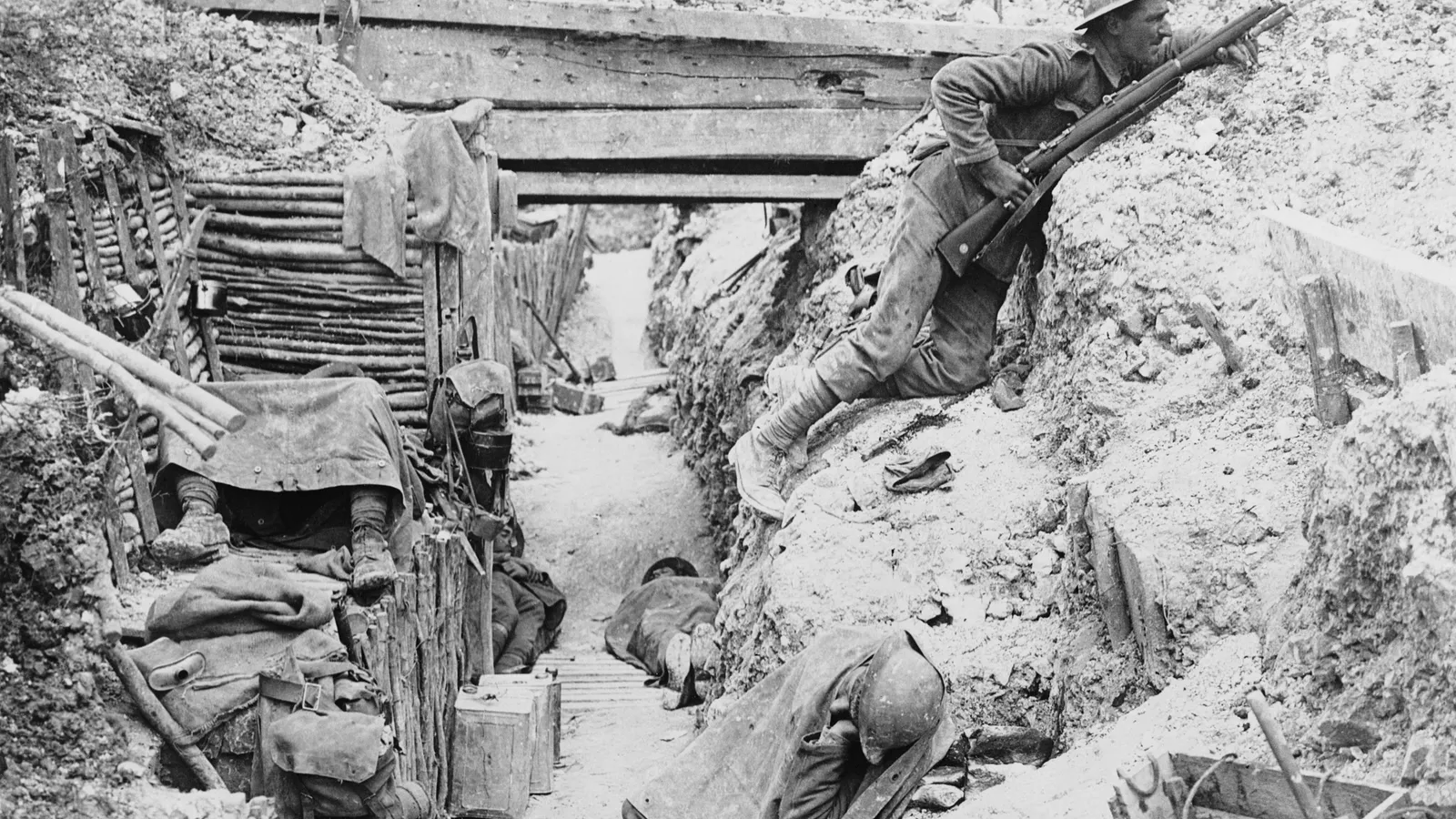
At 7:28 a.m. on 1 July 1916, a mine packed with roughly 27 tons of ammonal explosive tore open the chalk ground beneath a German strongpoint near the village of La Boisselle, throwing earth and men hundreds of feet into the air and leaving a crater more than 300 feet across. Two minutes later, whistles sounded up and down a 15-mile stretch of front in the French region of Picardy, and tens of thousands of British and French soldiers climbed out of their trenches and began walking, in long, evenly spaced lines, toward the German positions across the Somme river valley. By nightfall, the Battle of the Somme had produced the single bloodiest day in the history of the British Army, and the fighting that followed would grind on for four and a half more months, consuming well over a million casualties on both sides before the offensive finally sputtered out in the mud and early snow of November. No battle of the First World War is more closely associated with the industrialized slaughter of trench warfare, and none has left a deeper mark on how the English-speaking world remembers the conflict.
The Road to the Somme: Verdun and the Weight of Alliance
The Somme offensive was not originally conceived as a British battle at all. When Allied commanders met at Chantilly in December 1915, they agreed on a joint strategy for 1916: coordinated offensives by Britain, France, Russia, and Italy, timed to prevent Germany from shifting reserves freely between fronts. On the Western Front, this meant a combined Franco-British attack along the Somme river, chosen less for any tactical advantage than because it was the point where the British and French sectors met, allowing the two armies to attack shoulder to shoulder.
That plan changed dramatically on 21 February 1916, when the German Army launched a massive offensive against the French fortress city of Verdun, intending to grind down the French Army in a battle of attrition on ground the French could not afford to abandon for reasons of national pride and strategic geography. As Verdun consumed French divisions at a horrifying rate through the spring of 1916, the planned Somme offensive shifted in character. What had been envisioned as a roughly equal Anglo-French effort became, by necessity, a predominantly British one, with France’s contribution shrinking from an initial commitment of some 40 divisions to a much smaller force as men and guns were funneled instead toward Verdun. The Somme also took on new urgency: French commanders pressed their British counterparts to attack as soon as possible, hoping a major British offensive elsewhere on the front would draw German reserves away from Verdun and relieve the pressure on the exhausted French garrison there.
The army Britain sent to the Somme was itself a product of this alliance’s earlier years. Following the outbreak of war in 1914, Field Marshal Lord Kitchener, the newly appointed Secretary of State for War, had launched an appeal for volunteers that produced an extraordinary popular response — nearly 2.5 million men enlisted in what became known as Kitchener’s New Army. Recruiting offices encouraged men to enlist alongside friends, neighbors, and workmates in so-called Pals battalions, raised by towns, trades, and social clubs across Britain rather than by the traditional county regimental system. It was largely this New Army, trained but still relatively inexperienced in the realities of industrial warfare, that would carry the main weight of the British attack on 1 July 1916. Kitchener himself would not live to see his army’s greatest test: he drowned on 5 June 1916 when the cruiser HMS Hampshire, carrying him on a mission to Russia, struck a mine and sank off the coast of Orkney, just weeks before the offensive he had helped build toward finally began.
Commanders on Both Sides: Haig, Rawlinson, and Falkenhayn
Command of the British Expeditionary Force fell to General Sir Douglas Haig, a career cavalry officer who had taken over as Commander-in-Chief in December 1915. Haig believed the war could still be won through a decisive breakthrough on the Western Front, one that would rupture the German line, restore mobile warfare, and allow cavalry to exploit the gap into open country beyond the trenches. This ambition shaped his hopes for the Somme from the outset.
Beneath Haig, the offensive’s day-to-day planning and execution fell to General Sir Henry Rawlinson, commander of the newly formed Fourth Army, which would carry out the main assault. Rawlinson and Haig disagreed, sometimes sharply, over the offensive’s basic character. Rawlinson favored a more cautious “bite and hold” approach — seizing limited objectives, consolidating quickly, and forcing the Germans into costly counterattacks against prepared defenses — while Haig continued to press for a more ambitious breakthrough that could be exploited by cavalry waiting behind the lines. The plan that emerged by late June was, in the judgment of many historians since, an uneasy compromise between these two visions: neither fully Rawlinson’s methodical bite-and-hold nor Haig’s decisive rupture, and arguably weaker for trying to be both.
On the French side, the Somme sector fell under General Ferdinand Foch, commander of France’s Northern Army Group, with the Sixth Army under General Émile Fayolle carrying out the actual attack alongside the British. Fayolle’s forces, benefiting from more experienced troops, heavier artillery concentrations, and lessons already absorbed from earlier fighting in Artois and Champagne, performed markedly better on the opening day than their British counterparts to the north — a contrast that became one of the more uncomfortable footnotes of the battle’s first hours.
Opposing them, German forces on the Somme were commanded by General Fritz von Below, whose Second Army had spent nearly two years fortifying the chalk ridgeline above the Somme valley with deep dugouts, layered belts of barbed wire, and mutually supporting machine-gun positions. Above Below in the German chain of command stood General Erich von Falkenhayn, Chief of the German General Staff and the architect of the ongoing offensive at Verdun. Falkenhayn’s precise strategic thinking for 1916 remains a subject of historical debate — a memorandum he later claimed to have written for the Kaiser in December 1915, describing an intention to “bleed France white” at Verdun, has had its authenticity questioned by modern historians, since no copy of the original document has ever been found. Whatever his exact intentions, the twin pressures of Verdun and the Somme proved ruinous for Falkenhayn’s own position: on 29 August 1916, with both battles grinding on inconclusively and Romania having just entered the war against Germany, the Kaiser dismissed him, replacing him with the team of Field Marshal Paul von Hindenburg and General Erich Ludendorff.
Ground and Guns: Terrain and the Preliminary Bombardment
The battlefield itself favored the defenders. German positions occupied the high ground along a low chalk ridge overlooking the Somme valley, giving them clear observation over the British approach and allowing engineers nearly two years to dig deep, shell-proof dugouts into the soft chalk — bunkers that could shelter defenders 30 feet or more underground through even the heaviest bombardment. Belts of barbed wire, in places dozens of yards deep, had been strung in front of the German trenches, and machine-gun positions were sited to sweep no-man’s-land with interlocking fields of fire.
British commanders hoped to overcome these defenses with a week-long preliminary bombardment, beginning on 24 June 1916, intended to cut the German wire, destroy their trenches, and suppress their artillery before the infantry ever left their own lines. Over the following seven days, British and French guns fired more than 1.7 million shells at the German positions — an enormous expenditure of ordnance by the standards of the time, and one that convinced many British soldiers preparing to attack that nothing living could possibly survive it. The bombardment’s actual effect fell well short of these hopes. British artillery was spread thinly across the entire front rather than concentrated at key points, roughly two-thirds of the shells fired were shrapnel rounds effective against exposed troops but nearly useless against deep dugouts or barbed wire, and a high proportion — some estimates put it near 30 percent — failed to explode at all, a consequence of wartime Britain’s rushed and often inconsistent shell production. German garrisons, sheltering in their deep dugouts throughout the week-long barrage, emerged largely intact once the shelling lifted and the infantry assault began.
To supplement the bombardment, British engineers had spent months tunneling beneath several German strongpoints and packing the resulting galleries with high explosive. The largest of these, the Lochnagar mine near La Boisselle, contained some 60,000 pounds of ammonal and was detonated at 7:28 a.m. on 1 July, two minutes before the infantry assault began — the explosion remains among the largest deliberately triggered by human beings before the nuclear age, and its crater survives today as one of the most visited memorial sites on the former battlefield.
The First Day: 1 July 1916
At 7:30 a.m. on 1 July 1916, whistles blew along the British front and roughly 120,000 British soldiers climbed out of their trenches and advanced across no-man’s-land, many of them ordered to walk rather than run, in evenly spaced lines, carrying heavy loads of equipment. Along most of the line, the preliminary bombardment had failed to cut the German wire or destroy the deep dugouts, and German machine-gun crews, emerging within minutes of the shelling’s end, caught the advancing British infantry in the open with devastating effect. In some sectors, entire battalions were cut down within minutes of leaving their trenches; the Newfoundland Regiment, attacking near Beaumont-Hamel, suffered catastrophic losses — of roughly 800 men who went forward, only 68 answered roll call the following day, with the great majority of the day’s casualties inflicted within the first half hour. The Accrington Pals, a battalion raised from the Lancashire mill town of Accrington and nearby villages, suffered similarly: of some 720 men who advanced toward the village of Serre, well over 500 became casualties in around thirty minutes of fighting.
By the end of the day, British forces had suffered approximately 57,470 casualties, including roughly 19,240 men killed outright — figures that make 1 July 1916 the single deadliest day in the history of the British Army, before or since. Losses were not evenly distributed: in the southern sector of the attack, where French Sixth Army forces under Fayolle fought alongside British Fourth Army units, better artillery preparation and more experienced troops produced significant early gains, including the capture of several fortified villages along the German front line. But across the wider British sector to the north, the day was an almost unrelieved catastrophe, with virtually no ground gained relative to the casualties suffered to take it.
Haig’s own diary entry the following day, 2 July, has become one of the most quoted — and most criticized — documents to survive from the battle’s opening.
“The A.G. [Adjutant-General] reported that the total casualties are estimated at over 40,000 to date. This cannot be considered severe in view of the numbers engaged and the length of front attacked.” — Douglas Haig, diary entry, 2 July 1916
Haig’s underestimate of the true casualty figures — the actual first-day total alone exceeded his two-day estimate — has often been cited by historians as emblematic of the gulf between headquarters and the front line during the Somme offensive, though Haig’s defenders note that accurate casualty reporting in the battle’s opening chaos was genuinely difficult and that his language reflected the grim arithmetic of attrition warfare rather than simple indifference.
Attrition Through the Summer
Despite the catastrophic opening, Haig chose to continue the offensive rather than call it off, reasoning that continued pressure on the Somme remained essential to relieving Verdun and that abandoning the attack would squander the sacrifices already made. Through July and into August, the battle settled into a grinding pattern of localized attacks against individual German trench lines, woods, and fortified villages — Mametz Wood, Trônes Wood, Contalmaison, Longueval — each contested yard by yard, often changing hands more than once before being secured.
One of the more costly of these subsidiary actions came at Pozières, a village on the Albert–Bapaume road that Australian troops of the Australian Imperial Force were ordered to take starting on 23 July. Over six weeks of fighting through early September, the Australian 1st, 2nd, and 4th Divisions captured the village and the ridge beyond it, but at a cost historians have estimated at more than 23,000 Australian casualties, including nearly 6,800 dead — losses concentrated into a stretch of ground the Australian official historian Charles Bean later described as more densely shelled than any other position the AIF fought over during the entire war.
Cavalry, held in reserve throughout the campaign in the hope of the breakthrough Haig continued to anticipate, saw only limited action. On 14 July, during the Battle of Bazentin Ridge, Indian cavalry of the 9th (Secunderabad) Cavalry Brigade — including the Deccan Horse — charged German positions near High Wood in one of the few mounted actions of the entire battle, achieving only modest, temporary gains against determined machine-gun resistance before withdrawing.
The strain of the fighting fell on individual soldiers as well as on formations. Siegfried Sassoon, then a junior officer with the Royal Welch Fusiliers, was awarded the Military Cross for his conduct during operations near Mametz Wood in early July 1916; the official citation credited him with remaining under fire for ninety minutes to bring in wounded men from a raided trench.
“For conspicuous gallantry during a raid on the enemy’s trenches. He remained for 1½ hours under rifle and bomb fire collecting and bringing in our wounded. Owing to his courage and determination all the killed and wounded were brought in.” — Siegfried Sassoon’s Military Cross citation, 1916
Fellow officer and future writer Robert Graves, serving with the same regiment, was severely wounded by shell fragments near Bazentin-le-Petit on 20 July 1916 — wounds serious enough that his colonel wrote a letter of condolence to his parents, and The Times mistakenly reported him as having died of wounds. Graves survived to record his Somme experiences in his 1929 memoir Goodbye to All That, one of the most widely read personal accounts to emerge from the battle.
Delville Wood and the Colonial Contribution
Few actions during the Somme campaign illustrate the offensive’s cost, and the breadth of the empire that fought it, as starkly as the battle for Delville Wood. On 15 July 1916, the 1st South African Infantry Brigade — some 3,150 officers and men — was ordered to clear and hold the dense woodland northeast of Longueval, a position German troops fought with equal determination to recover. For six days the South Africans held the wood against repeated German artillery bombardment and infantry counterattacks, in fighting so intense that the position became known to the men who fought there as “Devil’s Wood.” When the brigade was finally relieved on 20 July, only 755 officers and men were able to answer roll call; the rest — well over 2,000 men — had been killed, wounded, or were missing. It remains, by most accounts, the costliest single action the South African Brigade fought on the Western Front, and the wood today is the site of South Africa’s national memorial to its war dead.
The Somme drew on manpower from across the British Empire and the wider Allied coalition in ways few earlier battles had. Newfoundland — at the time a separate dominion, not yet part of Canada — lost the better part of a generation of young men from its capital, St. John’s, and outlying communities in the few minutes its regiment spent advancing at Beaumont-Hamel on 1 July. Indian cavalry and infantry units served throughout the campaign, alongside troops of the Royal Naval Division and, from September onward, the Canadian Corps, whose divisions would make their own costly contribution to the fighting around Courcelette. The Somme’s casualty lists, compiled from communities scattered across five continents, gave the battle a genuinely global reach even as it was fought on a fifteen-mile stretch of French farmland.
The Tanks Arrive at Flers-Courcelette
By September 1916, with the offensive’s early ambitions long since abandoned in favor of grinding, incremental gains, Haig authorized the introduction of a new weapon that had been under secret development in Britain since early in the war: the tank. On 15 September, during the Battle of Flers-Courcelette, 49 Mark I tanks were committed to the attack, though mechanical unreliability meant only 32 reached the start line and roughly 18 made it into action at all. Where they functioned, the tanks had a genuine, if localized, psychological and tactical impact, crushing barbed wire and advancing ahead of infantry to suppress German machine-gun positions; in one celebrated instance, a single tank helped British infantry clear the village of Flers itself.
The Canadian Corps, newly arrived on the Somme after service in the Ypres Salient, fought its first major action of the battle that same day at Courcelette, capturing the fortified village and a nearby sugar refinery in fierce, often hand-to-hand fighting, at a cost of more than 7,000 Canadian casualties. It was, by the standards of the wider Somme campaign, a genuine tactical success, one of relatively few clear-cut Allied victories of the entire offensive.
The tank’s combat debut, though far from decisive, marked the beginning of mechanized warfare’s slow transformation of the battlefield — a development Winston Churchill, then out of government but a longtime advocate for the weapon’s development, watched with frustration, believing the new machines had been committed too early and in far too small numbers to achieve the breakthrough their inventors had envisioned.
“My poor ‘land battleships’ have been let off prematurely and on a petty scale.” — Winston Churchill, in a private letter, September 1916
The Battle’s Final Weeks: Mud and the Ancre
Fighting continued through the autumn in a series of further limited operations. On 26 September, after a sustained bombardment, the 18th (Eastern) Division finally captured the ruined village of Thiepval, one of the very first day’s objectives back on 1 July, at a cost of hundreds more casualties — a grimly illustrative measure of how far the offensive had fallen short of its original timetable. The final major British effort, the Battle of the Ancre, opened on 13 November 1916 in an attempt to seize the last of the ridge’s high ground before winter closed the campaign down.
By this point the ground itself had become as formidable an obstacle as the German defenders. Months of continuous shelling had pulverized the chalk soil of the battlefield, and heavy autumn rains transformed the shattered landscape into a swamp of mud deep enough to drown wounded men and swallow artillery pieces whole. Reconnaissance aircraft, essential for directing artillery fire, were grounded for days at a time by low cloud and rain. As sleet and early snow set in through mid-November, Haig finally called off the offensive on 18 November 1916, more than four and a half months after it had begun.
Immediate Aftermath
The Somme ended without the decisive breakthrough Haig had hoped for at its outset. The furthest Allied advance, achieved after nearly five months of fighting, amounted to roughly six miles at its deepest point — a strip of shattered farmland studded with the ruins of villages that had, in some cases, ceased to exist as recognizable places at all. The human cost dwarfed the territorial gain. British Empire forces suffered roughly 420,000 casualties over the course of the battle; French losses are usually put at around 200,000. German losses remain more disputed among historians, with estimates ranging from roughly 450,000 to over 600,000, reflecting long-standing disagreements over how German casualty records from the period should be interpreted and compared with Allied figures. Taken together, historians generally agree the battle produced more than a million combined casualties — killed, wounded, captured, and missing — making it one of the costliest single battles in human history.
Opinions on what, if anything, the battle achieved strategically have divided historians ever since. Some point out that the Somme succeeded in its immediate operational purpose of drawing German reserves away from Verdun, contributing to the French Army’s ability to hold that fortress through the rest of 1916. Others emphasize the offensive’s staggering cost relative to the ground gained, and argue that the volunteer New Army battalions — the Pals battalions especially — were never fully able to recover their pre-Somme character, since so many men from the same towns, streets, and workplaces had been killed or maimed within the same few weeks of fighting. What is not disputed is the scale of loss commemorated today at the Thiepval Memorial, designed by Sir Edwin Lutyens and inscribed with the names of more than 72,000 British and South African soldiers who died on the Somme before March 1918 and whose bodies were never identified or found.
Quick Facts
- Dates: 1 July – 18 November 1916
- Location: Along the Somme river, Picardy, northern France
- Commanders: Douglas Haig and Henry Rawlinson (Britain); Ferdinand Foch and Émile Fayolle (France); Erich von Falkenhayn and Fritz von Below (Germany)
- First-day British casualties: Approximately 57,470, including roughly 19,240 killed — the deadliest single day in British Army history
- Total casualties (all sides): More than one million, including roughly 420,000 British Empire, 200,000 French, and 450,000–600,000+ German (German figures remain disputed)
- Outcome: Inconclusive; limited Allied territorial gains of roughly six miles at the deepest point, no strategic breakthrough
- Notable firsts: First large-scale combat use of the tank, at Flers-Courcelette on 15 September 1916
Timeline of Key Events
- 21 February 1916: Germany launches its offensive against Verdun, altering the planned scale of the joint Anglo-French Somme offensive.
- 5 June 1916: Lord Kitchener drowns when HMS Hampshire strikes a mine off Orkney, weeks before the New Army he built goes into action.
- 24–30 June 1916: A week-long British and French preliminary bombardment fires more than 1.7 million shells at German positions.
- 1 July 1916: The battle opens; British forces suffer roughly 57,470 casualties on the single deadliest day in the British Army’s history.
- 14 July 1916: The Battle of Bazentin Ridge includes an Indian cavalry charge near High Wood.
- 15–20 July 1916: The South African Brigade holds Delville Wood against repeated German counterattacks.
- 23 July – 3 September 1916: Australian divisions capture and hold Pozières and its surrounding ridge at a cost of more than 23,000 casualties.
- 15 September 1916: The Battle of Flers-Courcelette marks the combat debut of the tank; the Canadian Corps captures Courcelette.
- 26 September 1916: British forces finally capture the village of Thiepval, an original objective from 1 July.
- 29 August 1916: Erich von Falkenhayn is dismissed as German Chief of the General Staff, replaced by Hindenburg and Ludendorff.
- 13–18 November 1916: The Battle of the Ancre marks the offensive’s final phase before deteriorating weather ends the campaign.
Legacy: Tanks, the “Lost Generation,” and the War Poets
The Somme’s most immediate technological legacy was the tank. Although its 1916 debut was hampered by unreliable machines and limited numbers, the weapon’s demonstrated potential led to steadily improved designs and tactics over the war’s remaining two years, and by 1918 tanks were being used in far larger, more coordinated formations that contributed meaningfully to the Allied victories of that year’s final offensives. Military planners in the interwar period, particularly in Germany, studied the lessons of tank warfare closely, and the armored, combined-arms doctrines that emerged would shape mechanized warfare through the Second World War and beyond.
In Britain especially, the Somme became — and has largely remained — a byword for the human cost of the First World War, occupying a place in national memory disproportionate even to its already enormous casualty toll. The concentrated losses suffered by the Pals battalions, in which men from the same street, factory floor, or football club had enlisted, trained, and often died together within the same few minutes of fighting, left visible scars on specific British towns and neighborhoods for a generation afterward — a phenomenon sometimes summarized, along with the war’s broader toll on an entire cohort of young men across Europe, by the phrase “Lost Generation.”
The battle also shaped some of the war’s most enduring literary responses, though its connections to individual writers are sometimes overstated or conflated with the wider war. Siegfried Sassoon and Robert Graves both served and were decorated or wounded on the Somme in 1916, and their wartime experiences there fed directly into the poetry and memoirs each published in the years that followed. Wilfred Owen, whose poetry is often associated in popular memory with the trenches of the Somme, did not in fact arrive in France until January 1917, after the battle had already ended; his most famous poems draw instead on his later experiences at the Somme sector in 1917–18 and elsewhere on the Western Front, a distinction worth preserving even as his work is rightly read as part of the same broader literary reckoning with industrial warfare that the Somme, more than any other single battle, came to represent.
Frequently Asked Questions
Why is 1 July 1916 considered the worst day in British military history?
British forces suffered approximately 57,470 casualties on the first day of the Somme, including roughly 19,240 men killed — more combined casualties than the British Army suffered on any other single day before or since. The losses stemmed largely from a preliminary bombardment that failed to destroy German barbed wire and deep dugouts, leaving advancing infantry exposed to machine-gun fire from largely intact defenses.
How long did the Battle of the Somme last?
The battle ran for nearly five months, from 1 July to 18 November 1916. It was fought not as a single continuous assault but as a series of distinct phases and subsidiary battles — including Bazentin Ridge, Delville Wood, Pozières, Flers-Courcelette, Thiepval Ridge, and the Ancre — as British and French forces attempted, with limited success, to push German defenders off the high ground overlooking the Somme valley.
Why did the preliminary bombardment fail to destroy the German defenses?
British artillery was spread across too wide a front to concentrate destructive force at any single point, roughly two-thirds of the shells fired were shrapnel rounds poorly suited to destroying deep fortifications or cutting wire, and a substantial proportion of shells — estimated at around 30 percent — were duds that failed to explode, a consequence of rushed wartime munitions production. German garrisons sheltering in deep dugouts largely survived the week-long bombardment intact.
What role did tanks play in the battle?
Tanks made their combat debut at the Battle of Flers-Courcelette on 15 September 1916, when 49 Mark I tanks were committed to the attack, though mechanical failures meant only around 18 actually saw action. Their impact that day was limited but noteworthy, and the operation marked the beginning of a new form of mechanized warfare that would be refined significantly over the war’s remaining years.
How many casualties did the Somme produce in total?
Combined casualties for all sides are generally estimated at more than one million, including roughly 420,000 British Empire casualties, around 200,000 French, and German losses variously estimated between 450,000 and over 600,000. Precise figures, especially on the German side, remain disputed among historians due to differences in how casualties were recorded and categorized at the time.
Did the Battle of the Somme achieve anything strategically?
Historians remain divided. The offensive helped draw German reserves and attention away from the ongoing battle at Verdun, contributing to the French Army’s ability to hold that position through 1916, and it inflicted casualties on German forces that some historians argue Germany could ill afford to sustain over a long war. Critics counter that the territorial gains — roughly six miles at the deepest point of the Allied advance — were vastly disproportionate to the casualties suffered to achieve them, and that no strategic breakthrough of the kind Haig had originally envisioned was ever achieved.
Recommended Reading
Martin Middlebrook’s The First Day on the Somme, first published in 1971, remains the definitive account of the battle’s catastrophic opening, built substantially from the testimony of surviving veterans. Peter Hart’s The Somme draws on the extensive oral history archives of the Imperial War Museum to reconstruct the battle’s full five-month course from the perspective of the men who fought it. William Philpott’s Bloody Victory: The Sacrifice on the Somme and the Making of the Twentieth Century offers a broader reassessment of the battle’s strategic significance within the wider Allied war effort, while Lyn Macdonald’s Somme and Martin Gilbert’s The Somme: Heroism and Horror in the First World War both weave firsthand testimony into narrative histories aimed at general readers seeking to understand how the battle was experienced by the soldiers who lived — and died — through it.
Read Next
August 8, 2026
The Siege of Yorktown: The Battle That Won American Independence
How Washington, Rochambeau, and a French fleet trapped Cornwallis at Yorktown in 1781, effectively ending the American Revolutionary War.
August 8, 2026
The Battle of Midway: The Turning Point of the Pacific War
How American codebreakers and a handful of dive bombers sank four Japanese carriers at Midway and turned the Pacific War.
August 8, 2026
The Battle of Gaugamela: Alexander the Great's Masterpiece
How Alexander the Great defeated a vastly larger Persian army at Gaugamela in 331 BC and effectively ended the Persian Empire.