Military History
The Battle of Midway: The Turning Point of the Pacific War
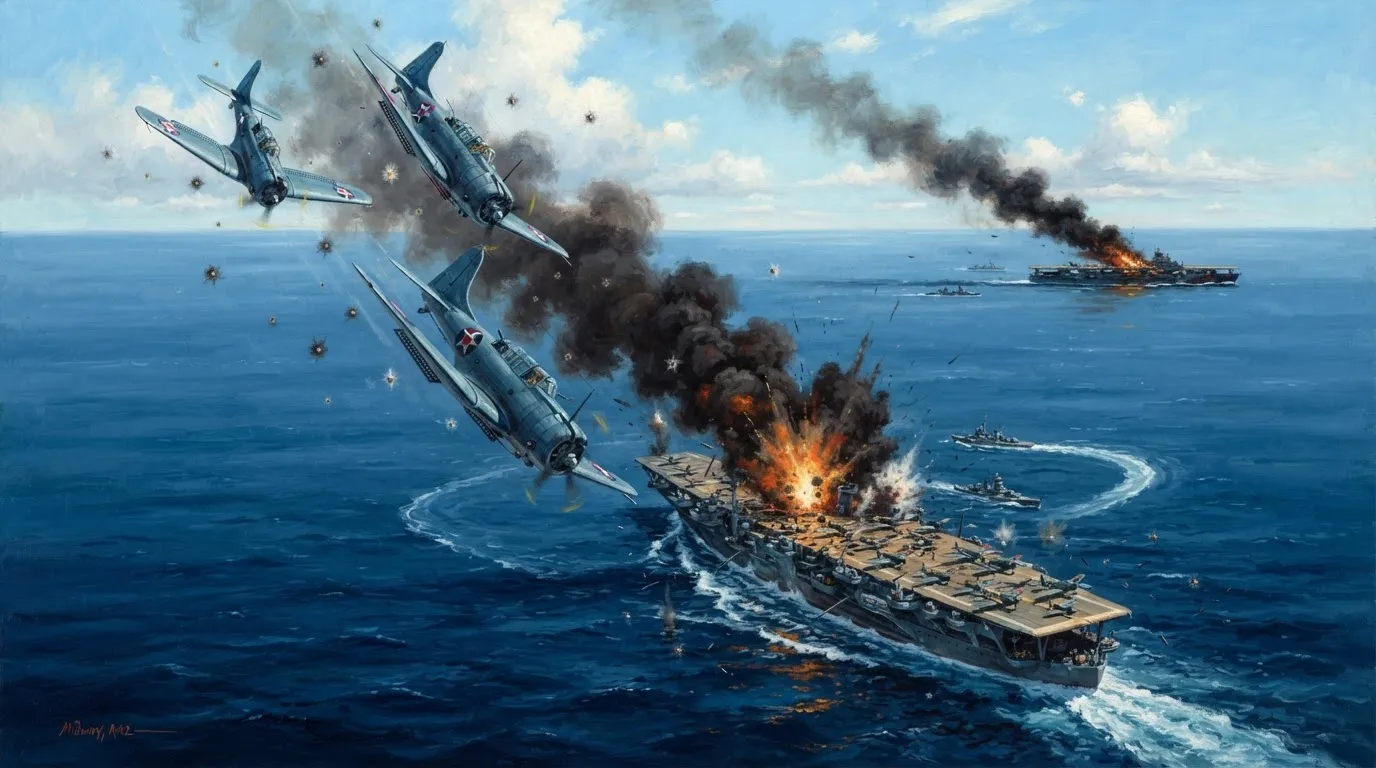
Fought over four days in June 1942, the Battle of Midway was the decisive naval engagement of the Pacific theater in World War II. Six months after the devastating surprise attack on Pearl Harbor, a heavily outnumbered American fleet inflicted a crushing defeat on the Imperial Japanese Navy, sinking four of its fleet carriers and permanently shifting the strategic balance of the Pacific War. It remains one of the most studied naval battles in history, not only for its dramatic reversal of fortune in the space of a few minutes, but for the intelligence work that made that reversal possible before a single American dive bomber ever left its flight deck.
The Pacific War After Pearl Harbor
Japan’s opening months of the Pacific War had gone almost exactly to plan. The carrier strike on Pearl Harbor on December 7, 1941, crippled the US Navy’s battleship fleet, and in the months that followed, Japanese forces swept through the Philippines, Malaya, Singapore, the Dutch East Indies, and Burma, achieving one stunning victory after another against Allied forces caught unprepared for the speed and skill of Japan’s combined-arms campaign. By the spring of 1942, Japan controlled an arc of territory stretching from the Aleutians in the north to the Solomon Islands in the south, and its naval leadership faced a strategic choice: consolidate these gains, or press the advantage further and try to finish off American naval power in the Pacific before it could recover.
American industry, still only beginning to convert to a wartime footing in early 1942, represented the long-term threat every senior Japanese planner understood but could not fully solve for. Japan’s economy, roughly a tenth the size of America’s, had no realistic path to matching the United States in sustained shipbuilding, aircraft production, or the training pipelines needed to replace lost pilots and crews. That imbalance did not matter in December 1941, when Japan held every tactical advantage of surprise and a battle-hardened, veteran carrier force without equal anywhere in the Pacific. It would matter enormously by 1943 and beyond, if the war lasted that long—which was exactly why men like Yamamoto felt such urgency to force a decisive engagement while Japan’s advantage in trained aircrews and frontline ships still held.
Admiral Isoroku Yamamoto, commander of Japan’s Combined Fleet, had studied at Harvard and served as a naval attaché in Washington, and he understood American industrial capacity better than most of his colleagues. He is widely quoted, in a version drawn from a 1941 letter to a Japanese politician and later popularized by the historian Gordon Prange, as writing that in the opening months of a war with the United States he would “run wild and win victory upon victory,” but that he had “no expectation of success” if the war dragged on—a private assessment far more cautious than the public optimism of Japan’s high command. That assessment made Yamamoto a strong advocate for seeking a decisive fleet battle as quickly as possible, before American shipyards could out-produce Japan’s navy.
Yamamoto’s Gamble
The event that hardened Yamamoto’s resolve was the Doolittle Raid of April 1942, a daring, mostly symbolic bombing raid on Tokyo launched from the carrier USS Hornet. The material damage was minor, but the psychological shock to Japan’s military leadership, who had promised the home islands were safe from attack, was significant. Yamamoto proposed an operation to seize Midway Atoll, a tiny but strategically located American base roughly 1,300 miles northwest of Hawaii, reasoning that an attack on American territory so close to Pearl Harbor would force the US Pacific Fleet to sortie in its defense, allowing Japan’s numerically superior carrier force to destroy it in a decisive battle that six months of victories had not yet delivered.
Yamamoto’s plan was elaborate, dividing the Combined Fleet into multiple widely separated groups, including a diversionary attack on the Aleutian Islands, part of Operation AL, intended to draw American attention and forces away from Midway and, Yamamoto hoped, split the US Pacific Fleet before the main battle even began. In practice, the dispersal of Japanese forces across two widely separated operations meant that Yamamoto’s powerful battleship force, and several other surface groups, were never in a position to influence the fighting around Midway itself, while Nimitz—thanks to the intelligence advantage described below—declined to take the Aleutian bait and kept his carriers concentrated near Midway instead. The plan assumed, above all, that Japan retained the element of surprise—an assumption that was no longer true.
The month before Midway had already cost Japan dearly, though not obviously so at the time. At the Battle of the Coral Sea in early May 1942, American and Japanese carrier forces fought to a tactical draw, but the strategic effect favored the United States: the Japanese light carrier Shōhō was sunk and the fleet carrier Shōkaku was damaged badly enough to require months of repair, while its sister ship Zuikaku, though undamaged, had lost so many aircrew that it could not be made ready for Midway either. Yamamoto would go into the coming battle with four fleet carriers instead of six.
Opposing Forces and Commanders
Japan’s carrier striking force, the Kidō Butai, was commanded by Vice Admiral Chūichi Nagumo, the same officer who had led the Pearl Harbor strike, aboard the fleet carrier Akagi. Under him sailed Kaga, Sōryū, and Hiryū, together carrying roughly 250 aircraft crewed by some of the most experienced naval aviators in the world, escorted by battleships, cruisers, and destroyers as part of a much larger overall operation that also included Yamamoto’s main battleship force trailing behind, out of effective supporting range.
On the American side, overall theater command rested with Admiral Chester Nimitz, commander of the Pacific Fleet, based at Pearl Harbor. Tactical command at sea was divided between Rear Admiral Frank Jack Fletcher, the senior officer afloat aboard the carrier Yorktown and in overall tactical command, and Rear Admiral Raymond Spruance, commanding Task Force 16 built around the carriers Enterprise and Hornet. Spruance was a late addition to the plan: Task Force 16’s usual commander, the aggressive and popular Vice Admiral William “Bull” Halsey, had been hospitalized with a severe skin condition in the weeks before the battle and recommended Spruance, his cruiser screen commander, as his replacement—a recommendation Nimitz accepted. Spruance had never commanded carriers in action before Midway.
Beyond the three carriers, Nimitz also had Midway Atoll itself, garrisoned with Marine, Army, and Navy aircraft and defended by Marine ground troops, and a screen of submarines positioned in a picket line to the northwest of the atoll to give early warning of the approaching Japanese fleet. None of the submarines managed to intercept Nagumo’s carriers before the battle began, a reminder that even with the codebreaking advantage, a great deal of the coming fight would still depend on timing, weather, and simple luck.
Breaking the Japanese Codes
The plan Yamamoto believed was secret had, in fact, already been substantially compromised. American naval cryptanalysts at Station HYPO in Hawaii, under the command of Commander Joseph Rochefort, had spent months working against the Imperial Japanese Navy’s operational code, designated JN-25, and by May 1942 had recovered enough of it to identify that a major operation was being planned against a target the intercepted messages referred to only by the designator “AF.” Nimitz’s intelligence staff was already confident by mid-May that “AF” meant Midway, based on patterns in Japanese traffic, but to remove any remaining doubt—and to help persuade Washington, where some codebreakers argued for a different target—Rochefort’s team arranged a simple deception: they had the Midway garrison transmit an uncoded message reporting that its freshwater distillation plant had broken down and the base was running short of water. Within days, American listening posts intercepted a Japanese message reporting that “AF” was short of water, confirming the target beyond doubt. The ruse is one of the most frequently cited case studies in the history of signals intelligence, though historians note it mainly reinforced a conclusion Nimitz’s staff had already reached rather than being the sole source of the discovery.
Armed with Japan’s own operational plan—including, in broad outline, the date of the attack and the direction from which Nagumo’s carriers would approach—Nimitz was able to do what Japan least expected: position his own carriers in ambush, northeast of Midway, rather than being caught by surprise a second time.
Nimitz’s Calculated Risk
Before the battle, Nimitz issued written orders to Fletcher and Spruance instructing them on how aggressively to engage a Japanese force they knew, even with the codebreaking advantage, still substantially outnumbered their own in carriers, aircraft, and surface ships. The order has become one of the most quoted pieces of American naval doctrine from the war:
“You will be governed by the principle of calculated risk, which you shall interpret to mean the avoidance of exposure of your force to attack by superior enemy forces without good prospect of inflicting, as a result of such exposure, greater damage to the enemy.”
In practice, this meant Fletcher and Spruance were authorized to strike hard and decisively when the opportunity arose, but were not to gamble their carriers—irreplaceable in the short term—on a battle they could not expect to win outright.
The Battle Opens: Japan Strikes Midway
Before dawn on June 4, 1942, Nagumo launched a strike of over 100 aircraft against Midway’s airfields and defenses, inflicting significant damage but failing to knock the base out of action. American radar on Midway detected the incoming raid in time to scramble the atoll’s fighters and get most of its bombers into the air ahead of the strike, but the fighters available—a mix of aging Brewster Buffalos and a handful of newer Wildcats—were badly outclassed by the Japanese Zero fighters escorting the raid, and losses among the defenders were heavy. Midway’s own aircraft—a mixed force of Marine, Navy, and Army planes, many of them obsolete types flown by inexperienced crews—attacked Nagumo’s carriers in a series of uncoordinated strikes through the morning, achieving no hits and suffering heavy losses to Japanese fighter cover and anti-aircraft fire. Based on the damage his aircraft had done to Midway, and unaware that American carriers were anywhere near the area, Nagumo ordered a second strike prepared against the atoll itself, directing that aircraft already armed with torpedoes for use against ships be rearmed with bombs suited to hitting land targets—a time-consuming process that would prove catastrophic.
Around 7:30 a.m., a scout plane from the cruiser Tone, which had been delayed in launching by roughly half an hour due to a mechanical problem, finally reported American surface ships—and, in a follow-up report, an American carrier—in the area. Nagumo now faced an agonizing decision: launch an immediate strike with the mixed, partially rearmed aircraft he had on hand, or wait to recover his returning Midway strike force, rearm everything properly for an anti-ship attack, and launch a single coordinated blow. He chose to wait, ordering his flight decks cleared and his aircraft rearmed again with torpedoes—a second reversal that left bombs, torpedoes, and fuel hoses cluttering the hangar decks of his carriers just as American aircraft were closing in.
Torpedo Squadrons Sacrificed
The first American carrier aircraft to find the Japanese fleet were three squadrons of TBD Devastator torpedo bombers, slow, lightly armed aircraft that proved catastrophically vulnerable without fighter escort. Torpedo Squadron 8, flying from Hornet under Lieutenant Commander John C. Waldron, located Nagumo’s carriers and attacked alone, without any of the promised fighter cover. Before the battle, Waldron had briefed his men in terms that anticipated exactly the fate that awaited them:
“My greatest hope is that we encounter a favorable tactical situation, but if we don’t, and the worst comes to the worst, I want each of you to do his utmost to destroy our enemies. If there is only one plane left to make a final run-in, I want that man to go in and get a hit.”
All fifteen of Torpedo 8’s aircraft were shot down, and every man aboard them was killed except one, Ensign George Gay, who survived in the water and watched the rest of the battle unfold from a life raft. Torpedo squadrons from Enterprise and Yorktown attacked in the following minutes with similarly devastating losses and, like Waldron’s squadron, achieved no hits. In pure tactical terms, the torpedo attacks were a disaster. Strategically, they proved decisive: they drew Nagumo’s covering fighters down to low altitude to deal with the threat, stripping away the high-altitude protection over his carriers at the precise moment American dive bombers, arriving from a different direction almost by chance, appeared overhead.
The Five Fateful Minutes
Air Group Commander C. Wade McClusky, leading Enterprise’s dive bombers, found the search area where he expected Nagumo’s carriers to be empty and, running low on fuel, made the consequential decision to extend his search rather than turn back—a gamble justified when his group spotted the wake of a Japanese destroyer racing to rejoin the fleet and followed it to Nagumo’s carriers. Arriving overhead at roughly the same time as Yorktown‘s dive bombers approaching from another direction, McClusky’s and Lieutenant Commander Max Leslie’s squadrons found Japanese fighters still down at low altitude chasing the remnants of the torpedo attacks, and the carriers’ flight decks and hangars packed with fueled, armed aircraft in the middle of being rearmed—exactly the volatile combination Nagumo’s indecision had created.
In a span of roughly five minutes beginning around 10:22 a.m., American dive bombers struck Akagi, Kaga, and Sōryū in near-simultaneous attacks. Bombs that penetrated to hangar decks stacked with ordnance and fuel triggered secondary explosions that turned all three ships into infernos within minutes. All three carriers were left burning wrecks; Sōryū and Kaga sank later that day, while Akagi, though her fires eventually proved unsalvageable, was finished off by a Japanese destroyer’s torpedoes on Yamamoto’s order the following morning rather than being sunk outright by American bombs. Nagumo, forced to transfer his flag from the burning Akagi to the cruiser Nagara, had lost three-quarters of his carrier force in the time it took to read this paragraph aloud.
Hiryū’s Counterattack and the Loss of Yorktown
Only Hiryū, the fourth Japanese fleet carrier, remained operational, and its commander, Rear Admiral Tamon Yamaguchi, wasted no time launching counterattacks. Two waves of dive bombers and torpedo bombers from Hiryū found and struck Yorktown through the afternoon of June 4, leaving the American carrier dead in the water and eventually forcing her crew to abandon ship. American dive bombers located Hiryū later that same afternoon and set her ablaze in an attack that mirrored the morning’s devastation of her three sister ships; she sank early the next morning. With Hiryū’s loss, Japan’s entire carrier striking force at Midway had been destroyed in barely twenty-four hours.
Yorktown did not sink immediately. Salvage crews kept her afloat and under tow for two more days, until the Japanese submarine I-168 penetrated her escorting destroyer screen on June 6 and put torpedoes into both Yorktown and the destroyer USS Hammann, which had come alongside to assist with salvage operations. Hammann sank within minutes; Yorktown, mortally wounded, rolled over and sank early on the morning of June 7, 1942, the only American carrier lost in the battle.
The Reckoning: Casualties and Losses
The disparity in losses reflected the scale of Japan’s defeat. Japanese forces lost four fleet carriers, a heavy cruiser (Mikuma, sunk on June 6 after colliding with her sister ship Mogami during the retreat and then being caught and wrecked by American carrier aircraft), roughly 248 aircraft, and more than 3,000 sailors and airmen killed, including a disproportionate number of the Imperial Navy’s most experienced pilots, mechanics, and flight-deck crew—losses Japan’s training pipeline never fully replaced for the rest of the war. American losses, while real, were far smaller in scale: one fleet carrier, one destroyer, roughly 150 aircraft, and 307 dead.
The wreckage of the battle left a grim postscript in the water east of Midway for days afterward: rafts of survivors from sunk ships on both sides, downed aircrews drifting in the open Pacific, and, in the case of Ensign George Gay of Torpedo 8, a lone survivor who spent more than thirty hours in the water, at one point hiding beneath his seat cushion as Japanese ships passed nearby, before being rescued by a PBY patrol plane.
Admiral Nimitz’s official communiqué to the fleet on June 6, 1942, while the battle’s final actions were still unfolding, captured the moment with characteristic understatement and a dry pun on the atoll’s name:
“Pearl Harbor has now been partially avenged. Vengeance will not be complete until Japanese sea power has been reduced to impotence. We have made substantial progress in that direction. Perhaps we will be forgiven if we claim that we are about midway to that objective.”
Why Midway Still Matters
Midway is widely regarded as the turning point of the Pacific War, though historians caution it did not end the conflict by itself—brutal fighting lay ahead at Guadalcanal, the Solomons, and across the central Pacific for another three years, much of it grindingly close-fought rather than decided in a single stroke the way Midway had been. What Midway did was end, in a single morning, any realistic Japanese hope of destroying American naval power before US industrial capacity made that impossible. Japan’s carrier fleet, the core of its naval striking power, never fully recovered from the loss of four fleet carriers and their veteran aircrews in one battle. The pilots and flight-deck crews lost at Midway had, in many cases, years of combat experience dating back to Japan’s war in China in the 1930s; Japan’s wartime training programs, chronically under-resourced compared to the American pipeline that would soon be turning out thousands of new naval aviators a year, never fully closed that gap. American shipyards, by contrast, would launch more than two dozen fleet and light carriers over the next three years, a productive capacity Japan could never hope to match. From Midway onward, the strategic initiative in the Pacific shifted permanently to the United States: within two months, American forces had landed on Guadalcanal, opening a grueling six-month campaign that, unlike Midway, ground down through attrition rather than a single decisive engagement, setting the pattern for the island-hopping campaign that carried American forces from the Solomons to Okinawa by 1945.
The battle is also a frequently cited case study in the role of intelligence and codebreaking in modern warfare. American commanders’ ability to anticipate Japan’s plan turned what Yamamoto intended as a decisive ambush into one instead—a reversal that decided the entire battle before the first shots were fired, and one that historians and military planners have studied ever since as an example of how intelligence, properly acted upon, can offset a substantial disadvantage in raw material strength. Equally important, and less often celebrated, was the human cost of the men who bought that intelligence advantage time to matter: the pilots of the doomed torpedo squadrons, who found the enemy fleet and died attacking it without support, pulled Japanese fighter cover down to sea level at exactly the moment the dive bombers needed the sky above Nagumo’s carriers left empty.
Timeline of Key Events
- December 7, 1941 – Japan attacks Pearl Harbor, bringing the United States into the Pacific War.
- April 18, 1942 – The Doolittle Raid bombs Tokyo, hardening Yamamoto’s resolve to force a decisive battle.
- May 4–8, 1942 – The Battle of the Coral Sea damages the Japanese carrier Shōkaku and depletes Zuikaku’s air group, keeping both out of the coming battle.
- Mid-May 1942 – US Navy codebreakers at Station HYPO identify “AF” as the likely target of Japan’s next major operation.
- Late May 1942 – The “water shortage” ruse confirms Midway as target “AF”; Nimitz positions Task Forces 16 and 17 in ambush northeast of Midway.
- June 4, 1942, dawn – Nagumo’s carriers launch a strike on Midway Atoll; American land- and carrier-based aircraft counterattack throughout the morning.
- June 4, 1942, ~10:22 a.m. – American dive bombers strike and cripple Akagi, Kaga, and Sōryū within minutes.
- June 4, 1942, afternoon – Hiryū’s aircraft cripple Yorktown; American dive bombers locate and set Hiryū ablaze in return.
- June 5–6, 1942 – Japanese cruisers Mogami and Mikuma collide during the retreat; Mikuma is sunk by American carrier aircraft.
- June 6, 1942 – Submarine I-168 torpedoes Yorktown and sinks the destroyer Hammann.
- June 7, 1942 – Yorktown sinks, marking the end of major action in the battle.
Quick Facts
- Dates: June 4–7, 1942
- Location: Near Midway Atoll, central Pacific Ocean
- Commanders: Chester Nimitz and Frank Jack Fletcher (United States) vs. Isoroku Yamamoto (Japan)
- Losses: 4 Japanese fleet carriers sunk vs. 1 American carrier (USS Yorktown); roughly 3,057 Japanese dead vs. 307 American dead
- Outcome: Decisive American victory
Frequently Asked Questions
Why was Midway such an important target for Japan?
Midway Atoll sat close enough to Hawaii to threaten Pearl Harbor directly and far enough from the American mainland that Yamamoto believed the US Pacific Fleet would have to sortie to defend it. He hoped to lure American carriers into a battle where Japan’s numerical advantage in ships and aircraft would let his navy finish the job it had started at Pearl Harbor.
How did American codebreakers know Japan was planning to attack Midway?
Cryptanalysts at Station HYPO in Hawaii, led by Commander Joseph Rochefort, had partially broken Japan’s JN-25 operational code and identified references to a target designated “AF.” Nimitz’s staff already suspected AF meant Midway; a ruse in which Midway transmitted an uncoded message about a fake water shortage, intercepted and repeated in Japanese traffic referring to “AF,” removed any remaining doubt before the battle.
Why did the American torpedo bomber squadrons suffer such heavy losses?
The TBD Devastator was already an obsolete, slow aircraft by 1942, and the torpedo squadrons attacked without fighter escort, arriving ahead of the dive bombers and flying directly into concentrated Japanese fighter cover and anti-aircraft fire. Nearly all of the torpedo bomber crews from all three American carriers were shot down without scoring a single hit. Their sacrifice, however, pulled Japanese fighters down to low altitude just before American dive bombers arrived overhead largely unopposed.
What was Nagumo’s fatal mistake?
Nagumo repeatedly changed his mind about how to arm his aircraft—first preparing a second strike on Midway with bombs, then reversing course to rearm for an anti-ship attack after American ships were spotted—leaving his carriers’ flight decks and hangars cluttered with fuel, bombs, and torpedoes at the exact moment American dive bombers attacked. Historians continue to debate how much of this was avoidable given the information available to him at the time, but the timing proved catastrophic regardless of intent.
How many carriers did each side have at Midway?
Japan committed four fleet carriers under Nagumo’s direct command (Akagi, Kaga, Sōryū, and Hiryū), all of which were sunk. The United States had three carriers (Enterprise, Hornet, and Yorktown), of which Yorktown was lost.
Did the Battle of Midway end the Pacific War?
No. Midway ended Japan’s ability to threaten American naval supremacy in a single decisive stroke, but the war in the Pacific continued for more than three additional years, through the grinding Solomon Islands and Guadalcanal campaigns, the island-hopping advance across the central Pacific, and finally the atomic bombings and Japanese surrender in August 1945.
Recommended Reading
Shattered Sword: The Untold Story of the Battle of Midway by Jonathan Parshall and Anthony Tully is widely regarded as the definitive modern account, drawing extensively on Japanese-language sources to correct long-standing myths about the battle. Walter Lord’s Incredible Victory, first published in 1967, remains a classic narrative account built from interviews with veterans of the battle, and Craig L. Symonds’s The Battle of Midway, part of the Oxford Pivotal Moments in American History series, offers a more recent scholarly synthesis of the intelligence, planning, and combat that decided the engagement.
Read Next
August 8, 2026
The Battle of Gaugamela: Alexander the Great's Masterpiece
How Alexander the Great defeated a vastly larger Persian army at Gaugamela in 331 BC and effectively ended the Persian Empire.
August 8, 2026
The Battle of Trafalgar: Nelson's Decisive Victory at Sea
How Nelson's outnumbered fleet destroyed the combined French and Spanish navy at Trafalgar in 1805, securing British naval dominance.
August 8, 2026
Genghis Khan and the Mongol Conquests
How Genghis Khan built the largest contiguous land empire in history through speed, discipline, and a radically mobile army.