Military History
The Battle of Austerlitz: Napoleon's Greatest Victory
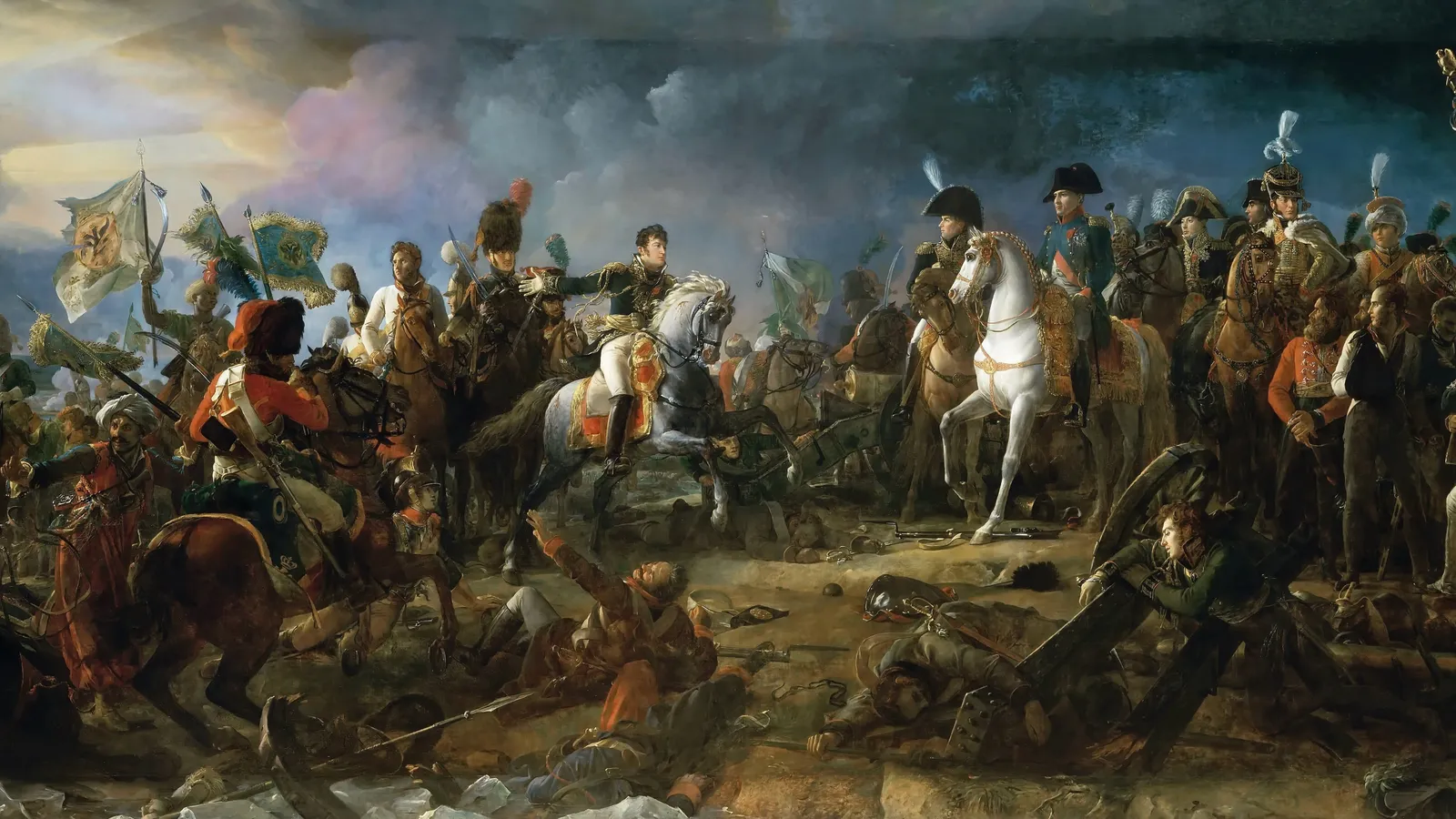
On the morning of December 2, 1805, a thick fog lay over a low ridge in Moravia, in what is today the Czech Republic. Three emperors and roughly 158,000 soldiers were converging on a stretch of farmland near a small town called Austerlitz. By early afternoon, one of those emperors had shattered the armies of the other two so completely that the coalition arrayed against him would collapse within weeks. Napoleon Bonaparte would later rank the battle as the finest of his career, and history has generally agreed with him: Austerlitz is still taught in military academies as the closest thing to a perfect battle that the era of massed armies produced.
The date was not an accident. Exactly one year earlier, on December 2, 1804, Napoleon had crowned himself Emperor of the French at Notre-Dame. Austerlitz became his self-styled anniversary gift to the empire — a victory so complete that contemporaries and later historians alike dubbed it the Battle of the Three Emperors, for Napoleon, Austria’s Francis II, and Russia’s Tsar Alexander I were all present on the field or nearby, each with a personal stake in the outcome. This article traces how the battle came about, how Napoleon engineered the trap that destroyed the allied armies, what actually happened on the ice of the Satschan and Menitz ponds, and why the campaign still shapes how militaries think about deception, tempo, and decisive battle more than two centuries later.
Background: The War of the Third Coalition
Austerlitz did not begin as a Central European campaign at all. Through much of 1805, Napoleon’s army — then styled the Armée d’Angleterre — sat encamped along the Channel coast at Boulogne, over 200,000 men poised for an invasion of Britain that depended on the French and Spanish fleets winning temporary control of the Channel. That naval gamble collapsed well before Admiral Villeneuve’s fleet met its end at Trafalgar in October; by late August 1805, Napoleon had already accepted that the invasion of England was off, and Austria and Russia had formed the Third Coalition with Britain, aiming to check French power on the continent.
Napoleon’s response was one of the most audacious redeployments in military history. He turned his Channel invasion force inland, marched it across France and the German states, and reorganized it as the Grande Armée. Rather than wait for the Austrians and Russians to combine their forces, he drove east at a pace that stunned his opponents, seven corps advancing on separate roads to converge on the Austrian army under General Karl Mack, which had pushed forward into Bavaria and taken up a defensive position at Ulm. Mack’s plan depended on Russian reinforcements under Mikhail Kutuzov arriving in time to support him. They did not. French corps enveloped Ulm from multiple directions, cutting Mack off from retreat, and on October 20, 1805, he surrendered the bulk of his army — roughly 25,000 men — without the general engagement he had expected to fight. It was a campaign won largely through marching and maneuver rather than pitched battle, and it is still studied as a model of operational envelopment.
The destruction of Mack’s army did not end the war. Kutuzov’s Russian force, along with the Austrian remnants that had escaped Ulm, fell back into Moravia, trading space for time while reinforcements gathered. Napoleon pursued, occupying Vienna in mid-November, but his own army was now stretched thin, far from its supply lines, with autumn turning to winter and Prussia’s intentions still uncertain. Napoleon needed a decisive battle, and he needed it on his own terms — which is precisely what he engineered at Austerlitz.
The Opposing Forces and Commanders
The armies that met near Austerlitz were unevenly matched on paper. The Grande Armée fielded somewhere between 65,000 and 75,000 men with roughly 157 guns, while the combined Austro-Russian force numbered close to 85,000–89,000 troops backed by well over 300 cannon. Napoleon was, by design, outnumbered — a fact he used deliberately to bait his opponents into overconfidence.
Napoleon Bonaparte commanded in person, as he nearly always did, with a headquarters staff that coordinated the movements of his corps commanders with a speed the allies could not match. Chief among his subordinates that day was Marshal Jean-de-Dieu Soult, whose IV Corps had been quietly withdrawn from the critical Pratzen Heights days before the battle, setting up the maneuver that would decide the day. Marshal Louis-Nicolas Davout, having driven his III Corps north from Vienna in a forced march of roughly 110 kilometers in under 48 hours, arrived just in time to anchor the French right flank against a much larger allied force. Marshal Jean Lannes held the French left, Marshal Jean-Baptiste Bernadotte’s I Corps stood in reserve near the center, and cavalry under Marshal Joachim Murat screened the French left and center.
On the allied side, command was split in a way that proved disastrous. Tsar Alexander I of Russia and Emperor Francis II of Austria were both present with the army, and both were eager for a battle that would avenge Ulm. Nominal command rested with the elderly Russian general Mikhail Kutuzov, a cautious and experienced soldier who favored delay, drawing Napoleon further from his supply lines while allied reinforcements — including a Russian corps still marching from the east and a Prussian army that might yet join the coalition — continued to gather. Kutuzov was overruled. The young Tsar, eager to prove himself and influenced by advisors who underestimated Napoleon, backed an aggressive battle plan instead. That plan was drafted by the Austrian chief of staff Franz von Weyrother, an elaborate scheme built around a sweeping attack on the French right flank by the bulk of the allied infantry, in columns commanded by Friedrich Wilhelm von Buxhoeveden with Dmitry Dokhturov leading the lead column, while Prince Pyotr Bagration held the allied right and Austrian cavalry under Prince Johann von Liechtenstein covered the center. It was a plan built for the army the allies wished they had, not the one across the valley from them — and Napoleon had all but written it for them.
The disparity in command culture between the two sides mattered as much as the disparity in numbers. Napoleon’s corps commanders were battle-hardened veterans who had worked together, in various combinations, across years of campaigning; orders moved down the French chain of command quickly and were executed with a shared understanding of the emperor’s intent. The allied army, by contrast, was a coalition force in the fullest sense — Austrian and Russian units operating under different languages, different staff procedures, and, on the morning of the battle, different levels of confidence in the plan they had been handed. Weyrother’s dispositions required close coordination among four separate columns advancing over difficult ground in darkness and fog, a level of synchronization that a unified, veteran army might have struggled to achieve and that a fractious coalition force had little chance of matching.
Napoleon’s Deliberate Deception
The core of Napoleon’s plan at Austerlitz was psychological as much as tactical. In the days before the battle, he deliberately advertised weakness where he intended to be strong, and concealed strength where he intended to strike.
The clearest example was the Pratzen Heights, a low but commanding ridge that dominated the ground between the two armies. Whoever held the Heights controlled the field. Rather than fortify the position, Napoleon ordered it abandoned, pulling Soult’s corps back and inviting the allies to occupy the high ground themselves. To officers accustomed to conventional principles of holding key terrain, surrendering the Pratzen Heights looked like weakness or even the beginning of a French retreat. It was neither. Napoleon wanted the allies to believe the ridge — and the French position behind it — were vulnerable enough to gamble on a decisive stroke.
At the same time, Napoleon thinned his own right flank near the villages of Telnitz and Sokolnitz, south of the Pratzen Heights, leaving it defended by a comparatively small force under Marshal Louis Davout — that same Davout who would arrive from Vienna only in the battle’s opening hours. A weak French right, combined with an apparently abandoned central ridge, presented the allied high command with what looked like an unmissable opportunity: swing the bulk of their army around the French right, cut Napoleon off from Vienna, and crush him against the Pratzen Heights that Weyrother’s plan assumed the allies would already control. Napoleon had, in effect, designed the battlefield he wanted his enemy to attack.
“Soldiers, I will myself direct all your battalions. I will keep myself at a distance from the fire, if, with your accustomed valor, you carry disorder and confusion into the enemies’ ranks. But should victory appear for a moment uncertain, you will see your Emperor expose himself to the first strokes.” — Napoleon, proclamation to the Grande Armée, December 1, 1805
The Terrain: Heights and Frozen Ponds
Understanding Austerlitz requires understanding its ground. The Pratzen Heights ran roughly north to south between the two armies, a gentle but militarily decisive rise that offered clear sightlines over most of the surrounding country. South of the Heights, the terrain dropped toward a chain of streams, marshy ground, and two artificial fishponds — the Satschan Pond and the Menitz Pond — both frozen over in the early December cold. These ponds and the boggy stream valleys around Telnitz and Sokolnitz constricted movement for any large force operating in that sector, funneling troops onto narrow causeways and frozen surfaces that could turn from an asset into a deathtrap depending on which way a battle broke.
North of the Heights, the ground opened into rolling country better suited to cavalry and the kind of rapid maneuver that would characterize the fighting around the Santon and Zuran hills, where French reserves and cavalry waited. The contrast mattered enormously: Napoleon built his plan around the assumption that the allies would commit the bulk of their strength to the constrained southern ground near the ponds, while he kept his own striking force positioned to exploit the open center once the Pratzen Heights had been stripped of allied defenders.
The Trap Is Set
By the night of December 1, both sides had effectively finished their dispositions, though only one commander understood what was actually about to happen. Weyrother had briefed the allied generals on an elaborate plan built around four infantry columns, plus cavalry and a reserve, all directed at enveloping the French right south of the Pratzen Heights. Kutuzov reportedly said little during the briefing and, according to several accounts, fell asleep partway through — a detail often repeated to illustrate his skepticism of a plan he had not designed and did not believe in, though it should be read as an anecdote rather than a settled fact.
Napoleon, by contrast, had ridden his own lines that evening and, according to French accounts, was greeted by soldiers who lit torches and straw bundles to mark the first anniversary of his coronation — a scene later mythologized in French popular memory as the eve of a foreordained triumph. Whatever the precise truth of the torchlight story, Napoleon’s actual dispositions were exact: Davout’s corps, still marching hard from Vienna, was ordered to reach the Telnitz-Sokolnitz sector by dawn to blunt the expected allied assault; Soult’s corps was concealed in low ground and fog near the base of the Pratzen Heights, ready to storm back up the slope the moment the allied center was stripped of troops; Lannes and Murat held the French left and center-left; and Bernadotte’s corps waited in reserve. The fog that settled over the valley that night, and lingered into the following morning, would prove to be an unplanned ally of the French deception, hiding Soult’s corps until the critical moment.
The Allies Take the Bait
At first light on December 2, the allied columns under Buxhoeveden began their advance exactly as Weyrother had planned, pushing south of the Pratzen Heights toward Telnitz and Sokolnitz in an effort to turn the French right. Fighting there was fierce and, for several hours, genuinely uncertain — Davout’s outnumbered troops, freshly arrived from their forced march, held the villages through repeated attacks, buying the time Napoleon’s broader plan required. The allied commanders, believing they were making progress against a weak French flank exactly as anticipated, kept feeding troops into the southern sector.
This was the crux of Napoleon’s gamble. As allied infantry columns continued marching south and west to reinforce the attack on Telnitz and Sokolnitz, they progressively emptied the Pratzen Heights of defenders, exactly as the French plan required. From his command post, Napoleon reportedly watched the allied columns stream off the ridge and remarked to his staff that the battle was already won, needing only a matter of time to finish. The precise wording attributed to him in popular accounts of this moment varies between sources and cannot be verified to a single authoritative text, so it is best treated as a paraphrase of the moment rather than a direct quotation. What is well documented is the decision that followed: with the Heights thinning of allied troops and the morning fog beginning to lift, Napoleon gave Soult the order to advance.
Soult Storms the Pratzen Heights
Soult’s IV Corps had spent the early morning hidden in low ground, screened by fog thick enough that allied lookouts on the Pratzen Heights could not make out the French formations below them. Around 9 a.m., as the sun began burning through the mist — a detail later inflated in French commemorative art and post-battle legend into the supposedly providential “sun of Austerlitz” — Soult’s divisions surged up the slope directly at the weakly held center of the allied line.
The assault caught the allied high command by surprise. The Pratzen Heights, which Weyrother’s plan had assumed would remain safely in allied hands throughout the battle, fell to French troops in a matter of hours, splitting the allied army in two. With the Heights in French hands, Soult’s corps, together with the Imperial Guard and Bernadotte’s reserve, wheeled to strike the flanks and rear of the allied columns still engaged around Telnitz and Sokolnitz to the south, and the allied right under Bagration to the north. What had begun the morning as an allied offensive built around Weyrother’s plan collapsed, within a few hours, into a fight for survival across nearly the entire allied line. By early afternoon, the allied position had disintegrated into separate, uncoordinated pockets of resistance, and the retreat that followed turned into one of the most consequential — and most disputed — episodes of the battle.
The Retreat Across the Ice
As the French center and Guard cavalry pressed south from the captured Pratzen Heights, the allied troops who had spent the morning fighting around Telnitz and Sokolnitz found their line of retreat increasingly constrained by the terrain that had helped bait them into the attack in the first place. Columns retreating from the collapsing southern flank were funneled toward the frozen surfaces of the Satschan and Menitz ponds, with French artillery, positioned on the high ground the allies had just lost, firing down into the retreating mass.
Napoleon’s own bulletins after the battle described French guns deliberately shattering the ice beneath retreating Russian columns, drowning large numbers of men, horses, and guns in the freezing water — a scene that quickly became one of the most vivid and widely repeated images of the entire Napoleonic Wars, reproduced in paintings, prints, and later histories for generations. It remains one of the battle’s most enduring set-pieces. It is also, as discussed below, one of its most historically contested.
The Disputed Legend of the Frozen Ponds
The story of the ice-drownings at Austerlitz illustrates how battlefield propaganda can calcify into accepted history. Napoleon’s official bulletins, written and circulated within days of the battle for maximum political effect at home and abroad, described the destruction of an entire allied column in the icy waters south of the battlefield, with casualty figures in the thousands. The image was dramatic, useful, and — crucially — largely unverifiable at the time, since it described chaotic events on a smoke- and fog-obscured field, reported by the victorious side with every incentive to maximize the scale of the enemy’s disaster.
Modern historians have treated the story with considerably more caution than nineteenth-century popular accounts did. There is little dispute that French artillery did fire on the retreating allied columns near the ponds, and that some men, horses, and guns went into the water as the ice gave way under the weight of retreating troops and artillery. What is disputed is the scale. Later excavation and drainage of the ponds — most notably during twentieth-century engineering and construction work in the area — reportedly failed to turn up anything approaching the thousands of drowned soldiers and horses that the most dramatic retellings of the battle describe, casting real doubt on the bulletin figures. Historians who have examined the episode closely, including specialists on the campaign such as Robert Goetz, have generally concluded that the death toll from drowning was real but far smaller than Napoleon’s own propaganda claimed, with total allied losses in that sector — from combat, capture, and the retreat across the ice combined — better explaining the scale of the disaster than the ice alone.
None of this erases the ponds from the story of Austerlitz. Men did die there, guns and wagons were lost in the water, and the retreat through that terrain was a real catastrophe for the allied units caught in it. But the popular image of an entire army swallowed by the ice owes at least as much to Napoleon’s talent for battlefield theater as to the archaeological and documentary record. A responsible account of Austerlitz repeats the story, because it is part of how the battle was remembered and mythologized — but repeats it as a contested legend shaped by propaganda, not as settled fact.
Aftermath: The Treaty of Pressburg
The scale of the allied defeat was, regardless of the ice, difficult to overstate. Commonly cited figures put French casualties at roughly 9,000 — around 1,300 to 1,500 killed, close to 7,000 wounded, and several hundred captured or missing — against allied losses estimated between 27,000 and 36,000, including 12,000 or more taken prisoner, alongside more than 180 guns, dozens of captured standards, and vast quantities of abandoned equipment. The Russian army that had marched into Moravia expecting to crush Napoleon between two fronts limped back toward its own borders. Austria, whose main field army had already been lost at Ulm before the battle even began, had nothing left with which to continue the war.
Emperor Francis II sought terms within days. A truce was agreed on December 4, just two days after the battle, and formal negotiations produced the Treaty of Pressburg, signed on December 26, 1805, in the city now known as Bratislava. Austria’s losses were severe: Venetia, Istria, and Dalmatia passed into Napoleon’s Kingdom of Italy; Tyrol and Vorarlberg went to Bavaria, one of Napoleon’s German allies; scattered Austrian territories in Swabia were handed to Baden and Württemberg; and Austria was compelled to pay an indemnity of 40 million francs. In partial compensation, Austria received the Electorate of Salzburg, but the treaty amounted to a comprehensive humiliation, stripping the Habsburg monarchy of territory, revenue, and prestige in a single stroke.
The political consequences reached beyond Austria itself. The Third Coalition, which had brought Britain, Austria, and Russia together against France, effectively dissolved — Britain’s naval supremacy after Trafalgar had already secured the seas, but on land the coalition’s continental strategy lay in ruins. Within months, Napoleon reorganized the German states loyal to him into the Confederation of the Rhine, a French-aligned bloc that rendered the old imperial structure meaningless. On August 6, 1806, Francis II formally abdicated as Holy Roman Emperor and dissolved the Holy Roman Empire outright, an institution that had nominally governed Central Europe for roughly a thousand years. Austerlitz did not single-handedly end the Empire, but it set in motion the chain of events — Pressburg, the Confederation of the Rhine, and Francis’s abdication — that finished it within a year.
“I am satisfied with you. In the Battle of Austerlitz you have justified all that I expected from your intrepidity. You have covered your eagles with immortal glory. An army of one hundred thousand men, commanded by the Emperors of Russia and Austria, has been, in less than four hours, either cut in pieces or dispersed.” — Napoleon, proclamation to the Grande Armée, December 3, 1805
Quick Facts
- Date: December 2, 1805
- Location: Near Austerlitz (present-day Slavkov u Brna, Czech Republic), Moravia
- Belligerents: French Empire vs. the Third Coalition (Russian Empire and Austrian Empire)
- Commanders: Napoleon Bonaparte (France); Tsar Alexander I, Emperor Francis II, and General Mikhail Kutuzov (allies)
- French strength: Roughly 65,000–75,000 troops, 157 guns
- Allied strength: Roughly 85,000–89,000 troops, over 300 guns
- French casualties: Approximately 9,000 (killed, wounded, captured/missing)
- Allied casualties: Approximately 27,000–36,000, including 12,000+ captured, plus over 180 guns lost
- Outcome: Decisive French victory; effective collapse of the Third Coalition
- Key consequence: Treaty of Pressburg (December 26, 1805); the Holy Roman Empire dissolved the following year
- Popular name: The “Battle of the Three Emperors”
Timeline of Key Events
- August 1805 — Napoleon abandons plans to invade Britain and turns the Grande Armée east toward Austria.
- Late September–October 1805 — The Ulm campaign: French corps encircle the Austrian army under General Mack.
- October 20, 1805 — Mack surrenders at Ulm, losing roughly 25,000 men without a major battle.
- November 1805 — Napoleon occupies Vienna; allied forces withdraw into Moravia to regroup.
- December 1, 1805 — Napoleon issues his pre-battle proclamation; allied commanders finalize Weyrother’s attack plan.
- December 2, 1805 — The Battle of Austerlitz. Allied columns attack the French right at Telnitz and Sokolnitz; Soult storms the Pratzen Heights; the allied army collapses by early afternoon.
- December 3, 1805 — Napoleon issues his victory proclamation to the Grande Armée.
- December 4, 1805 — A truce is agreed between France and Austria.
- December 26, 1805 — The Treaty of Pressburg is signed, ending Austria’s participation in the war.
- August 6, 1806 — Emperor Francis II abdicates as Holy Roman Emperor, formally dissolving the Holy Roman Empire.
Legacy and Historical Significance
Austerlitz occupies a singular place in the study of military history, not simply because Napoleon won, but because of how completely the victory validated a coherent operational philosophy: concentrate deceptive weakness where you want the enemy to attack, conceal genuine strength where you intend to strike, and use tempo — marching and maneuvering faster than the enemy can react — to turn a numerically inferior force into a locally superior one at the decisive point. Davout’s forced march from Vienna, Soult’s concealed corps waiting below the Pratzen Heights, and the deliberate abandonment of high ground that any conventional textbook would have said to hold, all fit into a single coherent design that unfolded almost exactly as planned.
That coherence is why Austerlitz has remained a fixture of professional military education long after the muskets and massed columns of the Napoleonic era gave way to entirely different technologies of war. It is routinely cited alongside battles like Cannae as a textbook case of using an opponent’s own assumptions against him — allowing the enemy to commit to a plan built on a false picture of the battlefield, then punishing that commitment at the moment it becomes irreversible. Military academies from West Point to Sandhurst have used Austerlitz for generations as a case study in operational art: the synchronization of maneuver, deception, and timing across an entire campaign rather than a single tactical engagement.
Austerlitz also marked the high-water point of Napoleon’s reputation as a commander, arguably never matched again in the remaining decade of his major campaigns. The victories that followed — Jena-Auerstedt against Prussia in 1806, Friedland against Russia in 1807 — extended French dominance over the continent, but none carried quite the same combination of numerical disadvantage, strategic risk, and near-total success. When his fortunes turned in Russia in 1812 and in the long collapse that followed through Leipzig and finally Waterloo in 1815, Austerlitz remained the reference point — the campaign Napoleon and his marshals looked back on as proof of what the Grande Armée, at its sharpest, had been capable of achieving.
The battle’s influence also extends into how later strategists thought about the relationship between deception and decisive engagement. Where many eighteenth-century commanders treated battle as a test of attrition — lines of infantry trading volleys until one side broke — Austerlitz demonstrated that a numerically inferior army could engineer victory before the first shots were even fired, by shaping what the enemy believed about the battlefield. That idea, that the outcome of a battle can be substantially determined by the deceptions and misjudgments that precede it, resurfaces throughout later military thought, from nineteenth-century Prussian staff doctrine through twentieth-century theories of maneuver warfare. Few battles offer as clean an illustration of the principle as Austerlitz, which is precisely why it remains, more than two centuries later, a fixture of the syllabus rather than a curiosity of the past.
Frequently Asked Questions
Why is Austerlitz called the “Battle of the Three Emperors”?
Because three reigning emperors were directly associated with the battle: Napoleon of France, who commanded the field in person; Francis II of Austria, who was present with the allied army; and Alexander I of Russia, who also accompanied his troops and played a direct role in overruling Kutuzov’s more cautious battle plan in favor of Weyrother’s aggressive one.
Why did Napoleon deliberately weaken his own position before the battle?
Napoleon abandoned the Pratzen Heights and thinned his right flank near Telnitz and Sokolnitz specifically to make his army look vulnerable in exactly the places he wanted the allies to attack. By inviting an assault on his right, he drew allied troops away from the center of their own line, which he then struck with Soult’s concealed corps once the Heights were lightly defended.
Did French cannon fire really cause thousands of allied soldiers to drown in frozen ponds?
This is one of the most debated details of the battle. Napoleon’s own bulletins claimed a dramatic mass drowning after French guns broke the ice beneath retreating allied troops near the Satschan and Menitz ponds. Some men, horses, and guns genuinely were lost in the water during the chaotic retreat, but later historical and archaeological review has found little support for the scale described in Napoleon’s propaganda, and most historians now treat the original bulletin figures as significantly exaggerated.
How does Austerlitz compare in scale to Trafalgar and Waterloo?
Austerlitz was fought by roughly 158,000 men combined, smaller than Waterloo’s approximately 190,000 but similar in the sense that all three battles were era-defining. Trafalgar, fought a few weeks earlier in October 1805, was a naval battle that secured British control of the seas but did nothing to stop Napoleon’s dominance on land — dominance that Austerlitz then confirmed in dramatic fashion. Waterloo, a decade later in 1815, reversed Austerlitz’s outcome entirely, ending Napoleon’s rule for good.
What happened to the Holy Roman Empire because of Austerlitz?
Austerlitz forced Austria out of the war and into the punishing Treaty of Pressburg, which stripped away territory and revenue and allowed Napoleon to reorganize the German states into the French-aligned Confederation of the Rhine. That reorganization made the old imperial structure unworkable, and on August 6, 1806, Francis II abdicated as Holy Roman Emperor, formally ending an institution that had existed in some form for roughly a thousand years.
Was Kutuzov actually in command of the allied army at Austerlitz?
Nominally, yes — Kutuzov held overall command of the combined Austro-Russian force. In practice, Tsar Alexander I and the Austrian high command favored an aggressive attack plan drafted by Franz von Weyrother, overruling Kutuzov’s preference for delay and further retreat. The battle plan the allies executed on December 2 was substantially Weyrother’s, not Kutuzov’s.
Recommended Reading
- David G. Chandler, The Campaigns of Napoleon (1966) — the classic single-volume account of Napoleon’s entire military career, with a detailed treatment of the Austerlitz campaign in its full strategic context.
- Robert Goetz, 1805: Austerlitz — Napoleon and the Destruction of the Third Coalition (2005) — a detailed operational study of the battle itself, including a close examination of the frozen-pond episode and its historical exaggeration.
- Ian Castle, Austerlitz 1805: Napoleon and the Eagles of Europe (2005) — an accessible narrative history focused specifically on the 1805 campaign and battle.
- Christopher Duffy, Austerlitz 1805 (1977) — an earlier but still widely cited campaign study, useful for its detail on the allied side of the battle.
Read Next
August 14, 2026
The Battle of Zama: Scipio's Defeat of Hannibal
How Scipio Africanus out-generaled Hannibal Barca at Zama in 202 BC, using Masinissa's cavalry and elephant-countering tactics to end the Second Punic War.
August 14, 2026
The Battle of Iwo Jima: The Marines' Costliest Battle of World War II
How the Marines fought Kuribayashi's underground fortress on Iwo Jima, the true story behind the famous flag-raising photo, and the battle's staggering cost.
August 14, 2026
The Fall of Constantinople: The End of the Byzantine Empire
How Sultan Mehmed II's 53-day siege breached the legendary Theodosian Walls in 1453, killed Constantine XI, and ended the thousand-year Byzantine Empire.