Military History
The Battle of Hattin: Saladin's Victory That Doomed the Crusader Kingdom
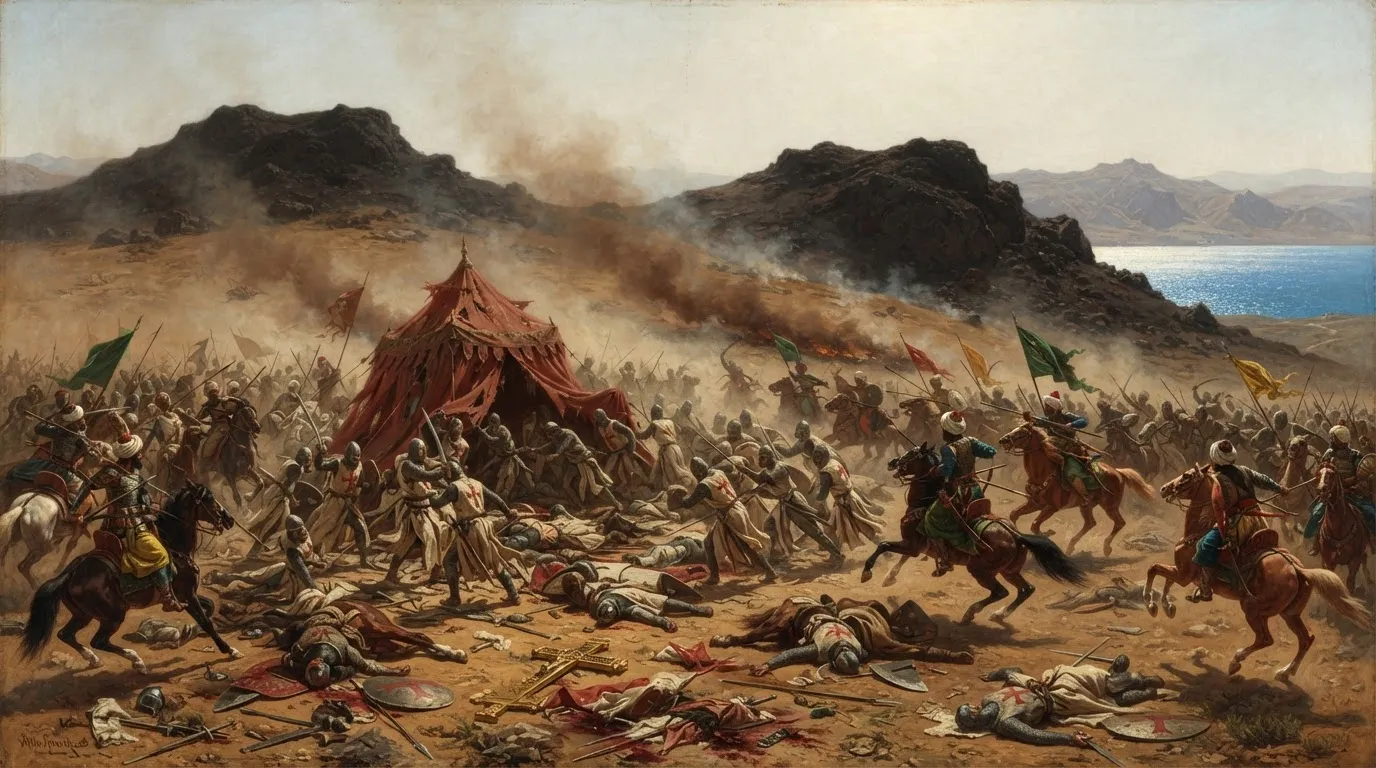
By the morning of July 4, 1187, the army of the Kingdom of Jerusalem had been marching, or trying to march, for most of a day and night without reaching water. Men were falling out of the column by the hundred. Horses staggered. Somewhere behind them, brush fires set by their enemies drifted smoke across the column, and Muslim archers rode the flanks picking off stragglers at will. Ahead, on a saddle of high ground between two extinct volcanic peaks known locally as the Horns of Hattin, the army finally stopped. It could go no further. Within a few hours, the kingdom that had held Jerusalem for eighty-eight years effectively ceased to exist as a military power. The city itself would fall within three months.
Saladin did not destroy the Crusader states at Hattin in a single afternoon by luck. He had spent a decade building toward it, and the Franks of Jerusalem, worn down by internal quarrels and a run of bad decisions at exactly the wrong moment, walked into the trap he set for them. This is the story of how that happened, and why a battle fought in a few square miles of Galilee hillside changed the map of the medieval Mediterranean for two centuries.
The Kingdom of Jerusalem, Ninety Years On
The First Crusade had captured Jerusalem in 1099 in a bloody, chaotic siege, and out of that conquest the Franks built something unlikely: a string of Latin Christian states running along the eastern Mediterranean coast, from the County of Edessa in the north down through the Principality of Antioch, the County of Tripoli, and the Kingdom of Jerusalem itself. By the 1180s that kingdom was in its fourth generation. Many of its knights and nobles had been born in the Levant. They spoke some Arabic, traded with Muslim merchants, and understood, better than any crusader fresh off a ship from Europe, how thin the ice under their feet really was.
The kingdom was never large. Population estimates are rough, but the Frankish settler population probably numbered somewhere in the low hundreds of thousands at most, ruling over a much larger native population of Muslims, Eastern Christians, and Jews. Its military strength depended on a relatively small pool of knights, supplemented by mercenaries, native auxiliary troops called turcopoles, and above all the military orders — the Knights Templar and Knights Hospitaller, standing professional forces answerable to the Pope rather than to the king. Losing a field army in the Kingdom of Jerusalem was not like losing one in France or England. There was no deep reserve of manpower behind it. Every knight killed or captured was a knight the kingdom could not easily replace.
For decades this fragile arrangement survived because the Muslim world surrounding it was divided against itself — rival emirs in Damascus, Aleppo, and Cairo who often found a Christian buffer state more convenient than a unified Muslim neighbor. That changed with the rise of one man.
Saladin’s Rise and the Fragile Peace
Yusuf ibn Ayyub, known to history as Saladin, began his career as a Kurdish officer in the service of Nur ad-Din, the ruler of Aleppo and Damascus. Sent to Egypt in the 1160s as part of a military expedition, he ended up as vizier of the crumbling Fatimid Caliphate almost by accident, then abolished it outright in 1171 and restored Egypt to Sunni orthodoxy. When Nur ad-Din died in 1174, Saladin moved quickly to absorb Damascus, then spent the next decade fighting, negotiating, and marrying his way into control of Aleppo and much of Muslim Syria and Mesopotamia. By the mid-1180s he ruled an empire stretching from the Nile to the Tigris, encircling the Crusader kingdom on three sides.
He was not simply a general. Saladin was a genuinely skilled political operator who understood that unifying the fractious Muslim princes of the region under the banner of jihad against the Franks gave him legitimacy he couldn’t get any other way. Every truce he signed with Jerusalem bought him time to finish absorbing a rival emirate. Every raid the Franks launched against Muslim caravans gave him a pretext, and a rallying cry, for the war he was already building toward.
The two sides had lived under a series of truces through the late 1170s and early 1180s, some negotiated out of genuine exhaustion, some because a bad harvest or a trade route mattered more to both parties than religious war. Merchants crossed the frontier in both directions. Reginald of Sidon reportedly spoke fluent Arabic and hunted with Muslim neighbors. None of this made the peace permanent. It just meant both sides had reasons, for a while, to prefer talking to fighting.
Raynald of Châtillon and the Broken Truce
Then there was Raynald of Châtillon.
Raynald had been in the Levant since the Second Crusade, had married his way into the Principality of Antioch, spent about fifteen years as a prisoner in Aleppo after a botched raid, and emerged from captivity around 1176 with a taste for freelance warfare that outlasted whatever royal policy happened to be in effect. He held the lordship of Oultrejordain, the desert territory east of the Dead Sea straddling the pilgrim and trade routes between Egypt and Syria. From his fortresses at Kerak and Montreal he could strike caravans that no other Crusader baron could reach, and he did.
In 1183 he launched a fleet down the Red Sea, an almost unheard-of move, threatening the Muslim pilgrimage routes toward Mecca and Medina themselves. Saladin’s brother eventually hunted down and destroyed the raiders. It was a direct insult to the entire Islamic world, not just to Saladin personally, and it was the kind of thing no Muslim ruler serious about jihad could ignore.
The final straw came in late 1186 or early 1187. A large, rich caravan traveling under safe conduct passed through Raynald’s territory on its way from Egypt to Syria. Raynald seized it, took the merchants and their families prisoner, and kept the plunder. Saladin sent envoys demanding compensation and the release of the prisoners. According to the chronicle tradition preserved in the Estoire d’Eracles, Raynald’s answer amounted to a shrug: he ruled his own land the way Saladin ruled his, and he had no truce of his own with the Saracens to honor. King Guy, technically Raynald’s overlord, either couldn’t or wouldn’t force the issue.
Saladin took it as a declaration of war, which functionally it was. He had wanted a pretext to end the truce anyway. Raynald handed him one gift-wrapped.
Succession Crisis: A Kingdom Divided Against Itself
While Saladin was consolidating an empire, Jerusalem was consuming itself over the question of who would rule it next.
King Baldwin IV had come to the throne as a teenager already showing signs of leprosy, and by his final years the disease had left him blind and largely paralyzed. He was, by most accounts, sharp-minded and brave almost to the point of recklessness — he had himself carried into battle on a litter rather than concede command to men he distrusted. But a dying, disfigured king with no children of his own left the succession wide open, and the court split into factions around it. Baldwin crowned his young nephew Baldwin V as co-king in 1183 and appointed Raymond III, Count of Tripoli, as regent, a man with deep roots in the kingdom’s nobility and, not incidentally, a personal parole agreement and something close to a working friendship with Saladin dating back to years spent as his prisoner after the Battle of Harim.
Baldwin IV died in the spring of 1185. The child-king Baldwin V followed him to the grave the next year, not yet nine years old. That left the throne to Baldwin IV’s sister Sibylla, and the barons who controlled the process gave her the crown on one condition: she had to set aside her husband first. She agreed, took the crown, and then simply remarried him on the spot in front of the assembled nobility. Her husband was Guy of Lusignan, a minor French nobleman of no particular distinction who had already been passed over once for the regency because Baldwin IV considered him incompetent.
Raymond of Tripoli was furious, and he wasn’t alone. A large part of the kingdom’s high nobility regarded Guy as an unproven outsider elevated by marriage rather than merit. Raymond refused for a time to recognize the new king at all, retreated to his wife’s city of Tiberias, and in 1186 reportedly reached an informal understanding with Saladin that let Ayyubid troops pass through his territory. That understanding produced one of the grimmer preludes to Hattin: in May 1187, a Templar and Hospitaller force under Grand Master Gerard de Ridefort stumbled into a far larger Muslim raiding column near the Springs of Cresson and was nearly annihilated. The Hospitaller Grand Master died there. Gerard survived, wounded, and carried both his hatred of Raymond and his zeal for a decisive strike into the campaign that followed.
By the time Saladin’s main invasion began two months later, the kingdom’s senior leadership had spent two years distrusting, undermining, and half-forgiving each other. That is not a healthy condition for an army about to fight for its survival.
The Opposing Forces and Commanders
The army the kingdom scraped together in the summer of 1187 was, by its own standards, enormous. Estimates vary, and historians disagree on exact figures, but the Crusader host is usually put at somewhere around 18,000 to 20,000 men in total, including roughly 1,200 knights drawn from Jerusalem and Tripoli plus another fifty who had marched down from Antioch, several thousand mounted sergeants and turcopoles, and a large body of infantry making up the bulk of the force. It represented nearly every fighting man the kingdom could muster, plus contingents from the Principality of Antioch and County of Tripoli and both military orders at close to full strength. Guy had emptied the garrisons to build it.
Saladin’s army was bigger, though how much bigger is genuinely contested. Muslim chroniclers writing after the fact had every incentive to inflate their own side’s numbers for effect, and modern historians’ estimates range anywhere from 20,000 up toward 40,000, with a hard core of perhaps 12,000 regular cavalry drawn from Egypt, Syria, and the Jazira. What’s not contested is that Saladin had spent months assembling this force deliberately, from every corner of his empire, specifically for this campaign, and that it dwarfed anything the Franks could match man for man.
Command on the Crusader side was split in ways that mattered. King Guy held nominal authority but limited personal credibility. Raymond of Tripoli commanded the vanguard and had the most combat experience against Saladin personally, along with the most reason to counsel caution — his own wife and children were currently under siege in Tiberias. Raynald of Châtillon wanted blood and had the ear of Gerard de Ridefort, whose Templars formed one of the few genuinely disciplined heavy cavalry units in the army. The Hospitallers fielded a comparable contingent under their own master. Balian of Ibelin, who would later negotiate Jerusalem’s surrender, rode with the army too, a competent and level-headed baron who mostly gets overshadowed in accounts of the battle by louder men.
On the other side, Saladin commanded with something the Franks lacked that summer: unity of purpose. His son al-Afdal rode with him. So did his nephew Taqi al-Din and a roster of emirs who, whatever their private rivalries, all answered to one man giving one set of orders. That difference would matter more than any tally of lances.
Saladin’s Trap: The Siege of Tiberias
Saladin crossed the Jordan River in force at the end of June 1187 and marched his army to the plateau near Kafr Sabt, within striking distance of the Sea of Galilee. On July 2 he sent a detachment to besiege Tiberias, Raymond of Tripoli’s own city, where Raymond’s wife Eschiva held the citadel with a small garrison. The town itself fell quickly; the citadel held out.
This was not really about Tiberias. Saladin knew the town’s fall would draw the entire Crusader field army out of its assembled position near the springs of Sepphoris, where it had ample water and shade and could simply wait Saladin’s invasion out until supplies or patience ran short on the Muslim side. Tiberias sat roughly twenty miles east across dry, broken hill country in high summer. Saladin had scouted that ground for years. He knew there was almost no water along the direct route, and he positioned his own forces to control what little there was.
It was, in essence, bait. The question was whether Guy’s council would take it.
The War Council That Doomed an Army
On the night of July 2, the Crusader leadership gathered at Sepphoris to decide what to do about Tiberias. According to the chronicle tradition, Raymond of Tripoli argued forcefully against marching. His own family was trapped in the besieged citadel, which made the argument harder to make and more compelling when he made it anyway: better to lose Tiberias, he said in substance, than lose the kingdom’s only field army chasing it across a waterless plain in July. Hold position at Sepphoris, force Saladin to either withdraw or attack on ground the Franks chose, and Tiberias could be recovered later.
The council seems to have agreed with him, at least initially. Then, overnight, the decision reversed. The particulars are murky and the sources disagree on exactly how it happened, but the pressure came from Raynald of Châtillon and Gerard de Ridefort, both of whom distrusted Raymond enough to suspect his advice was self-interested or worse, and both of whom argued that a king who refused to fight, especially after criticism for past caution, would be finished politically regardless of what happened on the battlefield. Guy, who had been mocked before for listening to Raymond and standing down from a fight, changed his mind. By morning the army was ordered to march.
It is worth sitting with how strange this decision looks with hindsight, and how understandable it must have felt at the time. Guy had inherited a throne he wasn’t fully trusted to hold. A king seen as too cautious, too influenced by a rival magnate, risked losing his nobles’ confidence even if caution was the right call militarily. Sometimes the safer military decision is also the more dangerous political one. Guy chose the fight.
The March Into the Desert
The army left Sepphoris early on July 3, heading east on the Tiberias road with Raymond commanding the van, Guy the center, and the rearguard under Balian of Ibelin and the military orders. Saladin’s forces shadowed the column from the moment it left camp, harassing the flanks and rear with mounted archers, and set fire to the dry summer scrubland to add smoke and thirst to the misery of the march. There was no water along this stretch of road, and none had been carried in quantities anywhere near sufficient for 20,000 men and their horses in July heat.
By afternoon the column had made poor progress and was strung out and exhausted. Rather than pushing on to reach the lake, the commanders made the fateful call to stop for the night on a barren plateau near the village of Meskenah, still miles short of any water source, surrounded on higher ground by Saladin’s forces, who had by then fully encircled the position. It was, in retrospect, already close to over. The army that woke on July 4 had gone roughly a full day with essentially no water in the height of a Galilean summer, was cut off from any hope of reaching some, and was ringed by an enemy that controlled every approach.
Encircled at the Horns of Hattin
The Crusaders tried to resume the march toward the Sea of Galilee at dawn on July 4, and it went badly almost immediately. Saladin’s forces pressed in from all sides, and the column, already disintegrating from thirst, broke apart. Much of the infantry, no longer under effective control, abandoned the march entirely and tried to climb toward the twin hills known as the Horns of Hattin, apparently hoping for some kind of defensible high ground or simple escape from the crush. Without infantry to screen them, the knights were left dangerously exposed.
Raymond of Tripoli led a cavalry charge in an attempt to break through the encirclement, and — in one of the battle’s odder footnotes — succeeded, or was allowed to succeed. Muslim forces reportedly opened their line to let his charge pass through rather than absorb it head-on, then closed ranks behind him. Raymond escaped the field entirely, riding for Tripoli. Whatever the tactical logic behind letting him through, it left Guy’s main body without his most experienced field commander at the worst possible moment.
What remained of the army fell back toward the Horns, made a stand, and tried repeatedly to break out. Ibn al-Athir, drawing on testimony he attributed to Saladin’s son al-Afdal, who watched the battle at his father’s side, recorded a vivid account of the fighting around Guy’s tent as the Franks made charge after charge against the surrounding Muslim lines:
“Be quiet! We have not beaten them until that tent falls.”
According to this account, when the red tent that marked the king’s position finally collapsed under the pressure of the fighting, Saladin dismounted, prostrated himself in thanks, and wept with relief. The battle was over. What remained of the Crusader army, dehydrated, encircled, and with its command structure broken, laid down its arms or was cut down where it stood.
The Capture of the True Cross and King Guy
Among the losses that day was the relic that had marched with Jerusalem’s army into nearly every major battle for most of a century: a fragment believed to be part of the True Cross, carried into the field by the Bishop of Acre, who died defending it. Saladin’s forces captured the relic outright. It was taken to Damascus and, despite later negotiations and at least one ransom offer, was never returned to Christian hands. Its capture was, for contemporaries on both sides, close to unthinkable — arguably a psychological blow to the kingdom’s surviving population even heavier than the military defeat itself.
King Guy himself was taken prisoner along with most of his surviving commanders: Gerard de Ridefort, Humphrey of Toron, the Marquis William of Montferrat, and a long roster of the kingdom’s remaining nobility. Only a few hundred knights, Raymond’s contingent chief among them, escaped the field entirely. The rest of the army, the ordinary men-at-arms and infantry who made up the bulk of its numbers, were mostly killed or taken captive; a substantial number of the surviving common soldiers were sold into slavery in the markets of Damascus, so many at once that the price of a captive dropped sharply in the days after the battle, according to Muslim chroniclers describing the aftermath.
Judgment in Saladin’s Tent
That evening Saladin received his most important prisoners in his tent, and what happened there became one of the most retold episodes of the entire Crusading era, because it showed two very different faces of the same victorious commander within the space of an hour.
Guy, exhausted and presumably expecting the worst, was given a cup of iced water or sherbet, a customary sign under Muslim hospitality codes that a captive’s life would be spared. Guy reportedly passed the cup along to Raynald of Châtillon, who was kneeling beside him. Saladin would not let the gesture stand. According to the chronicle tradition, he made clear that he had not offered Raynald anything himself and that Guy’s courtesy could not extend a promise Saladin had never made. He then confronted Raynald directly over the broken truce, the plundered caravan, and the Red Sea raids against the pilgrim routes to Mecca — grievances Saladin had reportedly sworn an oath to answer personally if he ever had Raynald in his power.
What followed next is recorded with small variations across the sources. The most widely repeated version, drawn from Saladin’s contemporary biographer Baha ad-Din ibn Shaddad, has Saladin striking Raynald down himself with his own sword, after which attendants finished the killing. Guy, watching this, reportedly assumed he would be next. Saladin is said to have reassured him that a king does not kill a king — that Raynald’s death was a matter of personal oath-breaking and grievance, not the ordinary treatment of a defeated royal captive. Guy was spared, held for ransom, and eventually released the following year.
The captured knights of the Templars and Hospitallers received no such mercy. Saladin regarded the military orders as the most committed and least reformable enemies of Islam in the Levant, men whose entire purpose was to keep fighting regardless of treaties or ransom, and he ordered every one of them executed apart from Gerard de Ridefort, who survived by reasons the sources don’t fully agree on. The contemporary chronicler Imad ad-Din al-Isfahani, who was present in Saladin’s camp, described scholars, Sufi ascetics, and other pious men in Saladin’s retinue requesting the honor of carrying out the killings themselves:
“…each begged to kill one of them, drew his sword and rolled back his sleeve.”
Around two hundred captured knights of the military orders were beheaded in the aftermath of the battle. Imad ad-Din’s account of the scene afterward captures the mood in Saladin’s camp bluntly:
“Saladin, his face joyful, was sitting on his dais; the unbelievers showed black despair.”
It is a genuinely uncomfortable set of episodes to sit with precisely because they don’t resolve into a simple picture of Saladin as either merciful or ruthless. He was both, deliberately, depending on who stood in front of him and what he judged that person’s death or survival would accomplish.
The Fall of Jerusalem and Shockwaves in Europe
With the kingdom’s field army gone, there was almost nothing left to stop Saladin. Over the following weeks his forces rolled up city after city along the coast and inland with little or no resistance — Acre, Nablus, Jaffa, Sidon, Beirut, Ascalon all fell in quick succession through July, August, and into September. Only Tyre, reinforced just in time by the arrival of Conrad of Montferrat, managed to hold out and would go on to serve as the last toehold of the kingdom on the mainland.
Jerusalem itself was defended by a scratch garrison assembled largely by Balian of Ibelin, who had talked his way past Saladin’s own safe-conduct to enter the city and organize its defense — reportedly knighting dozens of squires and townsmen on the spot simply to have enough men who could formally bear arms. After a siege of less than two weeks, with the walls breached and no realistic hope of relief, Balian negotiated the city’s surrender. Saladin agreed to accept ransom payments in exchange for the population’s freedom rather than the massacre many feared given the memory of 1099’s slaughter, though many of the poorest residents who couldn’t pay were enslaved regardless. Jerusalem fell on October 2, 1187, not quite three months after Hattin.
News of the disaster reached Europe that autumn and landed like a physical blow. Tradition holds that Pope Urban III died within days of hearing the news, on October 20, 1187, though historians debate how directly the shock itself contributed to his death. His successor, Gregory VIII, issued the papal bull Audita Tremendi within roughly ten days of taking office, framing the loss of Jerusalem as divine punishment for the sins of Christendom and calling for penance alongside a new armed expedition to recover the city:
“…amend our sins with voluntary chastisement and, through repentance and acts of piety, turn to the Lord our God.”
The response, once it gathered momentum, was the largest crusading effort Europe had yet mounted. Emperor Frederick Barbarossa took the cross at Mainz in March 1188. Richard I of England and Philip II of France, despite years of mutual hostility, jointly committed to the crusade at Gisors in January 1188 and imposed a special tax, the so-called Saladin tithe, to fund it. What became known as the Third Crusade would drag on for years, recover Acre and a strip of coastline, and produce a famous stalemate between Richard and Saladin. It never came close to retaking Jerusalem itself.
Legacy: The Beginning of the End
Hattin didn’t finish the Crusader states outright. Frankish lordships clung to the Levantine coast for another century after 1187, propped up by waves of new crusades, Italian merchant fleets, and the military orders rebuilding themselves from their losses. But the kingdom that emerged after Hattin was a fundamentally smaller, weaker thing than the one that existed before it — a coastal strip rather than a territory with a real interior, permanently dependent on outside reinforcement to survive at all. The last mainland foothold, Acre, finally fell to the Mamluks in 1291, and nobody seriously argues that outcome wasn’t already written into what happened on that dry hillside above Tiberias.
The battle’s afterlife in European memory took an odd shape. Saladin, of all people, ended up admired in Western chivalric tradition almost as much as reviled — Dante placed him among the virtuous pagans in Limbo rather than in Hell, and later medieval and Renaissance writers turned him into something close to a model of honorable, merciful kingship, a useful foil for criticizing crusader brutality without criticizing crusading itself. The reality, as the events in his tent that July evening show, was considerably less tidy than the legend.
On the Islamic side, Hattin and the recapture of Jerusalem became, and remain, the defining achievement people reach for whenever Saladin’s name comes up, discussed and taught across the Arab and wider Muslim world in terms that treat the campaign as a template for uniting a divided Muslim world against outside occupation. That template has been invoked, explicitly, by rulers and movements across the twentieth and twenty-first centuries looking to borrow Saladin’s memory for their own political purposes, which says something about how durable this single battle’s symbolic weight turned out to be, nine centuries on.
Quick Facts
- Conflict: Battle of Hattin, part of the wider war between the Kingdom of Jerusalem and Saladin’s Ayyubid Sultanate
- Date: July 4, 1187 (with the siege of Tiberias beginning July 2)
- Location: Horns of Hattin, an extinct volcanic ridge near Tiberias in Galilee, present-day Israel
- Combatants: Kingdom of Jerusalem (with Antioch and Tripoli contingents, the Knights Templar and Knights Hospitaller) vs. the Ayyubid Sultanate under Saladin
- Crusader strength: Roughly 18,000–20,000 total, including about 1,200 knights (estimates vary among historians)
- Ayyubid strength: Commonly estimated at 20,000–40,000, including around 12,000 regular cavalry (sources disagree significantly)
- Outcome: Decisive Ayyubid victory; near-total destruction of the Crusader field army
- Notable casualties/captures: King Guy of Lusignan captured; Raynald of Châtillon executed by Saladin personally; roughly 200 captured Templar and Hospitaller knights executed; the relic of the True Cross captured and never recovered
- Immediate consequence: Jerusalem surrendered to Saladin on October 2, 1187; most of the kingdom’s coastal cities fell within weeks
- Wider consequence: News of the defeat helped trigger the Third Crusade (1189–1192)
Timeline of Key Events
- 1174 – Saladin takes control of Damascus following the death of Nur ad-Din, beginning his consolidation of Muslim Syria and Egypt
- 1183 – Raynald of Châtillon launches a fleet down the Red Sea threatening the pilgrim routes to Mecca and Medina
- March 1185 – King Baldwin IV of Jerusalem dies of complications from leprosy
- 1186 – Child-king Baldwin V dies; Sibylla and Guy of Lusignan take the throne over Raymond of Tripoli’s objections
- Late 1186/Early 1187 – Raynald of Châtillon seizes a Muslim caravan under safe conduct, breaking the truce with Saladin
- May 1, 1187 – Templar and Hospitaller forces under Gerard de Ridefort are routed at the Battle of Cresson
- Late June 1187 – Saladin crosses the Jordan River with his main invasion force
- July 2, 1187 – Saladin besieges Tiberias; Crusader war council at Sepphoris debates whether to march to its relief
- July 3, 1187 – The Crusader army marches from Sepphoris toward Tiberias and is harassed throughout the day; it camps overnight without adequate water near Meskenah
- July 4, 1187 – The Battle of Hattin: the Crusader army is encircled and destroyed near the Horns of Hattin; King Guy and most of the surviving nobility are captured
- July 1187 – Saladin executes Raynald of Châtillon and around 200 captured Templar and Hospitaller knights
- July–September 1187 – Acre, Nablus, Jaffa, Sidon, Beirut, Ascalon, and most other Crusader cities fall to Saladin’s forces
- October 2, 1187 – Jerusalem surrenders to Saladin following negotiations led by Balian of Ibelin
- October 20, 1187 – Pope Urban III dies shortly after receiving news of Jerusalem’s fall
- October 1187 – Pope Gregory VIII issues the bull Audita Tremendi, calling for a new crusade
- 1189–1192 – The Third Crusade, led in part by Richard I of England, Philip II of France, and Frederick Barbarossa, recovers Acre and other coastal territory but fails to retake Jerusalem
Frequently Asked Questions
What caused the Battle of Hattin?
The immediate trigger was Raynald of Châtillon’s seizure of a Muslim caravan traveling under safe conduct in late 1186 or early 1187, which broke the existing truce between Saladin and the Kingdom of Jerusalem. But the underlying causes ran deeper: Saladin had spent over a decade unifying Muslim Syria and Egypt under his own rule, and a divided, quarreling Crusader leadership made the kingdom far more vulnerable than it had been a generation earlier.
Why did the Crusaders march into the desert instead of holding their position?
At the war council of July 2, 1187, Raymond of Tripoli argued for staying at Sepphoris, where the army had water, and letting Saladin’s siege of Tiberias run its course rather than risk the field army on a waterless march. That advice was initially accepted, then overturned overnight after pressure from Raynald of Châtillon and Templar Grand Master Gerard de Ridefort, who argued that failing to relieve Tiberias would be politically ruinous for King Guy. Guy, still trying to shore up his own shaky legitimacy, reversed course and ordered the march.
How many soldiers fought at the Battle of Hattin?
Historians disagree on the exact figures. The Crusader army is usually estimated at around 18,000 to 20,000 men, including roughly 1,200 knights. Saladin’s army is generally thought to have been larger, with estimates ranging from about 20,000 up to 40,000, including some 12,000 regular cavalry, though contemporary Muslim chroniclers likely had reason to inflate the numbers.
What happened to King Guy of Lusignan after he was captured?
Saladin treated Guy with notable restraint. He was given water as a sign he would not be killed, and although Saladin refused to extend that same mercy to Raynald of Châtillon, he reportedly told Guy that a king does not kill a king. Guy was held for ransom and released in 1188. He later lost his claim to the throne of Jerusalem to Conrad of Montferrat but was compensated with the lordship of Cyprus, which he ruled until his death in 1194.
Why did Saladin execute the Templars and Hospitallers but spare King Guy?
Saladin viewed the military orders as uniquely committed enemies of his campaign, men bound by religious vow to continue fighting regardless of treaties, ransoms, or personal interest. Executing roughly 200 captured Templar and Hospitaller knights removed a core of experienced, irreconcilable fighters from the field permanently. Guy, as a secular king, could be ransomed and managed diplomatically in ways the military orders could not.
Did the Battle of Hattin end the Crusades?
No. It ended the first Kingdom of Jerusalem’s control of the interior of Palestine and led directly to Jerusalem’s fall in October 1187, but Crusader states persisted on the Levantine coast for another century. The shock of Hattin and Jerusalem’s loss triggered the Third Crusade, and later crusades continued into the 13th century until the fall of Acre in 1291 ended the mainland Crusader presence entirely.
Recommended Reading
- Thomas Asbridge, The Crusades: The War for the Holy Land (2010)
- Steven Runciman, A History of the Crusades, Volume Two: The Kingdom of Jerusalem and the Frankish East, 1100–1187 (1952)
- Malcolm Cameron Lyons and D. E. P. Jackson, Saladin: The Politics of the Holy War (1982)
- Jonathan Phillips, The Life and Legend of the Sultan Saladin (2019)
- Anne-Marie Eddé, Saladin (Harvard University Press, 2011)
- Carole Hillenbrand, The Crusades: Islamic Perspectives (1999)
Read Next
August 23, 2026
The Battle of Salamis: The Naval Victory That Saved Greece
Themistocles tricked Xerxes's fleet into a narrow Greek strait in 480 BC, delivering the naval victory at Salamis that broke Persia's invasion of Greece.
August 14, 2026
The Battle of Inchon: MacArthur's Amphibious Gamble
MacArthur defied his own Joint Chiefs to land at Inchon's impossible tides and seawalls, shattering North Korea's army and reversing the Korean War in days.
August 14, 2026
The Siege of Vienna: How the Ottoman Advance Into Europe Was Stopped
In 1683 a Polish-led relief army broke the Ottoman siege of Vienna in a massive cavalry charge, halting Ottoman expansion into Central Europe for good.