Military History
The Battle of Borodino: Napoleon's Bloodiest Day in Russia
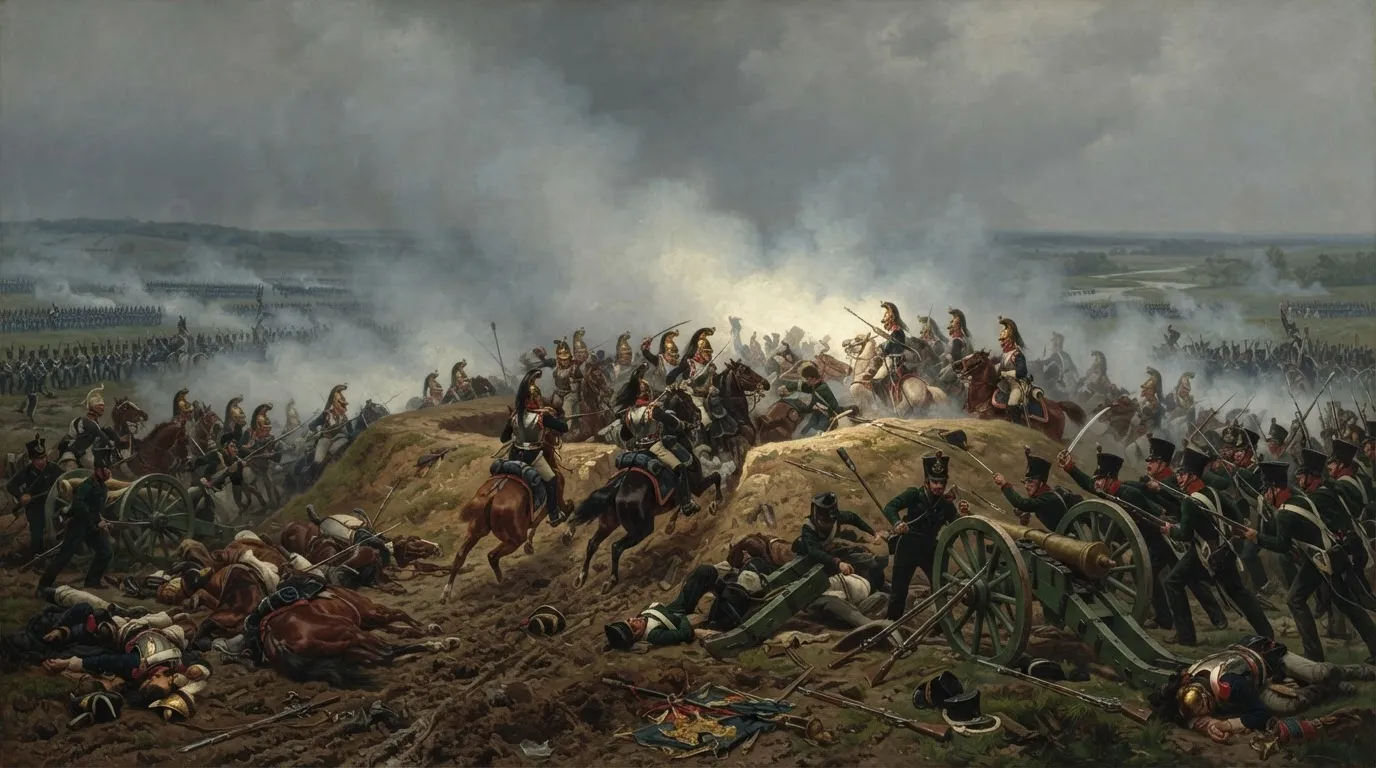
On the morning of September 7, 1812, roughly seventy miles west of Moscow, two armies that together numbered a quarter of a million men opened fire on each other across a few square miles of farmland, birch scrub, and low hills cut by a small river called the Kolocha. By nightfall, tens of thousands of them were dead or dying in the mud. No single day of fighting anywhere in the world would produce a higher number of casualties until the twentieth century arrived with machine guns and artillery on an industrial scale. The village that gave the battle its name, Borodino, has stayed attached to it ever since, spoken in Russian schoolrooms the way Americans speak of Gettysburg or the British speak of the Somme.
This was not the battle Napoleon Bonaparte wanted. He had invaded Russia that summer expecting a short, decisive campaign in the classic style he had perfected at Austerlitz and Jena: catch the enemy army, smash it in a single engagement, dictate terms. Instead he spent three months chasing an enemy that refused to stand still, watching his enormous army bleed away from disease, desertion, and hunger long before it fired a shot in anger. Borodino was the day the Russians finally stopped retreating. It did not go the way either side expected, and what happened afterward — the fall of Moscow, the fire, the long walk home through the snow — turned this single day into the hinge on which the entire invasion swung.
The Long Retreat That Preceded It
Napoleon crossed the Niemen River into Russian territory in the last days of June 1812 at the head of what was, for its time, an almost unimaginable force. Historians differ on exactly how large the Grande Armée was, partly because it wasn’t really one army but a coalition of French, Polish, German, Italian, Austrian, and other contingents assembled under Napoleon’s banner. The first wave crossing the river numbered somewhere around 440,000 men. Counting reserves and follow-on formations, the total commitment to the campaign ran as high as 600,000 to 685,000, along with well over 150,000 horses and nearly 1,400 guns. It was, by a wide margin, the largest military force Europe had ever seen assembled for a single campaign.
The plan was simple enough on paper. Find the main Russian armies, force them into a decisive battle near the frontier, win it, and Tsar Alexander I would sue for peace within weeks. The Russians declined to cooperate. Commanding the largest Russian force, the 1st Western Army, General Michael Barclay de Tolly chose to retreat rather than fight, trading space for time and pulling his army eastward while a smaller Russian force under Prince Pyotr Bagration tried, and mostly failed, to link up with him. It was not a strategy anyone had planned in advance so much as one Barclay backed into out of necessity — his army was outnumbered and he knew it. But it worked, in the sense that it kept the Russian field army intact while the Grande Armée shrank with every week that passed. Heat, bad water, and long marches over poor roads did more damage to Napoleon’s force in the campaign’s first month than any Russian saber.
Barclay’s caution bought time, but it cost him politically. Russian officers grumbled that their commander — a general of Baltic German descent with a foreign-sounding name — was simply running away from the invaders and abandoning Russian soil without a fight. Bagration wrote letters back to St. Petersburg accusing him of something close to treason. None of it was really fair to Barclay, who understood the military math better than most of his critics, but fairness rarely wins an argument at court. The retreat through Smolensk in mid-August, where a bloody two-day battle failed to produce the decisive stand the army and the public wanted, made the criticism impossible to ignore. Alexander needed someone the army and the nobility would actually rally behind. On August 29, 1812, he handed overall command to Mikhail Kutuzov, a 66-year-old veteran who had lost the use of one eye fighting the Ottomans decades earlier and carried the scars, quite literally, of a lifetime in Russian service.
There was also a supply problem eating at Napoleon that had nothing to do with battles won or lost. The invasion route ran through country that was poor to begin with and had already been picked clean by two retreating armies. Napoleon’s supply trains, designed for the shorter campaigns he’d fought in central Europe, simply couldn’t keep pace with an advance this deep into Russian territory. Men and horses were dying of exhaustion, bad water, and dysentery well before they ever saw a Russian uniform, and by the time the two armies faced each other at Borodino, the Grande Armée that had crossed the Niemen ten weeks earlier had already shed a very large fraction of its original strength to causes that had nothing to do with combat.
Kutuzov’s appointment did not change the underlying math. He understood, probably better than the officers pressing him for battle, that trading his army for a symbolic victory would be a catastrophic error. But he also knew he had been put in command specifically to fight, and that continuing Barclay’s retreat all the way to Moscow without a battle was not politically survivable, whatever the strategic logic behind it. He kept retreating for another week and a half after taking command. Then, near a village called Borodino on the old Smolensk road, he decided this was where he would make his stand.
The Commanders and Their Armies
Napoleon led the Grande Armée in person, as he had at nearly every major battle of his career, though by 1812 he was in his forties, overweight, and suffering from what was probably a bladder or urinary complaint that left him uncharacteristically passive during parts of the coming battle. Underneath him were some of the most capable soldiers France had produced. Marshal Louis-Nicolas Davout commanded I Corps, a hard, exacting professional whose troops were arguably the best-drilled in the entire army. Marshal Michel Ney led III Corps in the center; a cavalryman’s son from Lorraine, famous for personal courage bordering on recklessness (Napoleon would later call him “the bravest of the brave,” though that particular nickname came from his conduct during the retreat rather than at Borodino itself). Prince Eugène de Beauharnais, Napoleon’s stepson, commanded IV Corps on the northern flank, and Joachim Murat led the cavalry reserve.
On the Russian side, command was more tangled. Kutuzov held overall authority, but Barclay de Tolly still commanded the 1st Western Army on the right and center, and Bagration commanded the 2nd Western Army on the left. The two men disliked each other. Bagration thought Barclay’s retreat had been close to cowardice; Barclay thought Bagration reckless. Kutuzov, watching from the village of Gorki behind the lines, gave broad direction but left a great deal of the actual tactical decision-making to his subordinates once the fighting started — a point later historians such as Alexander Mikaberidze have leaned on to push back against the old Soviet-era image of Kutuzov as a battlefield chess master calling every move. General Nikolay Raevsky held the center, defending the fortified hill that would end up bearing his name.
The numbers each side actually put into the field are still argued over, which is typical for a battle this size and this old. The most widely cited modern figures put the French at somewhere between 103,000 and 135,000 men present, with roughly 109,500 actually engaged — Napoleon held back around 18,500 of his elite Imperial Guard and never sent them in. The Russians fielded something like 120,000 to 160,000, with about 122,000 engaged, a figure that includes some 10,000 Cossacks and militia irregulars of uneven fighting value. Whatever the exact totals, both armies were of comparable size, which was itself unusual — Napoleon had spent the whole campaign trying to catch the Russians at a numerical disadvantage and had mostly failed to do so.
None of this was a fair fight in the sense of two similar forces meeting on equal terms. The Grande Armée that showed up at Borodino was a multinational patchwork — Frenchmen fighting alongside Poles, Württembergers, Italians, Bavarians, and Dutchmen, many with no particular stake in whether Napoleon’s Russian gamble paid off. The Russian army, by contrast, was defending home ground, a fact that mattered more than any organizational chart could capture once the shooting started. Soldiers on both sides had been marching or retreating for months by the time they reached this field, and exhaustion was as much a part of each army’s condition as its official strength on paper.
The Ground: Flèches and the Great Redoubt
Kutuzov chose the position, and it wasn’t a bad one. The Russian line ran roughly north to south across the old Smolensk road, anchored on the New Smolensk road to the north and trailing off into wooded, broken ground to the south. The Kolocha stream and its steep banks covered much of the front. Behind the line, engineers had spent days throwing up field fortifications, and two of them would decide the battle’s shape.
On the Russian left, in front of the village of Semyonovskoye, Bagration’s men had built a set of three arrow-shaped earthworks known as flèches — the French word for arrows, which is exactly what they looked like from above. Open at the back, mounting cannon, they were meant to break up any French assault before it reached the main line. In the center, on a modest rise called Kurgan Hill, Raevsky’s corps had built a larger, curved earthwork mounting around nineteen twelve-pounder guns. The French called it the Grand Redoubt; Russian accounts and most later histories call it the Raevsky Redoubt, after the general whose corps built and initially held it. Both positions were exposed and both had open, unprotected rears — a fact French commanders would eventually exploit, though not cheaply.
Kutuzov’s northern flank, by contrast, was heavily fortified and barely touched during the battle. Whether that represented sound defensive planning against a possible flanking march, or simply an overcautious commander stacking his strongest reserves somewhere the enemy never showed up, is one of the smaller but persistent arguments among historians of the battle.
The Fight for the Flèches
The battle opened at six in the morning with a hundred and two French guns firing on the Russian positions, the opening bombardment of a day that would settle into something closer to industrial slaughter than the maneuver warfare Napoleon usually favored. Davout’s corps went in first against the flèches, and the fighting there set the tone for everything that followed: narrow ground, packed troops, and repeated frontal assaults against fortified artillery.
The flèches changed hands something like seven or eight times over the course of the morning. French infantry would take a position, get thrown out by a Russian counterattack, regroup, and go back in. Davout himself was thrown from his horse when it was killed under him early in the fighting; he was badly bruised by the fall but stayed with his men rather than leave the field. Ney’s corps was fed into the fighting alongside Davout’s as the morning wore on, and Murat’s cavalry supported both. By around 11:30 in the morning the French finally held the flèches for good, though “held” is a generous word for ground that had been fought over so many times it had stopped looking like farmland.
It’s worth pausing on the sheer density of the fighting here, because it’s easy to lose in a list of times and place names. This was not skirmishing. It was tens of thousands of men crammed into a stretch of ground barely a mile wide, taking artillery fire at close range for hours, with no real cover and nowhere to retreat to that wasn’t itself under fire. Losses on both sides were enormous even by the standards of Napoleonic warfare, which were already brutal.
Bagration’s Wound
Sometime around eleven in the morning, as the fighting for the flèches reached its worst point, a shell burst near Bagration and drove splinters into his leg. He kept command for a while afterward, but the wound was serious, and he was eventually carried from the field. Command of the 2nd Western Army passed to General Dmitry Dokhturov, who held the position together as best he could, but the loss of Bagration at exactly the moment his flank was cracking was a serious blow to Russian cohesion on that side of the field.
Bagration did not die immediately. He was moved to the village of Sima in Vladimir province, where his wound turned to gangrene over the following two and a half weeks. He died on September 24, having reportedly torn himself out of bed in agitation days earlier on hearing that Moscow had fallen and was being abandoned — the exertion, on top of a body already failing, is said to have hastened his death. He was one of Russia’s most respected field commanders, a veteran of Suvorov’s campaigns, and his loss at Borodino removed a man whose aggressive instincts had shaped Russian tactics throughout the retreat from the frontier.
The Storming of the Great Redoubt
With the flèches finally in French hands, the weight of the battle shifted toward the center and the Raevsky Redoubt. This position had already been fought over once in the morning, briefly taken by a French division and then retaken by a Russian counterattack. The main assault came in the early afternoon, after Eugène’s IV Corps and supporting cavalry had spent hours working around and probing the position.
The redoubt fell for good at around half past three in the afternoon, following a series of infantry assaults combined with a massed cavalry charge that rode directly into the position through its open rear and gun embrasures — an extraordinary and costly way to take a fortified artillery position, and one that succeeded mainly because the defenders were exhausted and running low on ammunition after hours of continuous combat. French cavalry losses in that final assault were severe. General Auguste de Caulaincourt, leading part of the charge, was killed taking the position his brother would later write about in his own memoirs of the campaign.
By late afternoon the French held both major Russian strongpoints. The Russian army had been pushed back from its forward positions but had not broken, and it re-formed a new line further east, still blocking the road to Moscow. Fighting continued in a diminished form into the evening — artillery duels mostly, with the infantry on both sides too spent to mount fresh attacks — before it finally sputtered out as darkness came on.
The Guard That Never Marched
By mid-afternoon, with the Russian line bent but not broken and French losses mounting badly, several of Napoleon’s marshals pressed him to commit the Imperial Guard — his best troops, held in reserve the entire day, some 18,500 veteran infantry and cavalry who had not fired a shot. General Jean Rapp, wounded himself earlier in the fighting, was among those who urged Napoleon to throw the Guard into the center and finish the Russian army off while it was reeling.
Napoleon refused. According to the account later given by General Philippe de Ségur, who served on Napoleon’s staff during the campaign, the Emperor’s response was blunt:
“I will most definitely not; I do not want to have it blown up. I am certain of winning the battle without its intervention.”
Marshal Jean-Baptiste Bessières, who commanded the Guard cavalry, is generally reported to have advised against committing it as well, reinforcing Napoleon’s caution.
Whether this was the correct call is one of the oldest arguments about Borodino, and it has never really been settled. The case against Napoleon is straightforward: he had the freshest, best troops on the field, the Russian center was cracking, and a decisive push might have turned a mauling into the annihilating victory he had wanted from the Russians all along — possibly even ending the campaign there and then. The case for him is less flattering to Napoleon’s boldness but not unreasonable: he was eight hundred miles from France, deep in hostile territory, with no realistic way to replace the Guard if it was chewed up in a battle that, even with its help, might not have destroyed the Russian army outright given how much fight was left in Kutuzov’s re-formed lines. Historians have argued both sides for two centuries without reaching a consensus, and this article isn’t going to be the place that settles it either.
A Single Day’s Slaughter
The casualty figures from Borodino are staggering by any standard, and they are also, frustratingly, imprecise — the kind of thing that gets recalculated every generation as historians dig through regimental returns and argue about what counts as a casualty. The commonly cited modern range puts French losses at somewhere between 30,000 and 42,000 killed, wounded, or missing, with about fifty French generals and senior officers killed or wounded in a single day. Russian losses are usually put at 40,000 to 53,000, with 29 generals killed or wounded, including Bagration. Combined, that puts total casualties somewhere in the range of 70,000 to 80,000 men in roughly twelve hours of fighting, though some estimates that count Russian losses more generously push the combined total higher still. Depending on exactly which figures you use and what you count, Borodino sits comfortably among the bloodiest single days in the history of warfare before the First World War made such numbers almost routine.
Neither side had the medical infrastructure to cope with wounds on this scale. Field surgeons worked through the night and into the following day; men who might have survived with modern trauma care simply bled out or died of infection over the following weeks. The village of Borodino and the ground around it were, for days afterward, a landscape of unburied dead and abandoned equipment stretching for miles.
Dominique Jean Larrey, the chief surgeon of the Grande Armée and by then already famous for his battlefield medical innovations, was reportedly worked to the point of near-exhaustion by the sheer volume of wounded passing through his hands in the days after the battle, operating with the crude tools and no anesthesia that were standard for the era. Multiply that single surgeon’s caseload across every corps in both armies and it becomes a little easier to understand why so many of the wounded who survived the battle itself did not survive the following weeks. There was no evacuation system capable of moving tens of thousands of injured men to real hospitals, and a lot of them were simply left in barns and peasant huts near the battlefield to recover or die on their own.
Quick Facts
- Date: September 7, 1812 (August 26 on the Julian calendar then used in Russia)
- Location: Near the village of Borodino, roughly 75 miles (120 km) west of Moscow
- Combatants: Napoleon’s Grande Armée vs. the Imperial Russian Army
- French commander: Napoleon Bonaparte
- Russian commander-in-chief: Mikhail Kutuzov
- French strength: Roughly 103,000–135,000 present; about 109,500 engaged
- Russian strength: Roughly 120,000–160,000 present; about 122,000 engaged
- French casualties: Estimated 30,000–42,000 killed, wounded, or missing
- Russian casualties: Estimated 40,000–53,000 killed, wounded, or missing
- Key terrain: The Bagration flèches and the Raevsky Redoubt (Great Redoubt)
- Outcome: Contested — French held the field; Russians withdrew in reasonably good order
- Aftermath: Russians abandoned Moscow a week later; Napoleon occupied a burning, evacuated city and later retreated in disaster
Timeline of Key Events
- June 24, 1812 — Napoleon’s Grande Armée begins crossing the Niemen River into Russian territory.
- August 16–18, 1812 — Battle of Smolensk; Napoleon takes the city but fails to trap the main Russian armies.
- August 29, 1812 — Tsar Alexander I appoints Mikhail Kutuzov commander-in-chief, replacing Barclay de Tolly.
- September 7, 1812 — Battle of Borodino fought; roughly 70,000+ combined casualties in a single day.
- September 13, 1812 — Council of Fili; Kutuzov decides to abandon Moscow rather than risk another battle.
- September 14, 1812 — Napoleon enters Moscow; fires break out and much of the city burns over the following days.
- October 19, 1812 — Napoleon begins his retreat from Moscow, having waited in vain for peace terms.
- December 1812 — The remnants of the Grande Armée stagger out of Russia, a fraction of the force that had invaded.
Retreat, Moscow, and Fire
Kutuzov pulled his battered army back east after Borodino, still screening the road to Moscow but no longer able, in his own judgment, to risk it in a second general engagement. On September 13, at a war council held in the village of Fili on Moscow’s outskirts, Russian generals argued over whether to defend the city or give it up. Opinion was close to evenly split. Kutuzov overruled the officers who wanted to fight and ordered the army — and the city’s population — to evacuate. Moscow would be surrendered without a battle.
Napoleon entered an eerily empty capital on September 14. Within days, fires that had probably been started deliberately (Moscow’s governor, Count Rostopchin, is usually credited or blamed, depending on the account) swept through most of the largely wooden city, destroying supplies Napoleon’s army badly needed and denying him the winter quarters he had been counting on. He waited five weeks in the ruins for a peace offer from Alexander that never came. By the time he gave the order to retreat on October 19, it was already dangerously late in the year for an army this size to be marching back across the same devastated ground it had crossed on the way in.
What followed over the next two months is its own story — cold, starvation, disease, Cossack raids, and the crossing of the Berezina River, where the disintegration of the Grande Armée became total. Only a small fraction of the men who had crossed the Niemen in June made it back out of Russia that winter, though the exact surviving count depends on how you define “the army” by that point and what you do with detachments that had been left garrisoning towns along the route. Borodino did not by itself cause that collapse. But it was the day the Russian army proved it could stand and fight the Grande Armée without being destroyed, and it was the battle that set in motion the sequence of decisions — the march on Moscow, the wait for terms, the late retreat — that ended in catastrophe.
It’s worth noting how differently the campaign might have looked if Kutuzov had lost badly at Borodino instead of merely being forced back. A shattered Russian army couldn’t have screened Moscow, couldn’t have harassed the French retreat later that winter, and might well have left Alexander no real choice but to negotiate. Borodino’s importance isn’t that the Russians won it outright — by most measures they didn’t — but that they survived it as a functioning army capable of fighting again. That’s a much less dramatic outcome than a clean battlefield triumph, and it’s exactly why the battle keeps generating arguments instead of settling them.
Echoes: Borodino in Memory
Kutuzov, on hearing that Napoleon had finally abandoned Moscow and begun his retreat, reportedly broke down in tears. He is said to have exclaimed:
“Russia is saved.”
Whatever the precise wording, the sentiment stuck, and Kutuzov himself became a fixture of Russian national memory as the general who had traded a battle for a war and won.
Much of that image comes filtered through Leo Tolstoy, whose 1869 novel War and Peace devotes some of its most famous pages to Borodino, following characters through the fighting at the flèches and the redoubt and using the battle as the philosophical center of the book’s argument about how little any individual commander, Napoleon included, actually controls the outcome of a battle this size. Tolstoy’s Kutuzov is a patient, unglamorous figure, deliberately drawn in contrast to a vain and overconfident Napoleon — a portrait that has shaped how generations of readers, in Russia and well beyond it, have pictured the two men, whatever the historical record’s more complicated view of both.
The ground itself has never entirely stopped being a battlefield. Borodino Field is preserved today as a state museum-reserve, and in October 1941, as German forces drove toward Moscow in the opening phase of what Soviet historiography calls the Great Patriotic War, Red Army units fought a delaying action on almost the same ground, buying time for the capital’s defenses further east. A Soviet colonel is said to have written in the museum’s guestbook, shortly before the fighting reached it, that he had come to defend the battlefield. German troops occupied the site for several months before Soviet forces retook it in the winter counteroffensive; the old monastery there was burned and the museum damaged in the process, an odd historical rhyme with the fires that had swept Moscow 129 years earlier.
Historians remain split, in a low-grade and probably permanent way, on how to score Borodino itself. The French held the field at the end of the day, took the enemy’s fortified positions, and inflicted (or at least traded) horrific losses — by the narrow, traditional definition of who owns the ground when the shooting stops, that’s a French victory. But the Russian army survived intact enough to fight again, Napoleon’s occupation of Moscow gained him nothing durable, and the campaign ended in the destruction of his army rather than the destruction of Kutuzov’s. Call it a tactical French win layered under a strategic Russian one, if you like tidy formulas. Plenty of serious historians resist that framing too, on the grounds that it lets both sides claim victory a little too conveniently for a battle that, by any honest reading, nobody really won.
Frequently Asked Questions
Who won the Battle of Borodino?
It depends on how you define winning. The French held the battlefield at the end of the day and forced the Russians to withdraw, which by traditional standards counts as a tactical victory. But Napoleon failed to destroy the Russian army, which regrouped and continued the campaign, and his subsequent occupation of Moscow led to disaster. Many historians describe it as a French tactical win and a Russian strategic one.
How many soldiers died at Borodino?
Precise figures are disputed, but commonly cited modern estimates put French casualties (killed, wounded, and missing) at roughly 30,000 to 42,000, and Russian casualties at roughly 40,000 to 53,000. Combined totals in the range of 70,000 to 80,000 in a single day are widely cited, making it one of the bloodiest single-day battles in history up to that point.
Why didn’t Napoleon use his Imperial Guard at Borodino?
Napoleon held back his elite Imperial Guard reserve despite pressure from several of his marshals to commit it. He reportedly said he did not want to risk it so far from France and was confident of victory without it. Historians still debate whether committing the Guard could have destroyed the Russian army outright or would simply have added Guard casualties to an already staggering toll.
What happened to Prince Bagration?
Bagration, commanding the Russian left flank at the flèches, was struck by shell splinters in the leg around mid-morning. The wound turned gangrenous over the following weeks, and he died on September 24, 1812, roughly two and a half weeks after the battle.
Did Napoleon capture Moscow after Borodino?
Yes. The Russian army withdrew after Borodino, and following a war council at Fili on September 13, Kutuzov chose to abandon Moscow rather than risk another battle. Napoleon entered the city on September 14 to find it largely evacuated; fires broke out shortly afterward and destroyed much of it. He waited five weeks for a peace settlement that never came before beginning the retreat that ultimately destroyed his army.
Is Borodino connected to Tolstoy’s War and Peace?
Yes, closely. Tolstoy devotes extensive sections of the novel to the battle, using it to develop his arguments about history, chance, and the limits of individual command. The novel’s portrayal of Kutuzov as a patient, humble commander and Napoleon as vain and overconfident has strongly influenced popular perceptions of both men, well beyond Russia.
Recommended Reading
- Adam Zamoyski, Moscow 1812: Napoleon’s Fatal March on Moscow
- Dominic Lieven, Russia Against Napoleon: The Battle for Europe, 1807 to 1814
- Alexander Mikaberidze, The Battle of Borodino: Napoleon Versus Kutuzov
- Paul Britten Austin, 1812: Napoleon’s Invasion of Russia (an omnibus of his trilogy assembled from eyewitness accounts)
- Leo Tolstoy, War and Peace — not a history book, but the novel that did more than any academic study to fix Borodino in the popular imagination
Read Next
August 23, 2026
The Battle of Hattin: Saladin's Victory That Doomed the Crusader Kingdom
How Saladin lured the Crusader army into the waterless hills of Galilee in 1187, destroyed it at Hattin, and set up Jerusalem's fall three months later.
August 23, 2026
The Battle of Salamis: The Naval Victory That Saved Greece
Themistocles tricked Xerxes's fleet into a narrow Greek strait in 480 BC, delivering the naval victory at Salamis that broke Persia's invasion of Greece.
August 14, 2026
The Battle of Inchon: MacArthur's Amphibious Gamble
MacArthur defied his own Joint Chiefs to land at Inchon's impossible tides and seawalls, shattering North Korea's army and reversing the Korean War in days.