Military History
The Battle of Gettysburg: The Civil War's Turning Point
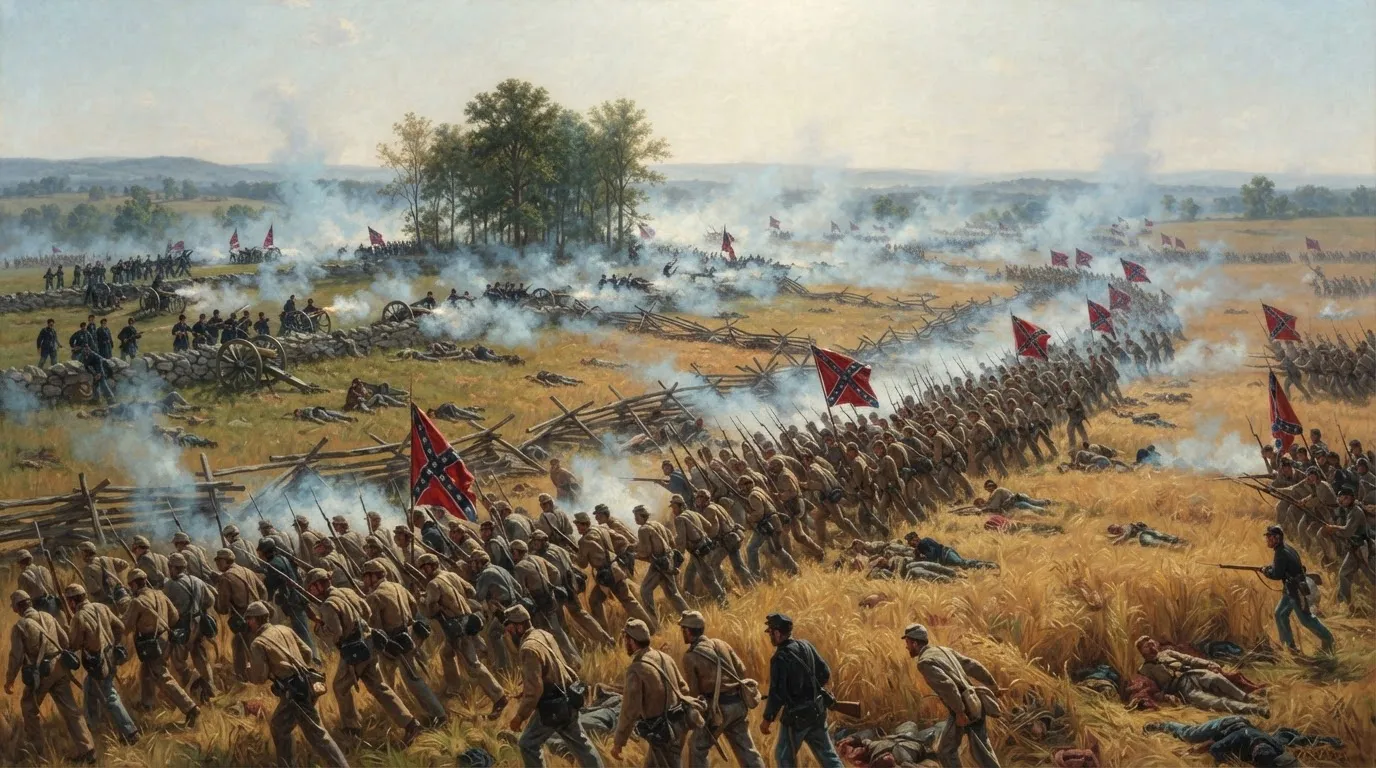
Fought over three days in July 1863, the Battle of Gettysburg was the bloodiest single engagement of the American Civil War and is widely regarded as its turning point. General Robert E. Lee’s second invasion of the North ended in a costly defeat that his Army of Northern Virginia never fully recovered from, while the Union victory, paired with the fall of Vicksburg the following day, shifted the war’s momentum decisively toward the North. More than 165,000 soldiers converged on a small Pennsylvania crossroads town that neither side had specifically chosen as a battlefield, and by the time the fighting ended, the rolling farmland around Gettysburg had become the most studied ground in American military history.
Lee’s Gamble
By mid-1863, the Confederacy had won a string of victories in the Eastern theater, most recently at Chancellorsville, where Lee had out-generaled a Union army twice the size of his own. Confident in his army and hoping to relieve pressure on Virginia’s farmland, resupply his forces from Northern territory, and possibly force a negotiated peace by winning a battle on Union soil, Lee marched roughly 75,000 men north into Pennsylvania. Opposing him was the Army of the Potomac, roughly 94,000 strong, now under the command of General George Meade, who had taken charge only three days before the battle began, replacing a Union commander whose caution had frustrated President Lincoln through much of the spring.
The stakes were considerable on both sides. A major Confederate victory on Northern soil, so soon after the string of Confederate successes in Virginia, might have strengthened the hand of Northern politicians calling for a negotiated end to the war, and could plausibly have influenced European governments still weighing whether to formally recognize the Confederacy. Lee’s army, moving largely blind without its usual cavalry screen—Major General J.E.B. Stuart had ridden off on a raid that kept him out of contact with Lee for much of the approach march—stumbled into contact with Union forces almost by chance.
The two armies collided almost by accident at the crossroads town of Gettysburg on July 1, 1863, when Confederate troops searching for supplies—by long tradition looking for shoes, though this detail is debated by historians—ran into Union cavalry under Brigadier General John Buford. What began as a skirmish escalated quickly as both sides fed in reinforcements, and neither Lee nor Meade had chosen Gettysburg as a battlefield in advance; the town’s dense network of converging roads simply pulled both armies toward it.
A timeline of the campaign and battle:
- May 1–3, 1863: Lee defeats a much larger Union force at the Battle of Chancellorsville; Stonewall Jackson is mortally wounded by friendly fire during the battle and dies eight days later.
- June 1863: Lee begins moving the Army of Northern Virginia north through the Shenandoah Valley and into Pennsylvania.
- June 28, 1863: George Meade replaces Joseph Hooker as commander of the Army of the Potomac, just three days before the battle begins.
- July 1, 1863: Confederate and Union forces collide west and north of Gettysburg; Union troops are pushed back to Cemetery Hill, Cemetery Ridge, and Culp’s Hill.
- July 2, 1863: Heavy fighting at the Wheatfield, Peach Orchard, Devil’s Den, Little Round Top, and Culp’s Hill; Union lines hold.
- July 3, 1863: A massive Confederate artillery bombardment precedes Pickett’s Charge, which fails with catastrophic Confederate casualties.
- July 4, 1863: Lee’s army begins its retreat toward Virginia; Vicksburg, Mississippi, surrenders to Ulysses S. Grant the same day.
- November 19, 1863: Lincoln delivers the Gettysburg Address at the dedication of the Soldiers’ National Cemetery.
The Opposing Forces and Commanders
The Army of the Potomac at Gettysburg was organized into seven infantry corps plus cavalry, commanded overall by George Meade, a Pennsylvania-born engineer known for careful, methodical generalship rather than flair. Beneath him served officers who would become central to the battle’s legend: Major General John Reynolds, commanding the First Corps, who was killed by a sharpshooter’s bullet within hours of the fighting’s opening on July 1; Major General Winfield Scott Hancock, given field command of the Union left-center and credited with much of the tactical organization of the Union defensive line; and Colonel Joshua Lawrence Chamberlain, a former college professor commanding the 20th Maine Volunteer Infantry, whose defense of the Union army’s extreme left flank on July 2 became one of the most celebrated small-unit actions of the war.
Both armies by 1863 were seasoned, well-equipped fighting forces rather than the raw volunteer militias of the war’s early years. Infantry on both sides were armed predominantly with rifled muskets, whose accuracy at far greater range than the smoothbore weapons of earlier wars made traditional close-order infantry assaults, of the kind Pickett’s men would attempt on July 3, extraordinarily costly against a prepared defender. Both armies also fielded substantial artillery arms, with several hundred cannon apiece distributed among their corps, and cavalry divisions whose skirmishing in the days before the battle—and whose near-total absence from Lee’s side during his approach march, after Stuart’s cavalry rode out of contact on a raid around the Union army—shaped much of the campaign’s early maneuvering.
Robert E. Lee commanded the Army of Northern Virginia through three corps commanders: Lieutenant General James Longstreet, Lee’s most trusted subordinate, who privately doubted the wisdom of much of the Gettysburg campaign and openly opposed the climactic assault on the battle’s third day; Lieutenant General Richard Ewell, who had inherited Stonewall Jackson’s old corps after Jackson’s death at Chancellorsville just two months earlier, and whose hesitation on the battle’s first day remains one of the most debated command decisions of the war; and Lieutenant General A.P. Hill, whose troops opened the fighting on July 1. Major General George Pickett, whose division would give its name to the battle’s most famous and costly assault, commanded one of three divisions in Longstreet’s corps.
Terrain and Strategic Stakes
Gettysburg’s terrain shaped nearly every tactical decision made over the battle’s three days. The town itself sat at the hub of roughly ten converging roads, which is largely why both armies were drawn there in the first place. South of town, a line of low hills and ridges—Cemetery Hill, Cemetery Ridge, Culp’s Hill, and the twin summits of Little Round Top and Big Round Top—formed a natural defensive position shaped, in the words of later historians, roughly like a fishhook, with Union forces able to shift troops quickly along interior lines from one threatened point to another. Confederate forces, by contrast, were strung out along a longer, more convex arc to the north and west, making rapid coordination between different parts of Lee’s army considerably more difficult.
Strategically, Lee’s invasion aimed at more than a single battlefield victory. A decisive win deep in Union territory might have forced Lincoln’s government toward a negotiated peace, drawn Union troops away from the ongoing siege of Vicksburg on the Mississippi, and demonstrated to skeptical European powers that the Confederacy could win the war outright rather than simply survive it. Meade’s more limited objective—protect Washington and Baltimore while defeating Lee’s army in the field—meant the defensive, high-ground posture the Army of the Potomac found itself occupying by accident on July 1 suited Union strategic aims almost perfectly.
Day One: The Armies Collide
On the first day, Confederate forces under A.P. Hill and, later, Richard Ewell pushed Union troops back through the town to defensive positions on high ground south of Gettysburg—Cemetery Hill, Cemetery Ridge, and Culp’s Hill. Union cavalry under Buford, badly outnumbered, bought crucial time in the morning fighting west of town, delaying the Confederate advance long enough for Reynolds’s infantry to arrive and establish a defensive line. Reynolds was killed almost immediately upon reaching the field, shot from his horse while positioning troops in what became known as Herbst Woods—the most senior Union officer to die at Gettysburg and one of the highest-ranking officers killed in the entire war.
By late afternoon, Union forces had been pushed back through the streets of Gettysburg in some disorder, but they rallied on the high ground south of town. Lee, sensing an opportunity to complete the day’s success, sent orders to Ewell to take Cemetery Hill “if practicable”—a famously ambiguous instruction that Ewell, uncertain of the strength of the position and wary of bringing on a wider engagement before the rest of Lee’s army had arrived, chose not to press. Historians have argued for more than 150 years over whether a more aggressive commander—Stonewall Jackson, most obviously, had he lived—might have seized the hill that evening and fundamentally altered the battle’s outcome. This high ground would prove decisive for the rest of the battle, giving Union forces a strong defensive position anchored on both flanks.
Day Two: The Wheatfield, the Peach Orchard, and Little Round Top
The second day saw brutal fighting at locations that have since become synonymous with the battle: the Wheatfield, the Peach Orchard, Devil’s Den, and Little Round Top, where Union troops narrowly held the Army of the Potomac’s left flank against determined Confederate assaults. Longstreet’s corps launched a massive assault against the Union left in the afternoon, driving Union forces out of an exposed salient at the Peach Orchard and through the boulder-strewn terrain of Devil’s Den, but Union reinforcements, rushed to the field at the last possible moment, held Little Round Top against repeated Confederate attacks.
The defense of the extreme end of the Union line at Little Round Top fell to Colonel Joshua Chamberlain’s 20th Maine, positioned at the very end of the Union flank with no troops beyond them to fall back on. After repelling wave after wave of attacks from Alabama regiments and running critically low on ammunition, Chamberlain ordered his men to fix bayonets and charge downhill into the exhausted Confederate attackers—an improvised, high-risk maneuver that broke the Confederate assault, captured more than 100 Confederate prisoners, and secured the Union flank. Chamberlain was awarded the Medal of Honor for the action three decades later, in 1893, “for daring heroism and great tenacity in holding his position on the Little Round Top against repeated assaults.” His regiment’s color sergeant, Andrew Jackson Tozier, who held the 20th Maine’s flag alone at an exposed point in the line after the color guard fell, was separately awarded the Medal of Honor for the same fighting.
Fighting on July 2 was not confined to the Union left. On the opposite end of the line, Confederate troops under Ewell launched evening assaults against Culp’s Hill and East Cemetery Hill, briefly gaining a foothold in lightly defended Union trenches on Culp’s Hill before being driven back the following morning in some of the war’s most protracted close-quarters fighting. Despite heavy casualties on both sides across the entire length of the line that afternoon and evening, Union lines held everywhere they were seriously tested, and Meade’s ability to shift reserves quickly along his shorter interior lines—reinforcing Little Round Top, the Wheatfield, and Culp’s Hill in turn as each came under pressure—proved decisive in absorbing Lee’s uncoordinated series of attacks up and down the Confederate line.
Day Three: Pickett’s Charge
The morning of July 3 opened with several more hours of hard fighting at Culp’s Hill, where Union troops finally drove out the Confederates who had gained a foothold there the previous evening. But the day’s decisive action came in the early afternoon. Around 1 p.m., roughly 150 to 170 Confederate cannon opened a massive bombardment against the Union center on Cemetery Ridge, in what remains one of the largest concentrated artillery barrages of the entire war, intended to soften Union defenses and silence their own artillery ahead of an infantry assault. Union batteries returned fire before deliberately slackening their response to conserve ammunition and lure the Confederates into believing the guns had been knocked out—a piece of battlefield deception that helped ensure Union artillery was very much still in action when the infantry assault began roughly an hour later.
The third day culminated in what is now known as Pickett’s Charge: with the Confederate bombardment failing to silence Union guns as thoroughly as Lee had hoped, an assault force of roughly 12,000–13,000 Confederate soldiers, drawn from the divisions of George Pickett, Johnston Pettigrew, and Isaac Trimble, advanced across nearly a mile of open ground toward the center of the Union line on Cemetery Ridge, under devastating artillery and rifle fire. James Longstreet, ordered to launch the assault despite his own deep misgivings, reportedly told Lee beforehand that he did not believe any 15,000 men arrayed for battle could carry the position; when Lee insisted the attack proceed, Longstreet later wrote that “nothing was left but to proceed.”
“General, I have been a soldier all my life… It is my opinion that no 15,000 men ever arrayed for battle can take that position.” — James Longstreet, recalling his objection to Lee before Pickett’s Charge
The assault failed catastrophically. Confederate troops reached the low stone wall at the Union center in only one sector, near a small stand of trees that later became known as the “high-water mark,” before being overwhelmed or driven back. Confederate casualties in the attacking force totaled roughly 6,500 of the 12,000–13,000 men engaged—more than half—including over 1,100 killed outright, with the remainder wounded or captured; Union losses defending the position were far lighter, roughly 1,500. It marked the effective end of the battle and, in hindsight, is often cited as the “high-water mark of the Confederacy,” a phrase later popularized by battlefield historian John B. Bachelder to describe the small copse of trees near the Angle where the Confederate assault reached its farthest point before collapsing.
In the aftermath of the failed charge, Lee rode out among his retreating soldiers and, according to accounts later recorded by officers who witnessed it, took personal responsibility for the disaster, reportedly telling his men and Longstreet, “It’s all my fault. I thought my men were invincible.” Lee never repeated so direct an admission in his official battle reports, but the remark, preserved in multiple postwar accounts, has become one of the most quoted moments of the entire campaign.
“It’s all my fault. I thought my men were invincible.” — Robert E. Lee, reportedly to his retreating soldiers after Pickett’s Charge
The Retreat and Immediate Aftermath
Lee held his position on July 4, expecting a Union counterattack that never came, then began withdrawing his battered army back toward Virginia that night in a wagon train of wounded men that reportedly stretched for miles. Meade, criticized afterward—including by a frustrated Lincoln—for not pursuing and destroying Lee’s army while it was pinned against a swollen, difficult-to-cross Potomac River, allowed the Army of Northern Virginia to escape back across the river and into Virginia by mid-July. The Confederacy had lost its offensive capability in the Eastern theater for good; Lee would fight almost entirely defensive campaigns on Virginia soil for the remainder of the war.
The human toll on the small town of Gettysburg itself was staggering. With a prewar population of roughly 2,400, the town found itself suddenly surrounded by more than 165,000 combatants and, in the battle’s aftermath, by tens of thousands of wounded men who overwhelmed every available church, barn, home, and public building pressed into service as a makeshift hospital. Confederate and Union dead alike lay in the July heat for days before burial parties, and later reinterment crews, could manage the scale of the task; thousands of horse carcasses had to be burned or buried across the farmland surrounding the town. It was this humanitarian crisis, and the need for a proper burial ground for the Union dead, that led directly to the creation of the Soldiers’ National Cemetery and, in turn, to Lincoln’s invitation to speak at its dedication that November.
Quick Facts
- Dates: July 1–3, 1863
- Location: Gettysburg, Pennsylvania
- Commanders: George Meade (Union) vs. Robert E. Lee (Confederacy)
- Forces engaged: Roughly 94,000 (Union) vs. roughly 75,000 (Confederate)
- Casualties: Roughly 51,000 combined, the highest of any Civil War battle
- Outcome: Decisive Union victory; Lee’s invasion of the North repelled
Why Gettysburg Still Matters
Lee’s retreat back into Virginia after Gettysburg ended the last major Confederate offensive into Northern territory. Combined with Ulysses S. Grant’s capture of Vicksburg on July 4, 1863, which split the Confederacy along the Mississippi River, the two victories marked a strategic turning point the Confederacy never reversed. The war would grind on for nearly two more years, but the Confederacy would never again mount a serious invasion of the North, and its ability to threaten Washington directly effectively ended on Cemetery Ridge.
The battle’s significance was cemented months later when President Abraham Lincoln delivered the Gettysburg Address at the dedication of the Soldiers’ National Cemetery there on November 19, 1863—a brief speech that redefined the war’s purpose around the principle that “all men are created equal” and remains one of the most quoted speeches in American history.
“Four score and seven years ago our fathers brought forth on this continent, a new nation, conceived in Liberty, and dedicated to the proposition that all men are created equal.” — Abraham Lincoln, the Gettysburg Address, November 19, 1863
Lincoln’s brief remarks, delivered after a two-hour oration by the more celebrated orator Edward Everett that has since been largely forgotten, reframed the war for a war-weary public not simply as a struggle to preserve the Union but as a test of whether a nation founded on the principle of human equality could actually endure. The speech’s closing call for “government of the people, by the people, for the people” to survive on earth gave the Union’s cause a moral clarity that outlasted the specific military and political circumstances of 1863, and it remains memorized by American schoolchildren more than a century and a half later.
Militarily, Gettysburg is studied today for the way defensive terrain, interior lines, and the failure of a single overwhelming assault against a prepared position combined to defeat one of the most capable armies and commanders of the 19th century. Pickett’s Charge in particular has become a byword, well beyond military history, for a catastrophic frontal assault against a strongly held position—a caution any well-read commander since has had reason to remember.
The battlefield itself has become one of the most thoroughly preserved and visited sites in American military history. Efforts to protect the ground began remarkably soon after the fighting ended, and the site is today maintained by the National Park Service as Gettysburg National Military Park, encompassing thousands of acres of the original battlefield along with more than 1,300 monuments and markers erected over the following century and a half by veterans’ groups, states, and regimental associations—a density of commemorative monuments unmatched on almost any other battlefield in the world. The park draws over a million visitors annually, a testament to how firmly the three days of fighting in July 1863 remain lodged in American historical memory.
The spot where Pickett’s Charge broke against the Union line—a low stone wall near a copse of trees on Cemetery Ridge—is marked today as the High Water Mark of the Confederacy, a phrase that has passed into general use as shorthand for the furthest point of any doomed advance. Fifty years after the battle, in 1913, thousands of aging Union and Confederate veterans returned to Gettysburg for a joint reunion; photographs from the encampment show old men who had once tried to kill each other shaking hands across the same stone wall where the charge had shattered, an image that did as much as any monument to fix the battle’s meaning as a story of reconciliation as well as sacrifice. That reunion narrative has itself become a subject of historical debate, since later scholars have noted it tended to emphasize soldierly valor on both sides while saying little about the war’s cause or the emancipation of nearly four million enslaved people—a reminder that how a battle is remembered can shift over time even when the battlefield itself stays the same.
Gettysburg’s dead were reinterred at the Soldiers’ National Cemetery in the months after the fighting, a project overseen locally and paid for by contributions from Northern states, each of which sections its dead by home state. Confederate dead, initially buried in hastily marked field graves, were mostly disinterred years later and returned to cemeteries in the South, a slower and more contested process that reflected the war’s unresolved politics for decades afterward.
Frequently Asked Questions
Why is Gettysburg considered the turning point of the Civil War?
It ended the Confederacy’s last serious offensive into Northern territory and inflicted casualties the Army of Northern Virginia could not replace, given the Confederacy’s far smaller population and industrial base compared to the Union. Combined with the fall of Vicksburg on the Mississippi River the following day, July 4, 1863, the two Union victories together marked a shift in momentum the Confederacy never reversed, even though the war continued for nearly two more years.
How did the battle start if neither side planned to fight at Gettysburg?
Neither Lee nor Meade selected Gettysburg as a battlefield in advance. Confederate troops moving toward the town on July 1, 1863, in search of supplies ran into Union cavalry under John Buford screening the area. What began as a skirmish escalated as both armies, marching toward each other along Gettysburg’s many converging roads, fed in reinforcements over the following hours, until neither side could easily disengage.
What was Pickett’s Charge and why did it fail?
Pickett’s Charge was a Confederate infantry assault on July 3, 1863, in which roughly 12,000-13,000 soldiers advanced across nearly a mile of open ground toward the center of the Union line on Cemetery Ridge, following an intense but ultimately ineffective artillery bombardment. The attack failed because the open ground gave Union artillery and infantry an unobstructed field of fire for the entire advance, Confederate artillery had not sufficiently suppressed the Union defenses beforehand, and the sheer distance the attackers had to cross under fire caused the assault to lose cohesion before it reached the Union line.
Who was Joshua Chamberlain and why is he famous from this battle?
Chamberlain was a former Bowdoin College professor commanding the 20th Maine Volunteer Infantry, positioned at the extreme left end of the Union line on Little Round Top on July 2, 1863. When his regiment ran low on ammunition after repelling repeated Confederate assaults, he ordered a bayonet charge downhill that broke the attack and secured the Union flank. He was awarded the Medal of Honor for the action in 1893.
How many soldiers died at Gettysburg?
Total casualties—killed, wounded, captured, and missing—on both sides are usually estimated at roughly 51,000, making it the costliest battle of the Civil War in absolute numbers. Precise figures vary somewhat between sources, since complete records were difficult to compile amid the chaos of a three-day battle involving well over 150,000 men.
Why didn’t Meade pursue and destroy Lee’s army after the battle?
Meade’s own army had suffered enormous casualties over three days of fighting and was itself exhausted, short on supplies, and uncertain of Lee’s exact intentions during the retreat. Heavy rain had swollen the Potomac River, initially trapping Lee’s army on the Maryland side, and a more aggressive pursuit might have offered a chance to destroy the Army of Northern Virginia outright—a decision Lincoln himself later criticized. But Meade, newly in command and wary of risking a hard-won victory, moved cautiously, and Lee’s army escaped back into Virginia by mid-July.
What happened to the Gettysburg battlefield afterward?
Part of the battlefield became the Soldiers’ National Cemetery, dedicated in November 1863 in the ceremony where Lincoln delivered the Gettysburg Address. The wider battlefield was preserved beginning in the late 19th century and is today maintained by the National Park Service as Gettysburg National Military Park, one of the most visited Civil War sites in the country.
Recommended Reading
Shelby Foote’s The Civil War: A Narrative offers a sweeping account of the battle within the wider war, while Stephen W. Sears’s Gettysburg is widely regarded as one of the most detailed single-volume studies of the three-day fight. Allen C. Guelzo’s Gettysburg: The Last Invasion provides a more recent, highly regarded narrative history of the campaign, and for readers interested in the battle’s most famous individual episode, Michael Shaara’s Pulitzer Prize-winning historical novel The Killer Angels remains an influential, if fictionalized, account of the three days of fighting.
Read Next
August 8, 2026
The Battle of Hastings: The Norman Conquest of England, 1066
How William the Conqueror defeated King Harold II at Hastings in 1066, ending Anglo-Saxon rule and transforming English history.
August 8, 2026
Sun Tzu's The Art of War: Key Principles Explained
A breakdown of the core strategic principles in Sun Tzu's The Art of War, and why this 2,500-year-old text still shapes military and business strategy.
August 8, 2026
The Fall of the Roman Empire: How the World's Superpower Collapsed
Explore the military and political decline that led to the fall of the Western Roman Empire in 476 AD, from civil wars to barbarian invasions.