Military History
The Battle of Waterloo: The End of Napoleon
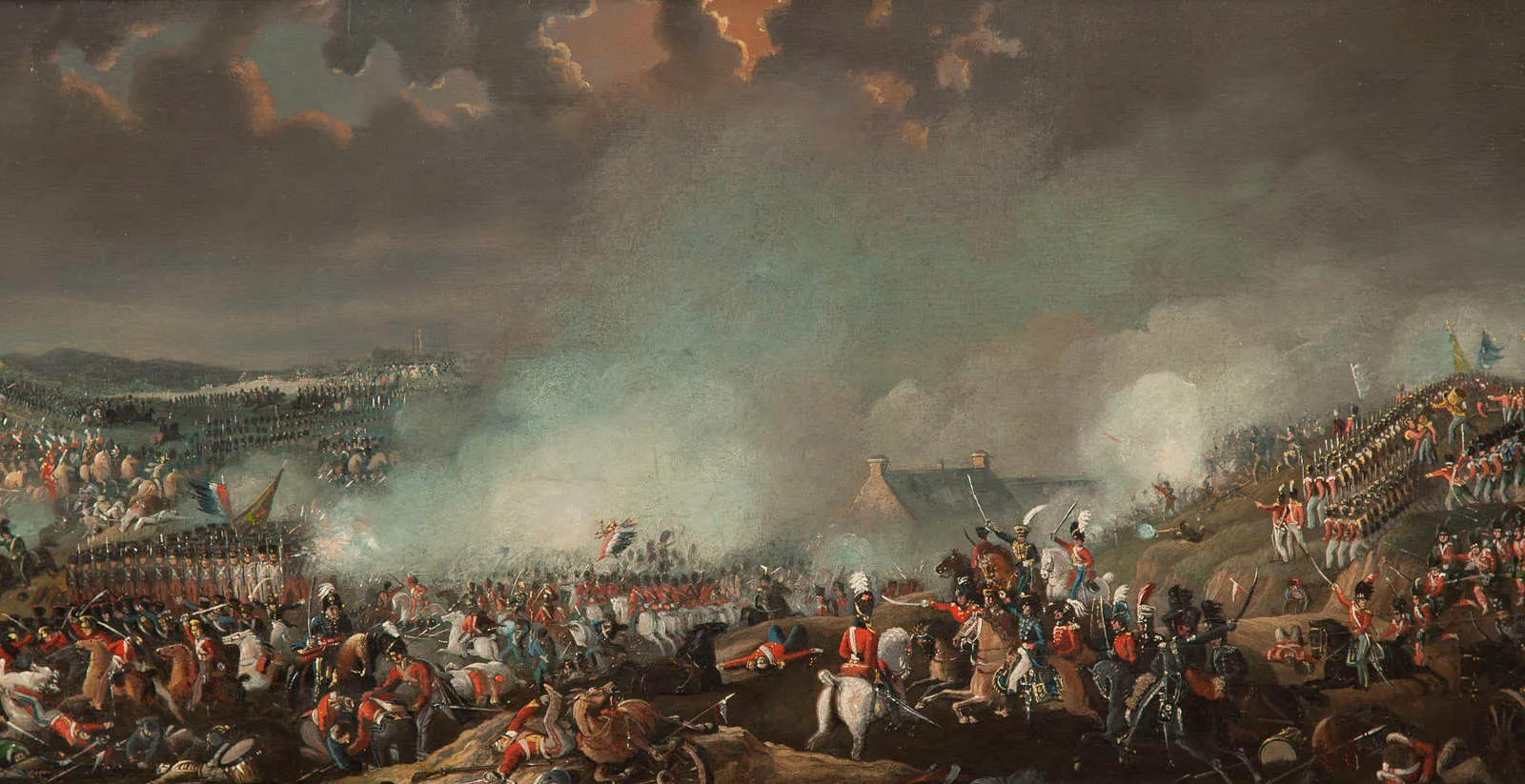
On June 18, 1815, near the village of Waterloo in present-day Belgium, Napoleon Bonaparte fought his last battle. His defeat at the hands of a British-led coalition under the Duke of Wellington, reinforced at a critical moment by a Prussian army under Field Marshal Gebhard von Blücher, ended the Napoleonic Wars for good and closed a quarter-century of near-continuous warfare that had reshaped Europe. By nightfall, the man who had crowned himself Emperor of the French, redrawn the map of the continent, and humbled every major power in Europe at one time or another was a fugitive, and within days he would be a prisoner of the nation he had fought hardest to defeat.
Few single days of combat have carried such disproportionate historical weight. Waterloo did not merely end a military campaign; it closed an entire era that had begun with the French Revolution in 1789 and had convulsed Europe through more than two decades of coalition wars, occupations, and shifting alliances. What happened on that muddy Belgian plateau, over roughly nine hours of fighting, determined the shape of European politics for the next century.
The Rise and Fall of an Emperor
To understand why tens of thousands of men converged on a stretch of farmland south of Brussels in June 1815, it helps to look back at the man whose ambition had made the battle necessary. Napoleon Bonaparte had risen from minor Corsican nobility to become the most consequential military and political figure of his age. A brilliant artillery officer who distinguished himself during the chaos of the French Revolution, he seized power in a coup in 1799, crowned himself Emperor in 1804, and spent the following decade winning a string of dazzling victories—Austerlitz, Jena, Friedland—that made the French Empire the dominant power on the European continent.
But Napoleon’s ambitions eventually outran his resources. His invasion of Spain in 1808 bogged France down in a brutal guerrilla war that drained manpower for years. Far worse was his catastrophic invasion of Russia in 1812, in which the Grande Armée, more than 400,000 strong at the outset, was reduced to a shattered remnant by the Russian winter and a scorched-earth retreat. Sensing weakness, a coalition of Austria, Prussia, Russia, and other powers combined against him, defeating his rebuilt forces at the enormous Battle of Leipzig in 1813 and finally forcing his abdication in April 1814. The victorious allies exiled him to the small Mediterranean island of Elba, off the coast of Italy, and restored the Bourbon monarchy to the French throne under King Louis XVIII.
Exile did not suit him. The Bourbon restoration under Louis XVIII, an aging and physically infirm king who had spent decades in exile himself, struggled from the outset to win the loyalty of a French population that had grown accustomed to Napoleonic-era reforms, land redistribution, and the Napoleonic Code. Returning émigré nobles pressed for the restoration of pre-Revolutionary privileges, alienating both the peasantry and the army’s rank and file, many of whom had served Napoleon for years and resented the return of aristocratic officers with no combat record. Watching from Elba as the restored Bourbon government grew increasingly unpopular and the great powers squabbled over the postwar settlement at the Congress of Vienna in Austria, Napoleon judged that his moment had come again.
The Hundred Days
In late February 1815, Napoleon slipped past British naval patrols and landed on the southern coast of France with barely a thousand men. What followed astonished contemporaries. Rather than being arrested, he was met with growing acclaim as he marched north; regiment after regiment sent to stop him instead defected to his side. He entered Paris on March 20 without a shot being fired, beginning the period historians call the Hundred Days. Louis XVIII fled into exile, and Napoleon set about rebuilding an army and a government almost from scratch.
The reaction from the rest of Europe was immediate and unified. The powers gathered at the Congress of Vienna—Britain, Austria, Prussia, and Russia chief among them—declared Napoleon an outlaw beyond the protection of the law and began mobilizing armies to crush him a second time. Napoleon knew he could not survive a war against the combined might of Europe if the coalition armies were allowed to concentrate. His only real hope was to strike quickly, defeating the coalition forces piecemeal before they could unite into an overwhelming mass.
Two Allied armies were within immediate reach in the Low Countries: a mixed British, Dutch, Belgian, and German force under the Duke of Wellington, and a Prussian army under the aggressive, elderly Field Marshal Blücher. Farther east, larger Austrian and Russian armies were still mobilizing and would take weeks to reach the Rhine in full strength. If Napoleon could drive a wedge between Wellington and Blücher and defeat each in turn before the Austrians and Russians arrived, he might still salvage his throne and force the coalition to negotiate rather than fight a drawn-out war of attrition he had little chance of winning. In early June 1815 he assembled the Armée du Nord, roughly 72,000 men rebuilt largely from veterans eager to serve under their old emperor again, and marched north into Belgium.
- February–March 1815: Napoleon escapes Elba, lands in France, and marches on Paris, beginning the Hundred Days.
- June 15, 1815: Napoleon crosses into Belgium, aiming to split Wellington’s and Blücher’s armies.
- June 16, 1815: French forces fight the Prussians at Ligny and the Anglo-allied army at Quatre Bras.
- June 17, 1815: Wellington withdraws to a defensive position near Waterloo; Blücher’s Prussians regroup at Wavre.
- June 18, 1815: The Battle of Waterloo is fought and decided.
- June 22, 1815: Napoleon abdicates for the second time.
- October 1815: Napoleon arrives at Saint Helena, where he remains in exile until his death in 1821.
Ligny and Quatre Bras: The Opening Moves
Napoleon’s opening gambit nearly worked. On June 16, he engaged the Prussians at the village of Ligny while dispatching a wing of his army under Marshal Michel Ney to confront Wellington’s forces at the crossroads of Quatre Bras. At Ligny, Napoleon personally led the main French force to a hard-fought victory, driving Blücher’s Prussians back in disorder. It was, on paper, exactly the kind of decisive local success Napoleon needed.
But the victory was incomplete in a way that would prove fatal. French forces failed to destroy the Prussian army outright or drive it away from Wellington in a direction that would keep the two Allied armies permanently separated. Blücher, despite personally being unhorsed and nearly captured during the retreat, kept his army largely intact and withdrew northward to Wavre—still within marching distance of Wellington’s position. Blücher’s decision to retreat toward his ally rather than away from him, preserving the option to reinforce Wellington, is often credited as one of the most consequential command decisions of the entire campaign.
At Quatre Bras, meanwhile, Ney’s attack on Wellington’s forces ended in a bloody stalemate; Wellington held the crossroads but, on learning of Blücher’s retreat from Ligny, judged his own position untenable and pulled back overnight to a ridge he had reconnoitered in advance near the village of Mont-Saint-Jean, just south of Waterloo. It was here, on ground he knew well from earlier scouting, that Wellington chose to make his stand.
The Opposing Forces and Commanders
The battle that followed pitted three armies and three very different commanders against one another.
Napoleon Bonaparte, 45 years old at Waterloo, commanded the Armée du Nord, roughly 72,000 men, a force built largely around veterans of his earlier campaigns along with newer conscripts. Napoleon’s army was strong in artillery and included the elite Imperial Guard, his most trusted and battle-hardened troops, held back as a final reserve. Napoleon’s most senior subordinate at Waterloo was Marshal Michel Ney, a famously courageous but sometimes impulsive commander whom Napoleon had nicknamed “the bravest of the brave.”
Arthur Wellesley, 1st Duke of Wellington, 46 years old, commanded an Anglo-allied army of roughly 68,000 to 73,000 men—a genuinely multinational force combining British regulars, King’s German Legion units, and Dutch, Belgian, Hanoverian, Brunswick, and Nassau troops. Wellington had built his reputation over years of campaigning against French armies in Spain and Portugal during the Peninsular War, where he had refined a defensive style of warfare built around using terrain, disciplined infantry squares, and the reverse slope of ridgelines to blunt attacking forces before counterpunching. Of his own army at Waterloo, composed of so many different nationalities and including many inexperienced troops, Wellington was famously guarded in his confidence.
Field Marshal Gebhard Leberecht von Blücher, at 72 the oldest of the three principal commanders, led the Prussian army, numbering roughly 45,000 to 50,000 men who would ultimately reach the field. Blücher was aggressive, fiercely anti-French, and personally popular with his troops despite his age and the bruising he had taken at Ligny two days earlier. His determination to march to Wellington’s aid despite the exhaustion of his men and the atrocious state of the roads after overnight rain was, in the judgment of many historians, decisive to the battle’s outcome.
“It has been a damned nice thing—the nearest run thing you ever saw in your life.” — attributed to the Duke of Wellington, in conversation with Thomas Creevey the day after the battle
The Battlefield and the Delayed Start
Wellington positioned his army along a low ridge running east-west near Mont-Saint-Jean, deliberately placing much of his infantry just behind the crest so that French artillery fire would sail over their heads before striking home—a technique he had used to good effect throughout the Peninsular War. In front of his main line, he garrisoned two fortified strongpoints: the walled farm complex of Hougoumont on his right, and the farmhouse of La Haye Sainte near the center, both intended to break up and disrupt any French advance before it reached his main position.
Overnight rain had turned the fields into thick, clinging mud, and this weather, more than any tactical decision, shaped the day. Napoleon, wary of bogging down his artillery and cavalry in soft ground, delayed the start of his main assault until roughly 11:30 a.m. or later—several hours after dawn. That delay, intended to let the ground firm up, instead gave Blücher’s Prussians precious extra hours to complete their exhausting march from Wavre and arrive on the battlefield in time to affect the outcome. It is one of the great what-ifs of military history: had Napoleon attacked at first light, the Prussians might never have arrived in time at all.
Hougoumont
The battle opened around midday with a heavy French assault on the fortified farm of Hougoumont, on the western end of Wellington’s line. Napoleon’s brother, Jérôme Bonaparte, commanded much of this attack, which was originally intended as a diversion to draw Wellington’s reserves away from the center. Instead, it turned into one of the most ferocious and prolonged engagements of the entire battle, consuming a vastly disproportionate number of French troops and casualties over the course of the day without ever succeeding in capturing the position.
British Guards and allied troops defended the farm’s walled courtyard and outbuildings for nearly the whole battle, repelling repeated French assaults in brutal close-quarters fighting. At one dramatic moment, a small party of French soldiers managed to force open the north gate of the farm complex and pour inside; a small group of British defenders, in a desperate action still remembered as the “Closing of the Gates,” fought their way to the gate and forced it shut again, trapping the French soldiers who had entered inside the courtyard, where nearly all were killed. Wellington himself later remarked that the successful defense of Hougoumont was essential to the outcome of the entire battle.
The French Cavalry Charges
In the early-to-mid afternoon, as fighting around La Haye Sainte and along the main ridge intensified, Marshal Ney—observing movement he apparently mistook for the beginning of an Allied retreat—launched a massive series of unsupported cavalry charges against Wellington’s center-right, without adequate infantry or artillery support to exploit any breakthrough. Wave after wave of French cuirassiers and lancers, numbering in total more than 5,000 horsemen, thundered up the slope toward the Allied line.
Wellington’s infantry responded by forming defensive squares—dense, hollow-square formations bristling with bayonets on every side, effectively impervious to cavalry that could not break the wall of steel to reach the men inside. Repeated charges failed to break a single Allied square, and French cavalry losses mounted horrifically as the horsemen milled helplessly between the squares under artillery and musket fire. It was a demonstration, still studied by military historians, of the folly of committing cavalry against unbroken infantry without combined-arms support. Later in the afternoon, La Haye Sainte finally did fall to French infantry after its King’s German Legion defenders ran low on ammunition, giving Napoleon’s forces a foothold much closer to the heart of Wellington’s line and briefly threatening to crack the Allied center.
The Prussian Arrival
Even as the fighting around Hougoumont and La Haye Sainte raged, the first Prussian units under General Hans von Zieten and General Friedrich von Bülow were completing their march from Wavre and beginning to appear on the eastern flank of the battlefield, near the village of Plancenoit. Napoleon had detached a portion of his own force under Marshal Emmanuel de Grouchy to pursue and contain the Prussians after Ligny, but Grouchy failed to prevent Blücher’s army from disengaging and marching to Wellington’s aid—one of the campaign’s most consequential command failures.
As Prussian forces began engaging the French right flank in increasing strength through the afternoon and into the evening, Napoleon was forced to divert troops, including elements of the Imperial Guard, to hold Plancenoit and screen his flank—troops he could ill afford to spare from the main effort against Wellington’s line. The arrival of the Prussians did not by itself win the battle, but it fatally stretched French resources at the precise moment Napoleon needed every man for his final gamble against Wellington’s center.
The Imperial Guard’s Last Advance
With his flank crumbling under Prussian pressure and daylight running out, Napoleon committed his last reserve: several battalions of the Imperial Guard, the elite veteran troops who had never before been defeated in a decisive infantry engagement. Around 7:30 to 8:00 p.m., the Guard advanced up the slope toward Wellington’s center in a final effort to break the Allied line before darkness and the full weight of the Prussian army made victory impossible.
Wellington, watching the advance from his position near an elm tree that would later become famous in paintings of the battle, held his own Guards and other units concealed until the last possible moment, then ordered them to rise and fire devastating volleys into the advancing French columns at close range. Staggered by the fire and outmaneuvered as Allied units wheeled to hit their flanks, the Imperial Guard—the symbol of French invincibility for two decades—broke and fell back. A famous story holds that a French officer, sometimes identified as General Pierre Cambronne, was asked to surrender and responded either with a defiant declaration that the Guard dies but does not surrender, or with a single unprintable word. Cambronne himself later denied ever making either statement, pointing out that he had in fact surrendered and survived; historians generally regard both versions of the story as apocryphal, though they entered French national legend regardless.
The repulse of the Guard broke French morale entirely. A cry went up along the lines—variously reported as “La Garde recule” (“the Guard is retreating”) or simply panic without words—and the French army, already reeling from the Prussian assault on its flank, dissolved into a rout. Wellington ordered a general advance along his entire line, and the retreat became a disintegration; French units that had fought with discipline all day broke and fled, save for a small number of Guard battalions who fought a doomed rearguard action to cover the collapse.
“The finest thing I ever saw.” — Wellington’s reported description of his army’s advance at the close of the battle, as recorded by several nineteenth-century historians
Quick Facts
- Date: June 18, 1815
- Location: Near Waterloo, present-day Belgium
- Commanders: Duke of Wellington and Gebhard von Blücher (Coalition) vs. Napoleon Bonaparte (France)
- Approximate forces: ~72,000 French; ~68,000–73,000 Anglo-allied under Wellington; ~45,000–50,000 Prussians under Blücher (arriving through the day)
- Casualties: Estimates vary, but total casualties (killed, wounded, and missing) across all armies are generally put at around 55,000–65,000, with roughly 25,000 French and 23,000 Allied casualties often cited, plus Prussian losses
- Outcome: Decisive Coalition victory; end of the Napoleonic Wars
- Aftermath: Napoleon abdicated for the second time and was exiled to Saint Helena
Immediate Aftermath
Napoleon fled the field as his army collapsed, narrowly avoiding capture in the chaotic retreat toward France. He returned to Paris within days, hoping to rally political support and continue the fight, but found none; the French legislature turned against him, and on June 22, 1815—just four days after the battle—he abdicated for the second and final time in favor of his young son. It made no difference. The victorious Allies had no intention of accepting any Bonaparte on the French throne, and Louis XVIII was restored as king for a second time.
Napoleon attempted to flee to the United States but found French ports blockaded by the Royal Navy. He ultimately surrendered himself to the captain of the British warship HMS Bellerophon in July 1815, reportedly hoping the British government would allow him to live out his life in exile in England. Instead, the British government—determined that he never again escape and plunge Europe into war—exiled him to the remote South Atlantic island of Saint Helena, thousands of miles from Europe, where he lived under close guard until his death in 1821. Later, reflecting on the battle from exile, Napoleon lamented to his companions that everything about the engagement had seemed to go wrong—“all was fatal in that engagement,” he told the Count de Las Cases, insisting that he ought nonetheless to have won.
For the soldiers who survived, the scale of the slaughter at Waterloo—concentrated into a single day on a battlefield only a few miles across—shocked contemporaries even in an age accustomed to the carnage of Napoleonic warfare. Farmers in the area spent years afterward recovering bones and equipment from the fields, and the battle became fixed almost immediately in the European popular imagination as a defining, apocalyptic clash.
Why Waterloo Still Matters
Waterloo ended Napoleon’s rule permanently and, with it, brought down the curtain on more than two decades of near-continuous European warfare that had begun with the French Revolutionary Wars in the 1790s. The peace settlement negotiated at the Congress of Vienna, finalized in the months following the battle, established a framework for great-power relations in Europe that—while imperfect and repeatedly tested—helped prevent another continent-wide war on the scale of the Napoleonic conflicts for roughly a century, until the outbreak of the First World War in 1914.
Militarily, Waterloo remains one of the most intensively studied battles in history: a case study in coalition warfare and the difficulty of coordinating allied armies with different languages, doctrines, and command structures; in the value of defensive terrain and reverse-slope tactics; in the risks of delaying an attack to wait for better ground conditions; and in the folly of committing cavalry without infantry and artillery support. Military academies around the world continue to teach the battle as an example of how a numerically inferior but well-positioned defender, reinforced at the decisive moment, can defeat a larger and more experienced attacking force.
The battle’s cultural legacy runs just as deep. The phrase “meeting one’s Waterloo” entered common usage across the English-speaking world as shorthand for a final, decisive, and total defeat—a linguistic legacy matched by few other battles in history. The site itself, preserved today with monuments, a visitor center, and the artificial Lion’s Mound built from earth taken from the battlefield, remains one of Europe’s most visited historical sites, drawing visitors curious to walk the same ridge where Wellington’s line held and the Imperial Guard made its last advance.
Beyond Europe, Waterloo also marked a geopolitical turning point. With France’s military ambitions checked for a generation, Britain emerged from the Napoleonic Wars as the world’s preeminent naval and commercial power, entering a long period of relative dominance—the beginning of what historians sometimes call the Pax Britannica—that shaped global affairs for the rest of the nineteenth century.
The battle also transformed the reputations of its principal commanders in lasting ways. Wellington went on to a long career in British public life, serving twice as prime minister and remaining a towering figure in British politics until his death in 1852; he is buried in St Paul’s Cathedral in London, close to Admiral Horatio Nelson. Blücher, though somewhat overshadowed in British and French popular memory by Wellington, was celebrated in Prussia and the German states as a national hero, and his insistence on marching to Wellington’s aid despite exhaustion and heavy losses at Ligny is still cited by German historians as a defining act of allied loyalty. Napoleon, for his part, spent his final years on Saint Helena dictating memoirs to loyal companions, shaping how the battle and his own career would be remembered by later generations—a final campaign fought not with armies but with narrative, whose influence on the popular memory of Waterloo persists to this day.
Frequently Asked Questions
Who won the Battle of Waterloo?
The Seventh Coalition—principally the Anglo-allied army under the Duke of Wellington and the Prussian army under Field Marshal Blücher—decisively defeated Napoleon Bonaparte’s French army. The battle ended Napoleon’s rule of France and his attempt to reclaim power during the Hundred Days.
Why did Napoleon lose at Waterloo?
Historians point to several interlocking factors: a delayed start to the battle that gave the Prussians time to arrive, Marshal Grouchy’s failure to prevent Blücher’s army from reinforcing Wellington, the costly and ultimately unsuccessful diversion of French resources into the prolonged assault on Hougoumont, unsupported cavalry charges that failed to break Wellington’s infantry squares, and the arrival of Prussian forces on the French flank at the critical moment the Imperial Guard was making its final advance.
How many soldiers fought at Waterloo?
Approximately 72,000 French troops under Napoleon faced roughly 68,000 to 73,000 Anglo-allied troops under Wellington, with a Prussian army of roughly 45,000 to 50,000 men under Blücher arriving over the course of the day to reinforce Wellington’s position.
What happened to Napoleon after Waterloo?
Napoleon fled to Paris, abdicated for the second time on June 22, 1815, and attempted to escape to the United States before surrendering to the British. He was exiled to the remote island of Saint Helena in the South Atlantic, where he remained under guard until his death in 1821.
Why is Hougoumont considered so important to the battle’s outcome?
The farm complex of Hougoumont, on Wellington’s right flank, absorbed a disproportionate share of French troops and casualties throughout the day in fighting that never succeeded in capturing it. Many historians, including Wellington himself, considered its successful defense essential to preventing Napoleon from turning the Allied flank before the Prussians arrived.
Where can I visit the Waterloo battlefield today?
The battlefield lies near the town of Waterloo, roughly ten miles south of Brussels, Belgium. The site includes a visitor center, preserved sections of the battlefield including Hougoumont farm, and the Lion’s Mound, an artificial hill built from earth removed from the battlefield, offering a panoramic view of the ground where the battle was fought.
Recommended Reading
Bernard Cornwell’s Waterloo: The History of Four Days, Three Armies and Three Battles is a widely praised narrative account for general readers, while Andrew Roberts’s Napoleon: A Life places the battle within the full arc of Napoleon’s career. Alessandro Barbero’s The Battle: A New History of Waterloo draws on soldiers’ accounts from all three armies to reconstruct the fighting in vivid detail, and Andrew Roberts’s shorter Waterloo: Napoleon’s Last Gamble offers a concise, well-illustrated overview of the campaign and battle for readers wanting a more compact treatment.
Read Next
August 8, 2026
The Battle of Gettysburg: The Civil War's Turning Point
How the three-day Battle of Gettysburg in July 1863 broke Lee's invasion of the North and turned the tide of the American Civil War.
August 8, 2026
The Battle of Hastings: The Norman Conquest of England, 1066
How William the Conqueror defeated King Harold II at Hastings in 1066, ending Anglo-Saxon rule and transforming English history.
August 8, 2026
Sun Tzu's The Art of War: Key Principles Explained
A breakdown of the core strategic principles in Sun Tzu's The Art of War, and why this 2,500-year-old text still shapes military and business strategy.