Military History
The Battle of Stalingrad: The Turning Point of World War II's Eastern Front
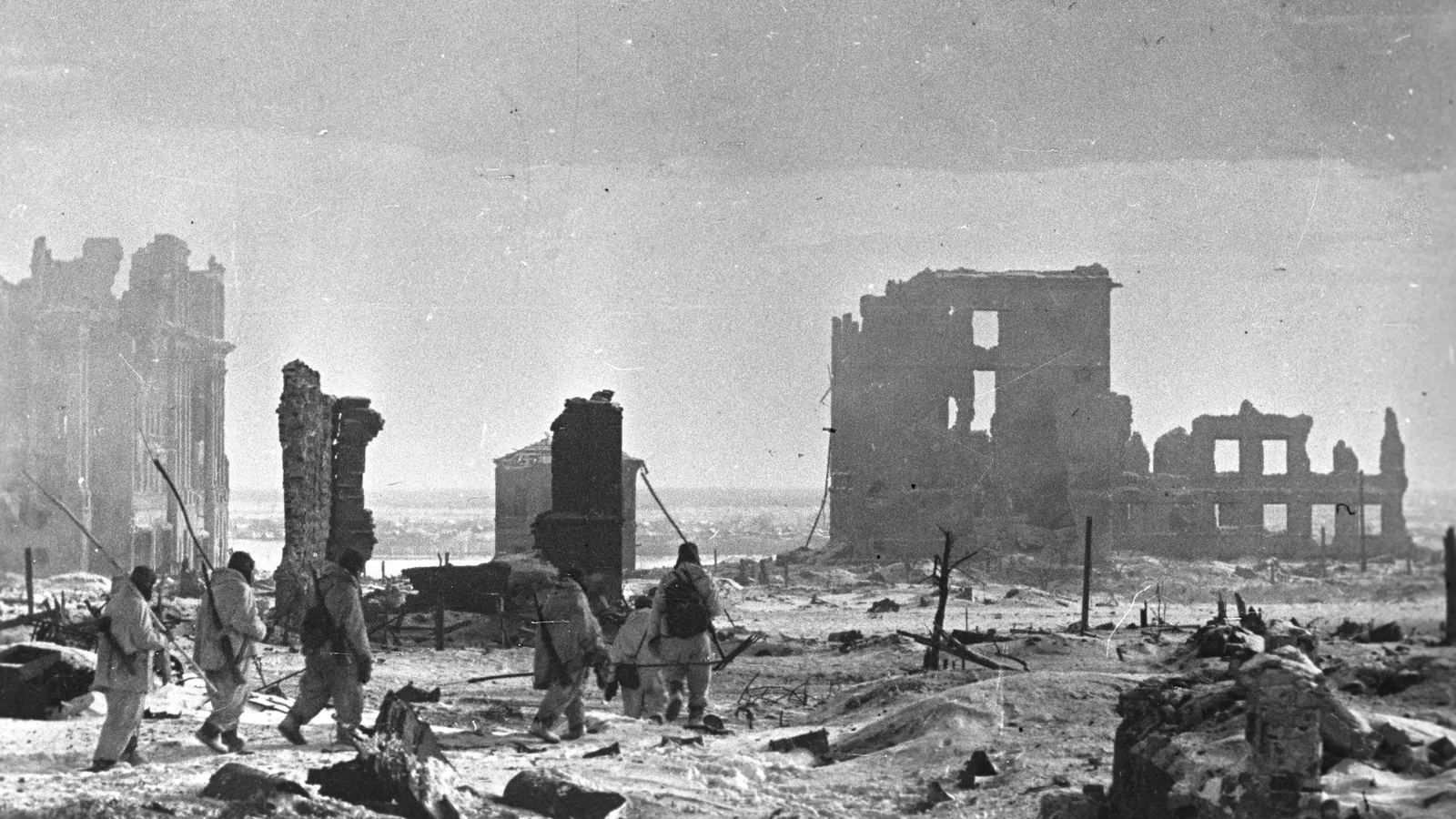
Fought between August 1942 and February 1943, the Battle of Stalingrad was the bloodiest single battle in human history and the moment the tide of World War II turned decisively against Nazi Germany. What began as a German offensive to seize a city on the Volga River ended with the destruction of an entire German army and marked the point after which Germany was permanently on the strategic defensive in the East. By the time the guns fell silent along the frozen banks of the Volga, a city had been reduced to rubble, hundreds of thousands of soldiers on both sides lay dead, and the myth of German invincibility that had carried the Wehrmacht from the English Channel to the gates of Moscow had been broken for good.
Quick Facts
- Dates: August 23, 1942 – February 2, 1943
- Location: Stalingrad (now Volgograd), Soviet Union
- Commanders: Vasily Chuikov and Georgy Zhukov (Soviet Union) vs. Friedrich Paulus (Germany)
- Casualties: Estimates exceed 1.7–2 million combined military and civilian casualties
- Outcome: Decisive Soviet victory; German Sixth Army destroyed or captured
A City on the Volga
Stalingrad sprawled for roughly 25 miles along the western bank of the Volga River in southern Russia, a narrow industrial city of factories, workers’ housing, grain elevators, and rail yards that had grown rapidly under Soviet industrialization. It was not, in the summer of 1942, an obvious prize of overwhelming strategic value in itself. Its importance was partly geographic—it sat astride the Volga, a crucial artery for oil and grain shipped north from the Caucasus and the Caspian—and partly symbolic, since the city bore the name of the Soviet leader, Joseph Stalin. For both dictators, the fight for the city would become entangled with personal prestige in a way that distorted military judgment on both sides.
The road to Stalingrad began the previous winter. In December 1941, the German invasion of the Soviet Union, Operation Barbarossa, had stalled short of Moscow, and a Soviet counteroffensive had thrown the Wehrmacht back from the capital’s outskirts for the first time since the invasion began in June 1941. Adolf Hitler, unwilling to repeat a broad-front offensive across the entire Eastern Front, redirected German strategy for 1942 toward the south, where the oil fields of the Caucasus promised to solve Germany’s chronic fuel shortages and starve the Soviet war machine of its own petroleum.
That offensive, codenamed Case Blue (Fall Blau), launched in June 1942. Its original design called for a two-pronged advance: one force would drive south into the Caucasus to seize the oil fields around Maikop, Grozny, and Baku, while a second force advanced toward Stalingrad primarily to screen and protect the northern flank of the Caucasus operation, cutting Volga River traffic in the process. Stalingrad was meant to be a shield, not the main objective.
That plan did not survive contact with Hitler’s growing fixation on the city. As German forces advanced with startling speed across the southern steppe in July 1942, Hitler split Army Group South into two separate army groups—A, driving into the Caucasus, and B, advancing on Stalingrad—dividing German strength at precisely the moment concentration mattered most. Over the following weeks, Hitler increasingly treated the capture of Stalingrad itself as an end unto itself, diverting the powerful Fourth Panzer Army back and forth between the two axes of advance and squandering the momentum that might have secured either objective decisively. By the time German Sixth Army, commanded by General Friedrich Paulus, closed on the city in earnest, it was already behind the accelerated schedule Hitler himself had demanded.
The Opposing Forces and Their Commanders
The German force tasked with taking Stalingrad, Sixth Army, was one of the Wehrmacht’s most experienced and battle-hardened formations, a veteran of the 1940 campaign in France and the drive across Ukraine in 1941. Paulus, a career staff officer who had helped draft the original plans for Barbarossa, was methodical, cautious, and deeply deferential to his superiors—qualities that made him an effective planner but, as events would show, left him poorly equipped to defy Hitler’s orders when defiance became militarily necessary. Supporting Sixth Army’s flanks were Third and Fourth Romanian Armies and the Italian Eighth Army to the southwest, and the Hungarian Second Army to the northwest—allied formations that were more lightly equipped, less experienced, and stretched thin across enormous sectors of front, a vulnerability Soviet planners would later exploit with devastating effect.
On the Soviet side, the defense of the city fell first to the 62nd Army, commanded from mid-September 1942 by Lieutenant General Vasily Chuikov, a blunt, physically imposing commander who had a gift for improvisation and an unsentimental willingness to spend lives to hold ground. Chuikov’s tactical innovation was to keep his forward positions as close to the German lines as physically possible—sometimes separated by no more than the width of a street or a stairwell—a technique later dubbed “hugging” the enemy, which neutralized the Luftwaffe’s overwhelming air superiority and Germany’s advantage in coordinated artillery support, since German commanders could not call in air strikes or heavy shelling without risking their own troops.
Behind the city’s defenders, Soviet high command—the Stavka—assembled the strategic reserves and the operational mind that would ultimately encircle and destroy Sixth Army. General Georgy Zhukov, already the Soviet Union’s most accomplished field commander after his role in the defense of Moscow, was dispatched to Stalingrad in late August 1942 as a representative of the Stavka, and together with General Alexander Vasilevsky, chief of the Red Army General Staff, he developed the operational concept for the counteroffensive that would eventually trap the German army in the city it had come to capture.
Looming over the entire battle was Joseph Stalin, whose Order No. 227, issued on July 28, 1942—before the battle for the city itself had begun—set the tone for the defense. The order, distributed to troops but never published in the Soviet press at the time, declared bluntly that “not one step back” without explicit authorization from higher command would be tolerated, warning that “panic-mongers and cowards must be destroyed on the spot” and establishing penal battalions and blocking detachments to enforce discipline among retreating units. It was a brutal instrument, but it reflected the desperation of a Soviet leadership that recognized the war itself might be lost if the German summer offensive were not finally stopped.
The German Advance
German Sixth Army reached the outskirts of Stalingrad in late August 1942, and on August 23 the Luftwaffe launched a massive bombing raid that killed thousands of civilians and reduced much of the city to burning rubble in a single day—an act that, rather than breaking Soviet resistance, foreshadowed the kind of ruin that would come to define the battle. German armor and infantry pushed into the city’s outskirts through late August and September, and by mid-September German troops had fought their way to the central rail station and, at several points, to the banks of the Volga itself, cutting the city’s defenders into isolated pockets.
Soviet defenders, reinforced by units ferried across the Volga under constant artillery and air bombardment—a crossing so costly that new arrivals sometimes suffered casualties before they ever reached the western bank—fought to hold a shrinking strip of ruined city against an enemy with overwhelming advantages in armor, artillery, and air support. What kept the defense alive was less matériel than method: Chuikov’s forces learned to fight from cellars, sewers, and shattered buildings, using the wreckage of the city itself as a fortress that neutralized Germany’s technological edge.
Stalin’s Order No. 227, read aloud to Soviet units rather than published, set the uncompromising tone for the defense of the city:
“Panic-mongers and cowards must be destroyed on the spot… Not one step back without orders from higher headquarters!”
— Order No. 227, Joseph Stalin, July 28, 1942
That order, issued weeks before German troops reached the city itself, established the penal battalions and blocking detachments that would enforce discipline through the desperate autumn fighting, and it captures the calculus that governed the defense: every day the city held bought time for the Soviet high command to assemble the forces for a counterstroke, and retreat without authorization was treated as a capital offense.
Urban Combat in the Ruins
By late September and through October 1942, the battle for Stalingrad had degenerated into some of the most brutal urban combat of the Second World War, concentrated around a handful of shattered landmarks that became synonymous with the fighting itself: the Mamayev Kurgan, a hill dominating the city that changed hands repeatedly and whose slopes were said to be so saturated with shell fragments and blood that grass would not grow there for years afterward; the vast Barrikady and Red October factory complexes, where fighting raged through machine shops and assembly lines still filled with unfinished tanks and artillery pieces; and the apartment block known to the Soviets as Pavlov’s House, held for nearly two months by a small Soviet garrison under Sergeant Yakov Pavlov against repeated German assaults, becoming a symbol of the defense’s tenacity.
Combat at this range and intensity produced its own vocabulary. Soldiers on both sides described the fighting as Rattenkrieg, or “rat war”—a struggle measured not in miles but in rooms, floors, and stairwells, where the front line might run through the walls of a single building, with Germans holding one floor and Soviets holding the one above or below. German soldiers, whose training and doctrine emphasized mobile combined-arms warfare, found their tanks and aircraft of limited use in an environment where visibility rarely extended beyond the length of a street and where Soviet defenders emerged from basements and sewer tunnels to attack from unexpected directions. Gains that would have amounted to a full day’s advance during the earlier, more mobile phases of the campaign were now measured in a handful of city blocks, purchased at enormous cost in men and matériel—a grinding, attritional style of combat that favored the defense and steadily consumed the German army’s offensive strength even as it appeared, on the map, to be winning.
Snipers played an outsized role in the fighting, most famously Vasily Zaitsev, whose exploits with the 62nd Army made him one of the war’s most celebrated marksmen and whose unit is credited with popularizing the defiant slogan “there is no land for us beyond the Volga”—a phrase that Chuikov himself later attributed not to his own words but to the soldiers themselves, calling it “words of the people” that captured the army’s determination to hold the city or die in the attempt.
By November 1942, German forces had captured perhaps 90 percent of the city, pinning Soviet defenders into a handful of narrow footholds along the Volga’s western bank. Sixth Army had, in a very real sense, won the battle for the city. It had not, however, won the campaign—and the cost of that near-total capture had bled Sixth Army of the mobile reserves and flank security it would soon need desperately.
Operation Uranus and the Encirclement
While Sixth Army exhausted itself in the ruins, Zhukov and Vasilevsky assembled the forces for a counterstroke designed not merely to relieve the city but to annihilate the German force besieging it. The plan, codenamed Operation Uranus, called for two Soviet fronts to strike simultaneously against the weakly held Romanian armies guarding Sixth Army’s flanks to the north and south of the city, break through in a double envelopment, and link up west of Stalingrad, sealing Sixth Army and its supporting units inside a pocket.
The offensive launched on November 19, 1942, preceded by a massive artillery bombardment. Soviet armor tore through the Romanian Third Army’s positions north of the city within a day, and a second Soviet thrust broke through the Romanian Fourth Army to the south on November 20. The two Soviet spearheads converged at the town of Kalach on November 23, 1942, closing the ring around Sixth Army and the bulk of Fourth Panzer Army—trapping roughly 250,000 German and allied troops inside a pocket that stretched across the ruined city and the surrounding steppe.
The speed and scale of the encirclement stunned German high command. Paulus, recognizing the danger, proposed an immediate breakout while the pocket’s western perimeter remained relatively weak. Hitler refused, insisting that Sixth Army hold its position and declaring Stalingrad a “fortress” that would be resupplied by air and relieved by a ground offensive. Hermann Göring, commander of the Luftwaffe, promised Hitler that his aircraft could sustain the trapped army by airlift—a pledge that proved wildly unrealistic. Sixth Army required a minimum of several hundred tons of supplies daily merely to sustain minimal combat operations; the Luftwaffe, hampered by poor weather, inadequate aircraft numbers, and increasingly effective Soviet air defense, delivered only a fraction of that amount on most days, and losses of transport aircraft mounted steadily through December.
A German relief effort, Operation Wintergewitter (“Winter Storm”), launched in mid-December under Field Marshal Erich von Manstein, drove toward the pocket from the southwest and at its closest approach came within roughly 30 miles of the encircled army—close enough that some among the trapped troops believed rescue was imminent. Paulus, bound by Hitler’s standing order to hold his position and lacking sufficient fuel to break out even if authorized, did not attempt to link up with the relief force. Soviet counterattacks against the exposed Italian Eighth Army on the middle Don, launched in mid-December, then threatened Manstein’s own flank and forced the relief effort to be abandoned by the end of the month. It was the last realistic chance for any significant number of Sixth Army’s men to escape.
The German Surrender
Trapped, starving, and running out of ammunition and fuel through one of the harshest winters in decades, the remnants of Sixth Army spent January 1943 in a steadily contracting pocket as Soviet forces methodically compressed and split it in two. Frostbite, starvation, typhus, and exhaustion killed thousands who never fired another shot; German field hospitals, overwhelmed and lacking supplies, could do little more than triage the dying. On January 8, 1943, Soviet commanders offered Paulus surrender terms guaranteeing food, medical treatment, and eventual repatriation for his men; Paulus, still bound by Hitler’s orders, refused.
On January 30, 1943—the tenth anniversary of Hitler’s rise to power—Hitler promoted Paulus to the rank of field marshal, a rank at that point in German history no field marshal had ever surrendered while alive, a signal many historians have read as an implicit expectation that Paulus would either break out, die fighting, or take his own life rather than capitulate. Paulus, a devout Christian, is recorded as having told a battalion commander the same day:
“I’m a Christian. I refuse to commit suicide.”
— Friedrich Paulus, January 30, 1943
The following day, January 31, 1943, Paulus surrendered the southern pocket of his shattered army in the ruins of Stalingrad’s central department store, where his headquarters had been located; the northern pocket, still fighting, held out two more days before surrendering on February 2, 1943, ending organized German resistance in the city.
Approximately 91,000 German and allied troops were taken prisoner in the final surrender, joining tens of thousands more captured or killed earlier in the encirclement; total German and allied losses in the Stalingrad campaign, including those killed, wounded, captured, and missing from the summer’s fighting onward, are estimated at roughly 300,000 men from Sixth Army and its attached units alone, figures that made it one of the most catastrophic single defeats in the history of the German army. The conditions endured by the prisoners in Soviet captivity were brutal: weakened by months of starvation and untreated wounds before capture, and marched or transported east into a Soviet POW system unprepared to receive so many at once, the overwhelming majority of those captured did not survive their imprisonment. Of the roughly 91,000 men taken prisoner in the final surrender, historians estimate that only about 5,000 to 6,000 ever returned home to Germany, with the last survivors not repatriated until the 1950s.
- Key dates of the encirclement and surrender:
- November 19–20, 1942 — Operation Uranus launched against Romanian-held flanks
- November 23, 1942 — Soviet spearheads link up at Kalach, sealing the pocket
- December 12–23, 1942 — Operation Wintergewitter relief attempt, halted and reversed
- January 10, 1943 — Operation Ring begins, the final Soviet reduction of the pocket
- January 30, 1943 — Paulus promoted to field marshal
- January 31, 1943 — Southern pocket surrenders
- February 2, 1943 — Northern pocket surrenders, ending the battle
Life and Death Inside the Pocket
Conditions inside the encircled pocket during the winter of 1942–43 were among the grimmest experienced by any modern army. Temperatures fell to -20°F (-29°C) or lower. Rations, already reduced before the encirclement, shrank further as the perimeter contracted and the airlift failed to deliver adequate supplies; soldiers subsisted on starvation-level bread rations supplemented by horse meat once the army’s remaining draft animals had been slaughtered. Fuel shortages left vehicles and even field kitchens unable to operate, and frostbite casualties mounted alongside combat losses. Letters written home by trapped soldiers in the final weeks—many never delivered, collected instead by German authorities and later published as historical documents—describe a growing despair and, in many cases, dawning anger at a leadership that had promised rescue and delivered none.
The civilian population of Stalingrad suffered alongside the soldiers fighting over the ruins of their city. Tens of thousands of civilians were killed in the initial bombing and the subsequent months of fighting, and those who survived did so largely by sheltering in cellars, ravines, and the same sewer systems that Soviet soldiers used as covered routes between strongpoints, enduring the same starvation, cold, and constant danger as the combatants around them.
Immediate Aftermath
The destruction of Sixth Army sent shockwaves through Germany. Hitler declared three days of national mourning, and the German propaganda ministry, under Joseph Goebbels, worked to recast the catastrophe as a heroic sacrifice rather than an avoidable disaster—a narrative effort that culminated weeks later in Goebbels’s “total war” speech in Berlin, which explicitly invoked Stalingrad in calling for the full mobilization of German society and economy behind the war effort. For the German public, however, Stalingrad marked an unmistakable psychological turning point: the sense of inevitable victory that had characterized official rhetoric since 1939 could not survive the destruction of an entire field army, and while the war would continue for more than two brutal years, the confident triumphalism of the Blitzkrieg years never fully returned.
For the Soviet Union, the victory at Stalingrad was the first unambiguous proof that the Red Army could not merely halt a major German offensive but destroy an entire German army in the field. It restored Soviet strategic initiative on the Eastern Front for good; although Germany would launch further offensives, most notably at Kursk in the summer of 1943, it would never again hold the strategic initiative in the East. Soviet forces, having demonstrated their capacity for large-scale encirclement operations at Stalingrad, would apply the same operational principles—identifying and exploiting weaker flank formations, achieving surprise and concentration of force, and executing rapid double envelopments—in a succession of increasingly ambitious offensives through 1943, 1944, and 1945 that carried the Red Army from the Volga to Berlin.
Why Stalingrad Still Matters
Stalingrad is widely regarded as the turning point of the war in Europe. Before it, Germany held the strategic initiative on the Eastern Front; after it, Germany fought an increasingly defensive war against a Soviet military that never again lost the offensive momentum, pushing steadily westward until reaching Berlin in 1945. Some historians debate whether Stalingrad or the earlier Soviet defense of Moscow in winter 1941–42 deserves the title of the war’s true turning point, since the failure to take Moscow arguably doomed the broader Barbarossa concept first; what is not seriously disputed is that Stalingrad represented the moment the destruction of German military power in the East became not merely possible but, in retrospect, inevitable.
Beyond its strategic significance, Stalingrad has become a byword for the human cost of total war and the danger of a single leader’s refusal to accept battlefield reality—Hitler’s insistence on holding the city and later refusing retreat directly caused the destruction of one of Germany’s most experienced field armies. Military historians continue to study the battle for its lessons in urban warfare, logistics, and the risks of overextended offensives. The battle also profoundly shaped the postwar Soviet historical memory: Stalingrad, rebuilt after the war and later renamed Volgograd, became the site of one of the Soviet Union’s most significant war memorials, the Motherland Calls statue on the Mamayev Kurgan, and the battle occupies a central place in Russian national memory of the “Great Patriotic War” to this day. The scale of destruction and death at Stalingrad—combined civilian and military casualties across the entire campaign are estimated to exceed 1.7 to 2 million—also cemented the battle’s reputation as, by most measures, the single bloodiest battle in the history of warfare.
Frequently Asked Questions
Why did Hitler insist on capturing Stalingrad specifically?
Stalingrad began as a secondary objective meant to protect the flank of the main German drive into the Caucasus oil fields, but Hitler became increasingly fixated on capturing the city that bore Stalin’s name, treating its capture as a matter of prestige as the campaign progressed. That fixation led him to divert resources away from the original strategic objective and, later, to refuse Sixth Army permission to retreat or break out even after it was surrounded.
How many soldiers were trapped in the Stalingrad pocket?
Operation Uranus encircled roughly 250,000 German and allied troops within the pocket around Stalingrad in November 1942. By the time the final surrender came in early February 1943, sustained combat, starvation, disease, and the brutal winter had killed a substantial portion of that force; approximately 91,000 survivors were taken prisoner in the surrender itself.
What happened to the German soldiers who were captured at Stalingrad?
Conditions in Soviet captivity were extremely harsh, compounding the already severe toll of starvation, wounds, and frostbite the prisoners carried with them from the pocket. Historians estimate that of the roughly 91,000 men captured in the final surrender, only about 5,000 to 6,000 survived to be repatriated to Germany, with the last of them not released until years after the war’s end.
Why is Stalingrad often called the turning point of World War II?
Before Stalingrad, Germany held the strategic initiative across the Eastern Front, and the Wehrmacht had suffered no defeat on the scale of losing an entire field army. After Stalingrad, Germany was permanently on the strategic defensive in the East, and the Red Army retained the offensive initiative for the remainder of the war, pushing steadily westward until it reached Berlin in 1945. Some historians point instead to the Battle of Moscow in winter 1941–42 as the true turning point, but Stalingrad is the moment most closely associated with the collapse of German fortunes in Soviet, German, and popular historical memory alike.
What was “Rattenkrieg” and why did it favor the Soviet defenders?
“Rattenkrieg,” or “rat war,” was the term soldiers on both sides used to describe the extremely close-quarters urban combat inside Stalingrad, fought room by room and floor by floor amid the ruins. It favored Soviet defenders because it neutralized Germany’s advantages in tanks, artillery, and air support—weapons that could not be used effectively, or safely, at such close range without risking friendly casualties—forcing the battle down to the level of infantry small-arms combat where the defenders’ familiarity with the terrain and willingness to fight from cellars and sewers gave them an edge.
Why didn’t Paulus disobey Hitler and order a breakout while he still could?
In the days immediately following the encirclement, Sixth Army still had enough fuel and cohesion to attempt a breakout to the southwest, and several of Paulus’s own subordinates urged him to act without waiting for authorization. Paulus, however, was a product of a military culture that prized obedience to the chain of command, and Hitler’s standing order forbade any withdrawal. By the time it became clear that the promised airlift and relief effort would fail, the pocket’s mobile forces had lost the fuel and combat strength necessary to break out even if Paulus had defied his orders.
Recommended Reading
Antony Beevor’s Stalingrad remains the definitive popular history of the battle, drawing on newly available Soviet archives to reconstruct the fighting from both sides. William Craig’s Enemy at the Gates: The Battle for Stalingrad, built from years of interviews with survivors of the battle, offers a vivid ground-level narrative of the fighting. Michael K. Jones’s Stalingrad: How the Red Army Triumphed draws heavily on Soviet veterans’ testimony to examine the battle from the Red Army’s perspective.
Hero image: “Center of Stalingrad after liberation,” RIA Novosti archive, image #602161, photo by Zelma, licensed under CC BY-SA 3.0.
Read Next
August 8, 2026
The Battle of Agincourt: Longbows Against Chivalry
How a small, exhausted English army under Henry V destroyed a much larger French force at Agincourt in 1415.
August 8, 2026
The Battle of Cannae: Hannibal's Perfect Victory
How Hannibal's double envelopment at Cannae in 216 BC destroyed a much larger Roman army and became history's model encirclement.
August 8, 2026
The Battle of Waterloo: The End of Napoleon
How Wellington and Blücher defeated Napoleon at Waterloo in 1815, ending the Napoleonic Wars for good.